Shahriyor Shavkat, a poet and publicist recognized in literary circles for his bold statements, author of several creative projects in poetry and bibliography, and recipient of the 'Builder of the Future' medal, is a descendant of independence. His trip to Afghanistan in February of this year generated significant interest among youth, word lovers, and the general public on social media.
Similar stories
Popular
Motivation for the trip to Afghanistan
It is interesting that this educational expedition was organized specifically in Afghanistan, rather than on the coast or in picturesque locations. In an interview about this informative journey, Shahriyor Shavkat shared that the first sprouts of his interest in history and the traces of ancestors emerged in childhood. His father showed him sacred places related to great ancestors, especially visiting the first tomb of Sohibqiron Amir Timur in Shahrisabz.
He recalls how the atmosphere there awakened feelings in him that are difficult to describe, and how his heart beat so loudly that it could be heard. These sensations later found reflection in his poems.
Influence of Literary Sources
These feelings were strengthened years later after reading Khayriddin Sultonov's work 'Boburiyнома'. The expedition described in the book greatly influenced him, and he began to imagine himself part of that caravan. He dreamed of walking the paths of great ancestors and speaking with compatriots in those lands.
Shavkat emphasized that during the period of gaining independence for his homeland, opportunities were extremely limited, but people dedicated to science and national memory undertook thousands of journeys. Today, as opportunities have expanded, he considers it his duty to continue this educational tradition.
Search for Spiritual Heritage
Furthermore, what led him to Afghanistan was not only curiosity but also a 'noble aspiration'. Hearing captivating memories from the renowned Uzbek scholar-Navoiyist Almaz Ulvi Binnatova about Khirat, his desire to see with his own eyes the land where Navoi lived and created intensified. He sought to meet this spiritual heritage.
After returning, he was tasked by his teacher Khayriddin Sultonov to write a book about the trip, which he titled 'To Khirat, to the House of Bobom'. Shavkat took this as a sign of approval and began working, viewing his expedition not just as a journey, but as a natural continuation of the spiritual relay from teachers and a meeting with the heritage of great ancestors.
Visits to Ancestors and Reflections
During the trip, he visited the burial sites of many ancestors, including Al-Biruni, Lutfi, Alisher Navoi, Kamoliddin Behzod Gavharshodbegim, Zakhir ad-Din Muhammad Bobur, and Boburahim Mashrab. In this responsible and moving process, he reflected on what comes to his mind in critical situations.
He admitted that he was most afraid not of the roads or books, but of not being able to realize a long-held dream, since he was going not as a tourist, but to spiritually connect with ancestors known through books whose poems inspired him.
Before visiting each site, he asked himself: 'Having reached this place, can I become a worthy descendant?'
The Legacy of Navoi and Biruni
At Alisher Navoi's grave, he recalled scenes from the stories of historian Khondamir: Sultan Husain Mirza dismounted to meet his great vizier and loyal friend, and Navoi, in turn, laid him in royal quarters. A seven-day mourning and procession followed. Reflecting on this, he saw modern Khirat, noting that wars had destroyed many graves, but popular memory could not erase Navoi. He concluded that although stones may crumble through the ages, national memory remains unshakable.
The visit to Navoi also touched him: masters restored his grave, and about two thousand trees planted by the Bobur Foundation turned the barren area into the greenest zone. He was moved by the fact that Uzbeks are a people of gardeners.
Finding the grave of Mawlano Lutfi proved to be the most difficult stage, as some local residents did not have sufficient information about the great poet. He shared with a local scholar what he knew about Navoi and felt like a grandson visiting his grandfather when visiting Lutfi's grave in the village of Shodijon.
In Gwazna, he immersed himself in a completely different state before Biruni's grave. Standing at the grave of the outstanding scholar, whom, according to Abdullah Oripov, the 'rational beacon' understood before the discovery of America, he reflected on the ruthlessness of time, noting the contrast between genius, which elevated human thought, and a very modest burial.
Visiting Bobur and Mashrab
In 'Bogi Bobur' in Kabul, he recited ghazals. Unlike the symbolic grave in Andijan, here he visited the authentic burial site of Zakhir ad-Din Muhammad Bobur. Seeing that he rested under the open sky according to his will, he felt the true greatness of the king in his modesty.
After the visit, local Uzbeks helped him plant a tree, continuing the good deeds started by their ancestors. The visit to Shah Mashrab took place at night. After checking the inscription on the peshtaq, he prayed for the soul of the poet.
Interaction with Local Residents
He was deeply moved by the encounter with Afghan Uzbeks, with whom he talked until morning. They spoke about Uzbekistan with such love that it caused emotion. They proudly spoke about the peace, knowledge, and opportunities for women in their country, often saying: 'Do not address us as 'Afghans', but as Uzbeks. We are a people who lived on this land even before the era of Amir Timur and Navoi!'
Ultimately, he concluded that all the holy sites visited, despite being located in different cities, unite him in one truth. He saw the great Turkic civilization as a single entity, where Abu Rayhon Biruni, Mawlano Lutfi, Alisher Navoi, Kamoliddin Behzod, Malika Gavharshodbegim, Zakhir ad-Din Muhammad Bobur, and Boburahim Mashrab are interconnected links.
He stressed that they are continuators of this great spiritual chain, and if we do not understand and pass on the heritage of our ancestors to future generations, history may condemn us.
Meeting with the President
As a result of the trip, the book 'To Khirat, to the House of Bobom!' was published, which he presented to the President. During a meeting with youth on June 30, the head of state stated that he was aware of his creative journey to Afghanistan in February and warmly congratulated him on visiting the holy sites associated with Navoi, Bobur, Lutfi, Biruni, and other ancestors. This made a big impression on him.
He handed the President the first copy of the book, and the head of state paused to note its symbolic significance and spiritual weight. This was a high appreciation for him, as he tried to incorporate into every page the heavy path, complex situations, feelings, and spiritual responsibility towards his ancestors.
He also noted that during the trip, he was able to convey sincere gratitude and greetings from his compatriots in Afghanistan regarding the peaceful foreign policy and humanitarian initiatives conducted by the President.
Conclusion and Assignment
At the meeting, he also spoke about theatrical evenings of poetry within the framework of the 'Word' project of the Center for Spirituality and Enlightenment of the Republic and the 'Mutolaa' project of the National Library and Youth Affairs Agency. The President highly appreciated such initiatives for spreading poetry through modern stage means.
The most unforgettable moment was the speech by President Abdulla Qodiri, who recalled the phrase: 'No one should leave this place dissatisfied!', and assigned the creation of a Youth Theater in the country, entrusting him with the leadership of this activity. For Shavkat, this was a huge trust and at the same time a great responsibility.
In response to the question about impressions of the local residents, he said that the biggest discovery was the endless love of Afghan Uzbeks for Uzbekistan and its ancestors. Talking with fellow countrymen in Mayman, Andkhwa, Forob, Kabul, and Khirat, they constantly repeated: 'For us, Uzbekistan is the homeland of our ancestors.' They were proud of such great ancestors as Amir Timur, Alisher Navoi, Zakhir ad-Din Muhammad Bobur, Imam al-Bukhari, Imam at-Tirmizi, Khoja Bakhouddin Naqshbandi, Zokirjon Holmukhamad oghli Furqat, and Mawlano Huwaydo. The cities of Samarkand, Bukhara, Tashkent, Andijan, Namangan, and Fergana are sacred centers of science and civilization for them.
Many dream of visiting Uzbekistan at least once in their lives to make a pilgrimage to Imam al-Bukhari and Imam at-Tirmizi, as well as to Amir Timur. At the end of the trip, the local residents asked him to wear a chapan and visit Amir Timur so that they could do so through him. One resident of Andkhwa said that he would prefer one Hajj visit to Amir Timur than two.
Supporting youth in all spheres, raising their moral level, and strengthening the principles of honesty and responsibility in public service are among the priority areas of state policy in the country. Special attention is paid not only to forming the professional skills of young employees of the law enforcement system but also to their spiritual perfection, patriotic spirit, and intolerance to corruption.
Event in Bukhara
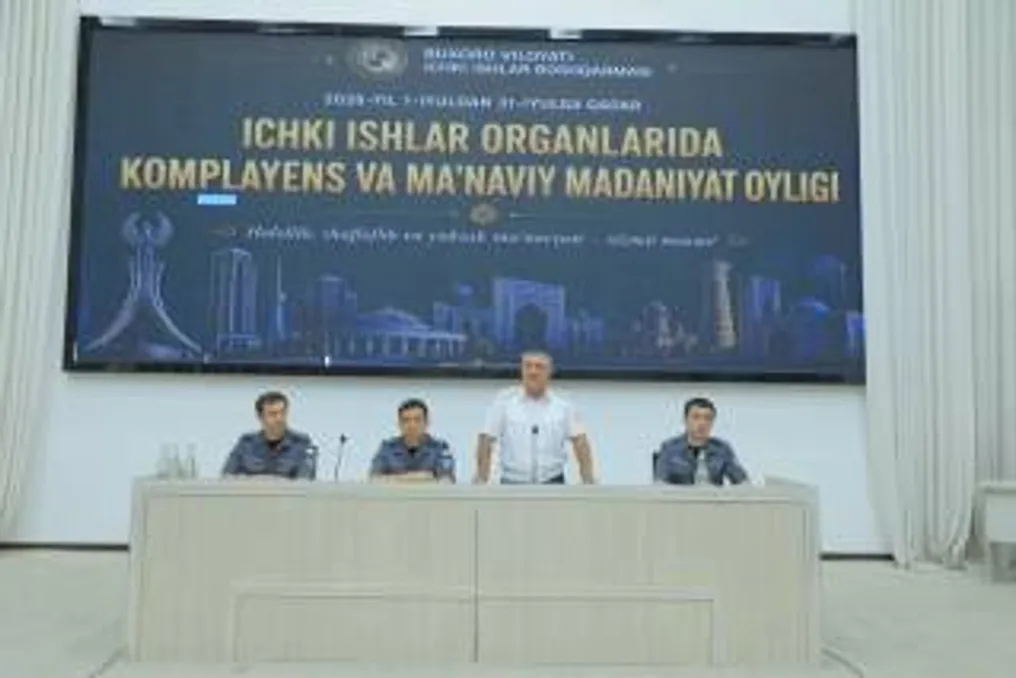
Within these noble goals, a meeting titled 'Leader and Youth' was organized in the internal affairs bodies in the Bukhara region, with the participation of young employees and their families. This large educational event took place as part of the 'Month of Compliance and Moral Culture' under the slogan 'Honesty, Transparency, and High Spiritual Level — The Measure of Service!'. During the meeting, important issues concerning the upbringing of the younger generation in the spirit of honest labor, high responsibility, and devotion to the Motherland were discussed.
Presentation and Speeches
The event began with the screening of special videos titled 'Heroes Among Us,' which demonstrated systematic work in combating corruption within the internal affairs bodies, achievements in youth policy, and stories of people who dedicated their lives to public order and the peace of the country. These videos made a great impression on those present, once again reminding them of the greatness of honor and duty of service.
Next, the Chief of the Internal Affairs Department of Bukhara Region, Ikromjon Tursunov, spoke. He elaborated on the broad opportunities provided to youth in the country, the continuous reforms being carried out in the internal affairs bodies, staff qualification improvement, strengthening the moral environment, and the relentless fight against any manifestations of corruption. Tursunov emphasized that young employees are not just executors of duties but worthy defenders of the country's peace and the trust of the people, calling upon them to be honest, disciplined, and self-sacrificing.
Requirements and Awards
Representatives of the working group of the Ministry of Internal Affairs participating in the event noted the necessity for every employee of the internal affairs body to perform their official duty with conscience, recognizing the high faith and attention of the head of state towards the youth, as well as the need to put the interests of the people first and act with high responsibility, which is realized within the framework of ongoing fair reforms.
One of the most significant moments of the meeting was the awards ceremony for distinguished figures, exemplary young employees, and their parents. In accordance with the order of the Minister of Internal Affairs of the Republic of Uzbekistan, several retired veterans were solemnly presented with the distinction 'Honorary Employee of the Internal Affairs Body' and commemorative clocks.
Furthermore, by order of the Chief of the Internal Affairs Department of Bukhara Region, a group of young employees and their parents who actively participate in the implementation of state policy regarding youth and approach their duties with conscience were rewarded with letters of appreciation and valuable commemorative gifts. This recognition highly valued the work and contribution of not only the employees themselves but also their parents.
Advice and Conclusion
During the event, veterans who had served in this field for a long time shared their life experiences, giving sincere advice to the youth about honesty, patriotism, dedication to the profession, and the need to meet the trust of the people. Their instructive words will undoubtedly become a guide for the younger generation.
Such meetings play an important role not only in improving the professional skills of young employees but also in strengthening their moral immunity, shaping a worldview resistant to corruption, creating a healthy atmosphere in the team, and reinforcing dedication to service. The main thing demonstrated by this event is that where a high spiritual level, honesty, transparency, and devotion to the Motherland prevail, public trust is strengthened, and public service becomes more worthy and effective. Today's awarded youth are the future mature leaders, reliable pillars of public order and the peace of the country.
As part of the nationwide event 'Month of Beautification and Generosity' in observance of the 35th anniversary of independence, people's deputies held open meetings with residents in the mahallas of the Syrdaryo district of the Syrdarya region.
Work with the Population in Mahallas
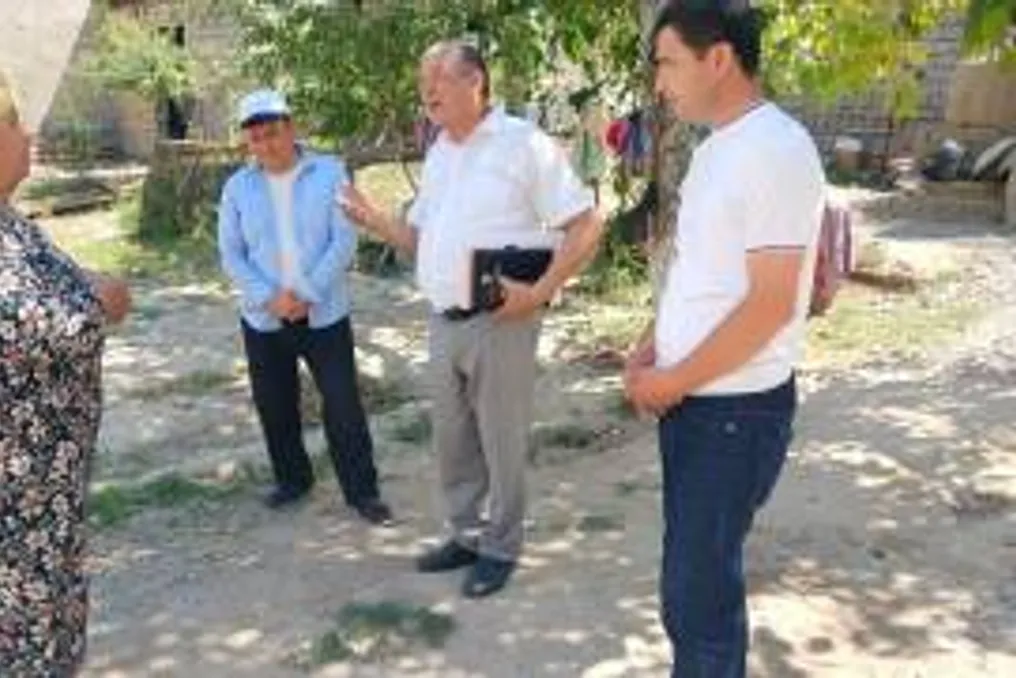
The deputy of the Syrdaryo District Council, Professor Ravshan Mahmudov, visited the mahallas of Quyosh and Elobod to personally familiarize himself with the problems causing concern among the people, listen to their opinions, and determine practical steps for their resolution. These meetings were not official gatherings but were aimed at practically solving pressing issues.
Problems in the Quyosh Mahalla
During conversations with citizens in the Quyosh mahalla, the issue of improving the infrastructure of educational institutions was raised. In particular, it was noted that the schoolyard of the 25th general educational institution needs asphalt paving. An agreement was reached to submit a deputy inquiry to the relevant ministries and agencies for the prompt resolution of this problem.
Needs of the Elobod Residents
In the Elobod mahalla, during communication with residents, information was received about families in need of social protection, and their needs were studied. The necessity of replacing old wooden electrical poles on Bosht Street with modern concrete supports was also identified. Regarding this matter, it was decided to assign specific tasks to the relevant organizations and submit a deputy inquiry.
Discussion of Infrastructure Issues
During the meetings, citizens' proposals regarding road infrastructure, quality of utility services, improvement works, and social issues were discussed comprehensively. It was emphasized that practical measures must be taken for each appeal with the participation of responsible persons.
Significance of Deputy Activity
It is stressed that the main criterion for evaluating a deputy's work is not the decisions made, but the practical resolution of problems that concern the population. Therefore, such open dialogues play an important role in timely identifying current issues in the regions, strengthening parliamentary oversight, and building public trust in state bodies.
These meetings in the mahallas once again confirmed that territorial development begins with listening to the problems that concern the population, studying them on site, and solving these problems through concrete practical measures.
Currently, the work of the youth leader in the mahalla is considered a key element in supporting the aspirations of young people, guiding them toward beneficial endeavors, as well as increasing their employment and social activity. Individual work with each young person, aimed at the proper utilization of their interests and potential, contributes to positive changes in the mahalla.
Activity of the leader in Gayrat mahalla
Navruzbek Isomiddinov, the youth leader of Gayrat mahalla in Jalakuduk district of Andijon region, implements his activities precisely based on this principle. He pays special attention to attracting the mahalla's youth to fields of sports, education, modern professions, and entrepreneurship, ensuring their employment and expanding opportunities for income generation.
Support for entrepreneurial activity
Thanks to identifying young people interested in entrepreneurship, providing them with necessary advice and practical assistance, and directing them toward effective use of available opportunities, the circle of proactive, active young people concerned about their future is constantly growing in Gayrat mahalla.