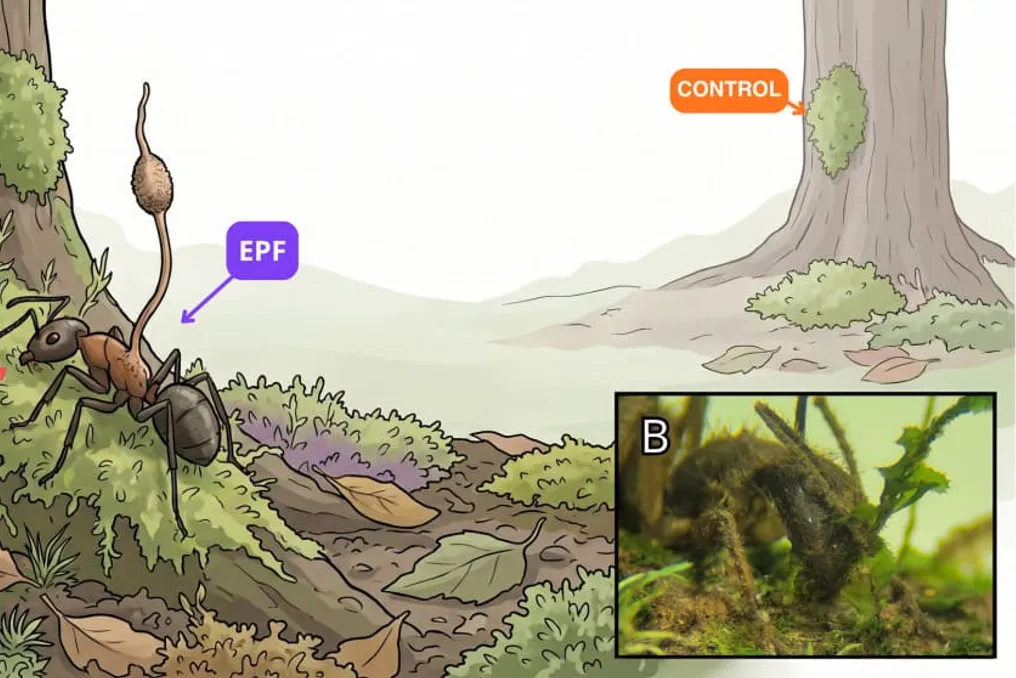
A team of scientists, led by the National Institute of Amazonian Research (INPA), discovered evidence that the fungus responsible for modifying ant behavior, transforming them into a state similar to 'zombies,' has an unprecedented stage in its life cycle. The study indicates that organisms belonging to the genus Ophiocordyceps also inhabit the mosses of the Amazon Forest, in addition to infecting insects.
This discovery was made through the analysis of samples collected in the Adolpho Ducke Forest Reserve, located in Manaus, and was published in the scientific journal IMA Fungus. The researchers argue that this finding deepens the understanding of the biology of these fungi and suggests that the interaction between fungus, insect, and plant is more intricate than previously thought.
Hidden stage of the fungus identified in mosses
The genus Ophiocordyceps includes over 350 types of fungi capable of infecting various insects. Some of these fungi are notorious for altering ant behavior, causing the animals to abandon their colonies, climb vegetation, and fix their mandibles on a specific point before dying. This behavior, called the 'death bite,' aids in the dissemination of the fungus's spores.
By examining the DNA of mosses collected in the forest, scientists located the same fungus in both infected insects and the plants where the ants perform this characteristic bite. This proof demonstrates that the organism has two distinct phases: one parasitizing insects and another living endophytically, that is, inside plant tissues. In 2020, research conducted in China had already shown that a similar species, O. sinensis, known as the 'gold of the Himalayas,' could live endophytically in plants in alpine areas. The new work shows that such behavior also occurs in species that manipulate insects, linking this hidden phase specifically to the plants used by ants during infection.
DNA analyses reinforce the discovery
The investigation employed metabarcoding methodology, which allows for the simultaneous identification of the genetic material of all fungi present in an environmental sample. The results confirmed the presence of Ophiocordyceps not only in affected ants but also consistently in the surrounding mosses, including plants located more than ten meters from any parasitized insect.
The researchers also found that highly specialized strains of the fungus, such as O. camponoti-nidulantis, which attacks Camponotus nidulans, and O. kniphofioides, linked to the species Cephalotes atratus, were housed in bryophytes present in the local flora.
The relationship between fungus, ant, and plant may be more complex
According to the authors, this discovery changes the perception of the life cycle of these fungi and the tactics they use to evolve and survive. The connection with plants may allow the organism to remain in the environment even when there is a scarcity of host insects.
Tales Alves Jr., a biologist and Master of Botany from INPA, the study's lead author, explained to Phys.org that the data suggest that the fungus is widely distributed in the moss communities near manipulated ants, indicating a much closer link between the life cycles of the plants and the fungi involved in this process.
João Paulo Machado de Araújo, co-author and researcher at the Natural History Museum of Denmark, University of Copenhagen, added that the behavioral manipulation promoted by Ophiocordyceps may not depend solely on the fungus-ant interaction, but rather on a broader relationship that includes the plant where the fungus remains discreetly as an endophyte.
Is the studied fungus the one that inspired The Last of Us?
The analyzed fungus belongs to the genus Ophiocordyceps, in the same order as the genus Cordyceps, popularized by the public due to the The Last of Us franchise. For many years, species now classified as Ophiocordyceps were grouped in the genus Cordyceps until they were reclassified based on genetic analyses. Although this group of parasitic fungi inspired the fictional organism in the games and the HBO adaptation, in nature, these species specialize in primarily infecting insects, such as ants, and not humans.