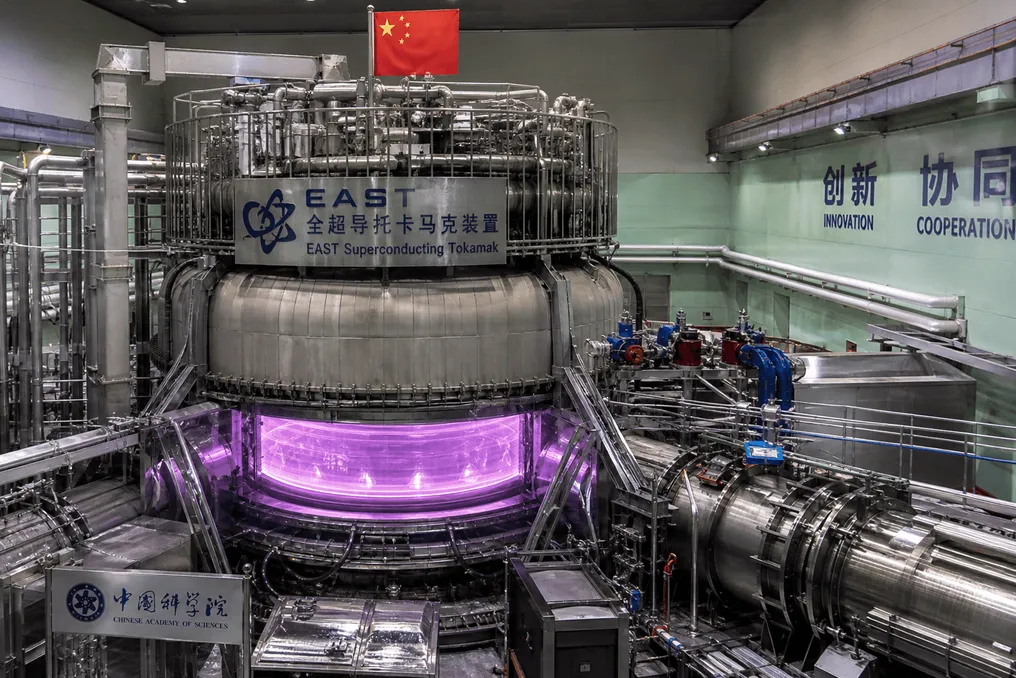
The global thermonuclear energy industry is attracting huge capital, reaching a cumulative funding of $14.24 billion, which is seven times higher than in 2021. Chinese scientist Wang Teng presented the progress of the EAST CRAFT and BEST projects, which bring China closer to launching the first thermonuclear energy power plant.
China's Goals and Strategy
At the Conference on Future Trends on July 30, Wang Teng, a scientist from the Institute of Physical Sciences CAS in Hefei since the 1990s, stated that China's research in thermonuclear energy is world-leading, and the country is aiming to launch the first generation source based on nuclear fusion. Nuclear fusion requires plasma with a temperature of 100 to 300 million degrees and faces two main challenges: efficient ignition and long-term stable confinement.
Government Support and Investment
Nuclear fusion is the ultimate goal of China's three-stage nuclear strategy, enshrined in the 15th Five-Year Plan, while the Atomic Energy Law will come into effect in January 2026. Global capital is actively flowing into this sector. According to the Thermonuclear Energy Industry Association's 2026 report, worldwide funding reached $14.242 billion, equivalent to approximately 96.4 billion yuan, which is seven times more than in 2021. In 2025, China invested about $4.7 billion, second only to the United States.
Development of the Chinese Sector
Since June 2026, eight Chinese companies involved in thermonuclear energy have completed funding rounds, including ENN Fusion, Zeta Fusion, Xinghe Fusion, Chaomag New Energy, and Beta Fusion. Xinghe Fusion announced a seed round of 830 million yuan in early July with participation from SAIC Capital, Shenzhen Capital Group, Hefei Innovation Investment, and Zijin Mining. Investor enthusiasm is explained by the fact that the power density of a thermonuclear reactor depends on the fourth power of the magnetic field intensity: doubling the magnetic field reduces the device volume by 30 times. Furthermore, the commercialization of nuclear fusion is accelerating due to the industrial production of high-temperature superconducting tapes and the application of artificial intelligence for predicting disruptions and optimizing configuration.
Prospects and Infrastructure
It is projected that investments in thermonuclear energy devices will amount to 20 billion yuan annually, providing a market potential of 50 billion yuan. Planned domestic thermonuclear energy projects exceed 150 billion yuan, and commercialization is expected around 2040. Hefei concentrates nearly 60 enterprises related to thermonuclear energy at all stages of the chain. China Fusion Energy Co., a subsidiary of CNNC, was registered in Shanghai with a charter capital of 15 billion yuan.
Achievements and Future of the Industry
Wang Teng emphasized the advancement of China's thermonuclear energy research infrastructure: EAST achieved high-confinement mode operation for a thousand seconds, CRAFT is close to full readiness, and BEST is in the intensive assembly stage. High-temperature superconducting magnets, AI-driven plasma control, and advanced manufacturing have accelerated the transition from laboratory tests to commercial installations. The combination of government support, private capital, and technological breakthroughs allows China to potentially lead the global race in thermonuclear energy, with the target date for launching the first commercial facility around 2040.