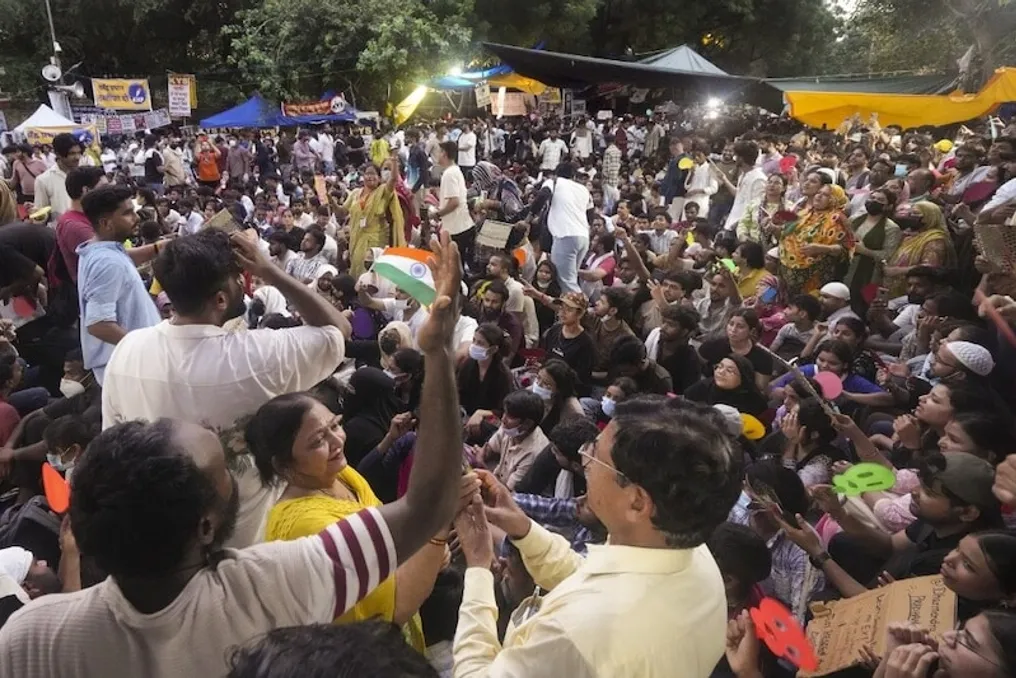
Following the scandal of the NEET exam material leak and under pressure from student protests, Education Minister Dharmendra Pradhan resigned. Simultaneously, Prime Minister Narendra Modi formed a task force led by Nandan Nilekani. These events indicate that the government recognizes the need to correct its mistakes.
The Opportunity for Educational Reforms
As PM Modi himself notes, 'every catastrophe brings an opportunity.' However, for the government, this is not just a time to address the consequences of a crisis. The young Gen-Z generation has given them a unique chance to achieve a true 'educational revolution' in the long-problematic education system.
The protests at Jantar Mantar were caused not only by malpractice in one specific examination but also by the anger of the Gen-Z generation, which has long borne the burden of an inefficient, questionable, and aimless education system. If the government makes significant changes now, the opposition will have fewer opportunities for political attacks, as the youth will be monitoring every step.
The Need for Systemic Changes
The question is not just about ensuring exam security. It is necessary to eliminate the 'traditional way of working' of the Ministry of Education, which constantly leads it to scandals, distracting it from its main task—education. The ministry has previously been embroiled in disputes over the chapter on Muslims and Hindus in the NCERT textbook, as well as issues of corruption in the judicial system.
Furthermore, there have been problems with controversial appointments of university deans, issues of academic independence, and unnecessary policies surrounding the three-language formula in UGC, alongside meaningless definitions of racial discrimination. Skill development programs often become targets of fraud, and agencies like NTA and faculty organization frequently remain outsourced, which is exacerbated by the NEET-UG exam material leaks.
Scale of the Problem and Solutions
The Nilekani committee can only 'reinforce the locks,' but the walls of the entire education system are in critical condition. Recent studies show a worrying picture: the country lacks over a million teachers, and about 110,000 schools operate with a single teacher, most of which are in rural areas. Without teachers, talk of 'smart classrooms' is meaningless.
To achieve a revolution, it is necessary to improve the teacher-student ratio, similar to what is implemented in Norwegian schools, where the average teacher has nine students. Moreover, teachers are overloaded with tasks unrelated to pedagogical activities, such as census taking, election counting, and distributing rations for school meals, which reduces their effectiveness.
There is a lag in global standards and curricula. The government should strictly enforce the 'Right to Education (RTE)' and modernize state schools based on Kendriya Vidyalayas (KVs). In the age of artificial intelligence and quantum computing, the current curriculum remains based on rote learning. Finland and Singapore demonstrate examples where the focus has shifted to practical learning, creativity, and mental health, with Singapore teaching coding and robotics.
Accessibility and Medical Education Issues
According to the ASER 2024 report by the NGO 'Pratham', despite increased enrollment after the pandemic and some progress in basic reading among third-grade children (23.4%), a significant portion of eighth-grade students still struggle to read second-grade books or solve simple math problems. This forces families to send children to tutors, making it a necessity rather than a choice, as private school costs exceed the average middle-class monthly income.
A revolution will come when world-class quality education becomes accessible to all. One can look at the example of Finland, where education is completely free and high-quality, or China, which introduced the 'dual reduction policy' in 2021, banning private tutoring services to lower education costs and support public schools.
In medical education, there is a severe imbalance: one doctor for every 800 people. This is due to insufficient doctor production. According to NMC data for 2026, there are only 136,939 MBBS seats across 823 medical colleges, while the number of NEET applicants exceeded 2.2 million. This huge gap between supply and demand generates leaks and influence from donation cartels.
To improve the situation, the number of seats in medical institutions must be increased. While medical education in the US and UK is very modern, places are limited. In contrast, Russia, Georgia, and Kazakhstan have sufficient places in colleges with world-class infrastructure, ensuring a better student-to-seat ratio.
Skill Development Issues and Expert Opinions
The 'Prime Minister's Skill Development Plan (PMKVY)' was created to prepare youth for future employment. However, a CAG audit for 2025-26 and a Parliamentary Committee (PAC) found that training partner organizations are fictitious, the employment rate has dropped to 8.45%, and training is conducted in sectors where there are no jobs. It is necessary to ensure the honest execution of skill development programs so they do not turn into a source of income for NGOs.
A revolution in this area is possible through the implementation of a 'dual education system,' as in Switzerland and Germany, where students receive practical training directly in the industry parallel to their studies in educational institutions.
Experts agree that the National Education Policy of India (NEP 2020) is one of the best on paper, but its implementation has serious flaws. Educationists note that the promise to increase the education budget to 6% of GDP remains unfulfilled. William Wadhwa from the ASER Center noted that while there is improvement in Foundational Literacy and Numeracy (FLN), a long journey remains, and a special strategy is required for children with weak knowledge.
The PAC report raises additional alarm, stating that 'unemployment is the biggest threat to the country, and youth are being given skills that are not in demand by the market.'
Conclusion: Opportunity for Change
The Modi government has received a unique chance unavailable to other administrations. Gen-Z has made it clear that they are concerned not with religious debates or changing history in textbooks, but with a safe future, transparent exams, quality schools, and jobs.
The new Education Minister and the Nilekani task force cannot limit themselves to just preventing leaks. The Ministry of Education must stop being a 'school of scandals.' A real 'educational revolution' will begin if vacancies in public school teachers are filled, educators are freed from secondary duties, opportunities in medicine and higher education are expanded, and skill development is linked to industry.