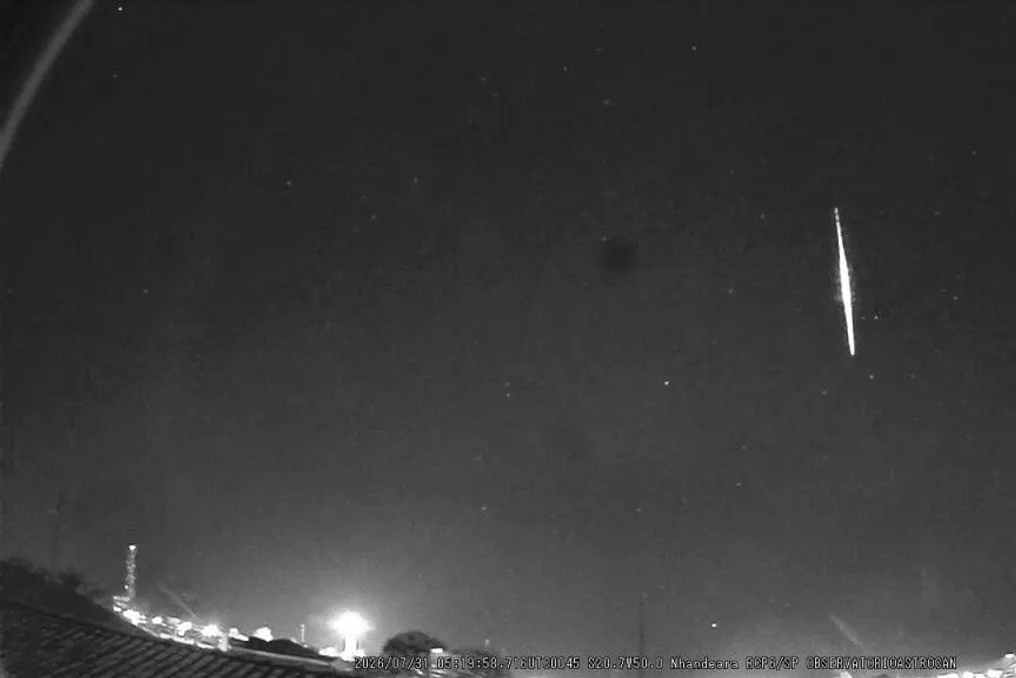
A meteor shower phenomenon was visible in several locations across Brazil during Friday morning. A monitoring station installed in Ceará registered a total of 134 meteors, even with the presence of the full moon.
Images collected by Exoss demonstrate the intensity of this event, which reached its peak activity this week. Records made in both Ceará and Santa Catarina attracted the attention of the astronomical community.
Records in Ceará and Santa Catarina drew attention
The Exoss station located in Carnaubal, Ceará, counted 134 meteors in the early hours of the day. This count was provided by astronomer Marcelo De Cicco, who is a member of the Brazilian Astronomical Society and coordinates the community project Exoss. This number was lower than the one recorded the previous night, when the same equipment identified 196 meteors between Wednesday and Thursday.
Additionally, the Exoss station located in Florianópolis, Santa Catarina, also captured images of the event, including one of a notably bright meteor. De Cicco had previously informed g1 that this period corresponded to the peak of the meteor shower.
Why do 'shooting stars' appear in the sky?
So-called shooting stars are, in reality, small pieces originating from comets or, in certain situations, asteroids. When these materials penetrate the Earth's atmosphere, friction causes heating, generating the glow that can be perceived from the surface.
In the Southern Hemisphere, the Delta Aquariids Southern shower is one of the main ones observed during this period. Typical characteristics of these events include the very small size of the space fragments, the extremely high speed of entry into the atmosphere, a brightness that usually lasts less than a second, and the classification of more intense events as bolides.
A meteor is classified as a bolide when its brightness exceeds that of Venus.
Upcoming meteor showers will bring new opportunities
Those who missed the spectacle will have other chances to observe meteors. The next major occasion will be on August 12, during the peak of the Perseids, with better visibility expected in Brazil, especially in the North and Northeast regions. On the same date, there is a forecast for a total solar eclipse that can be seen in some parts of Europe.
Another shower that should attract the attention of Brazilian observers will occur at the end of October, the Orionids. To take meteor photographs, Marcelo De Cicco advises avoiding locations near the moonlight and using long exposures, lasting approximately 10 seconds and with a high ISO.
Meteors can exceed 260 thousand km/h
The speed of meteors varies between 40,000 km/h and 260,000 km/h (equivalent to 11 to 72 kilometers per second), depending on their trajectory relative to Earth. This high speed causes particles, often smaller than a grain of sand, to heat up rapidly as they pass through the atmosphere, creating the luminous trail visible in the sky.
Although most meteors disappear in short moments, certain more vigorous events can remain visible for several seconds. Such occurrences tend to happen when the object enters the atmosphere at a shallower angle.