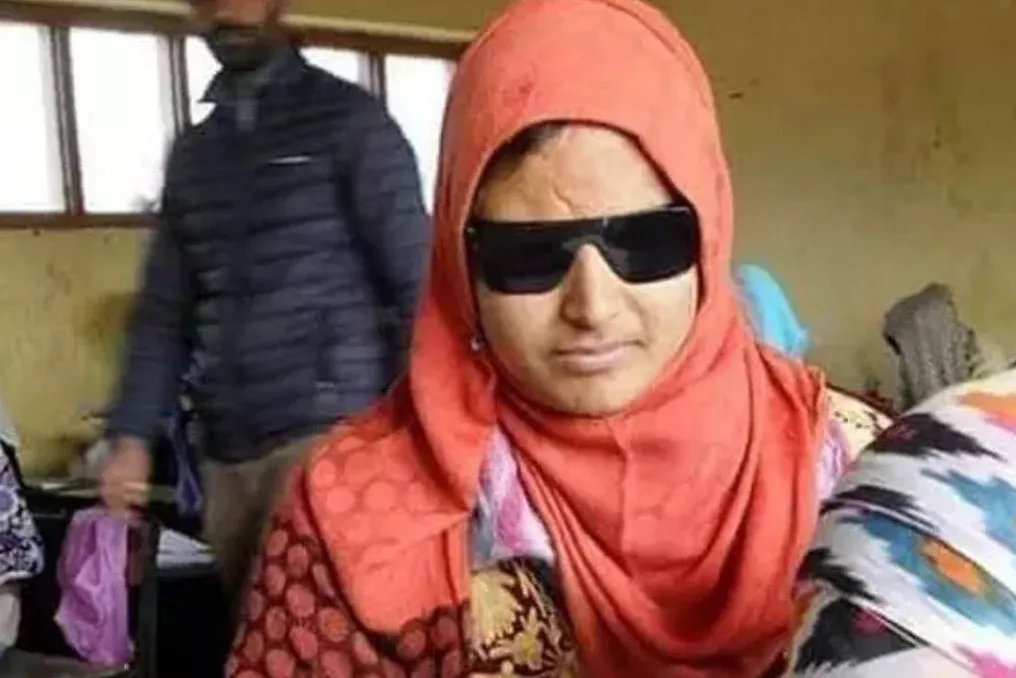
Insha Mushtaq, who lost her sight at the age of fourteen following an incident in Jammu and Kashmir, continues to live despite the injuries that have become public knowledge. Ten years after pellets deprived her of her vision during unrest in Jammu and Kashmir in 2016, she still bears scars that resurface in public discourse whenever India discusses crowd control.
Desire to Forget the Past
The 24-year-old Insha, residing in the village of Sedow, Shopian, approximately 75 km south of Srinagar, says she does not want to recall what happened. She notes: 'I don't want to remember. It doesn't help and it hurts.'
Memories and Political Context
However, the memory persists. Images of 14-year-old Insha, whose face was bandaged after being hit by pellets during protests following the killing of Hizbul Mujahideen commander Burhan Wani, were broadcast on television and social media in 2016. She became perhaps the most recognizable face in Jammu and Kashmir affected by shotgun pellets. Any new political debate about the use of force brings these photographs back into the public sphere.
Recent protests related to disturbances in New Delhi repeated this effect. For Insha, these debates mean reopening wounds that took her years to heal. She shares her plans: 'I don't know if I should speak or not. I want to find a job after finishing my studies.' Her father, Mushtaq Ahmad Lawn, and mother, Afroza Akhtar, sit quietly beside her.
Ambitions and Obstacles
Blindness changed her life, but not her aspirations. Insha is completing her Bachelor of Arts and hopes to secure a government position under the disability quota. She fears that public statements could jeopardize this dream.
She comments on the situation in Delhi: 'I don't know what happened in Delhi, but I know many lives were destroyed by shotguns in Kashmir.' Then her face brightens: 'I am blind, but we can use phones.'
History of Shotgun Use
Shotguns appeared in the security arsenal of Jammu and Kashmir around 2010 as a supposedly non-lethal alternative to live ammunition. They left hundreds of eye injuries, partial blindness, and irreversible vision loss. Although national attention has waned over the years, the memories have not disappeared. Protests in New Delhi have breathed new life into the long-standing debate.
The political battle continues. The ruling National Conference accuses the opposition People's Democratic Party of condoning the use of shotguns in New Delhi while defending their use in Jammu and Kashmir. In turn, the People's Democratic Party blames Chief Minister Omar Abdullah, who introduced shotguns during a previous period to quell protests after the death of about 110 demonstrators during an anti-terror operation in 2009–2010.
According to the Bharatiya Janata Party (BJP), the use of bullets and shotguns ceased after the abrogation of Article 370 in 2019, as protests largely subsided.
Expert Opinions on Weapon Use
Former Director General of Police Jammu and Kashmir SP Vaid, who headed the police during the 2016 unrest, stated that shotguns were first used during the 2009–2010 protests and again in 2016. He clarified: 'All those 110 people who died in 2010 died from bullets, not pellets. A shotgun should only be used in extreme circumstances, from a proper distance and aimed below the waist.'
Describing them as 12-gauge pump-action shotguns, he added: 'I am not saying shotguns are good. I am saying they are the best option in an emergency compared to a direct firing of live ammunition. If the choice is between bullets and shotguns, shotguns can save lives.'
Trauma and Recovery
Politics seems distant in Insha's two-story house. Now she climbs the stairs without assistance. In her room hang certificates of completion for classes 11 and 12. However, July 12, 2016, remains a vividly remembered day. Clashes were taking place outside her home. Tear gas canisters landed nearby. Curiosity prompted her to approach the window overlooking the village road. As soon as she opened it, a volley of pellets shattered the glass and struck her face. 'My forehead felt like it was burning from inside,' she recounted.
Initially, she was taken to the Shopian district hospital, from where doctors referred her to Shri Maharaja Hari Singh Hospital in Srinagar. She fell into a coma for 4 days. Her photos quickly became a symbol of the 2016 unrest, attracting the attention of the then People's Democratic Party and BJP government. At the time, Minister Mehbooba Mufti promised help—providing Insha's father with a job.
After nearly a month at SMHS, Insha was transferred to AIIMS New Delhi, where she stayed for almost two months. On September 13, 2016, she was moved to Aditya Jyot Eye Hospital in Mumbai, where ophthalmologist Dr. S Natarajan treated her for almost 24 days. Natarajan, who was the hospital director and president of the Indian Eye Trauma Society at the time, visited Jammu and Kashmir multiple times that year, operating on hundreds of survivors of pellet injuries.
Doctors eventually informed her family that she had no light perception, and the blindness would be permanent. Transformational intervention played a crucial role. Insha admitted: 'Nadir Ali helped me continue my education. He constantly insisted that I study. If it weren't for him, I would have given up.'
Support and Education
Ali, Chairman of the Jammu and Kashmir Peace and Justice Foundation, first met her in late 2017. He noted: 'She was not born blind. She was angry, very angry, and regularly underwent pellet removal surgeries.'
Ali enrolled her in a special educational department at Delhi Public School in Srinagar, where she spent almost two years learning Braille, mobility skills, and computer programs. He shared his observation: 'When I visited her home, I saw that people had given her certificates, but no one seemed to think about how she would build her future.' He emphasized: 'She wanted to study, and I wanted to help her. She had to learn to walk independently, use a computer, and adapt to a completely new way of life.'
Today, Insha is studying political science, English, pedagogy, and sociology through Ignou. Graduation is within reach. Ali reported: 'This is her last year... Our goal is to make her financially independent.'
Ali also appeals to journalists: 'As soon as you ask them to talk about their past, they sink back into trauma. Let them heal.' This may be the hardest thing for Insha.