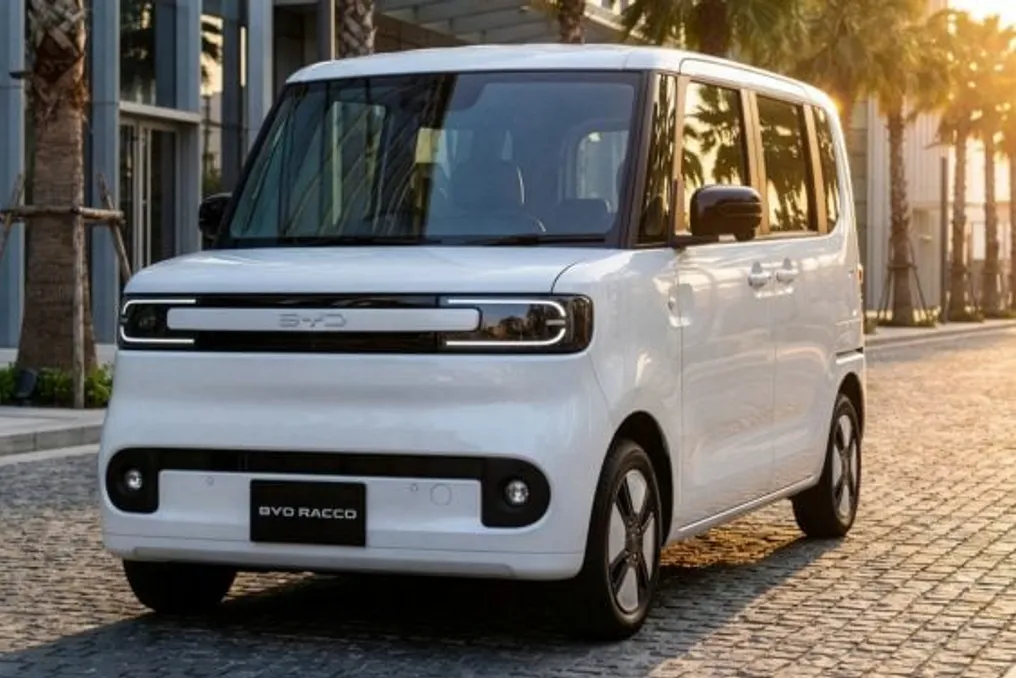
BYD introduced the Racco, its first kei vehicle, in Japan on Tuesday, the 28th. This launch marks the first time a foreign brand enters this automotive segment, which is crucial for the Japanese market. The electric car was specifically designed for the country, unlike adapted Chinese models, allowing the manufacturer to compete directly with Suzuki, Daihatsu, Honda, and Nissan.
Racco Details and Prices
The Racco line offers three options, all including consumption tax: the Racco 200, priced at 2,145,000 yen; the Racco 300 Plus, at 2,398,000 yen; and the Racco 300 Premium, valued at 2,497,000 yen. In direct conversion, these values correspond to between R$ 66,816 and R$ 77,781. The model name refers to the rakko, which means sea otter.
Kei Car Segment Characteristics
Kei cars are legally classified in Japan, requiring the vehicle not to exceed 3.40 meters in length, 1.48 meters in width, and 2 meters in height. Furthermore, the engine must have a capacity limited to 660 cubic centimeters and a maximum power of 64 horsepower. Conversely, owners of these vehicles pay lower taxes and insurance, establishing this category as the most popular in the country.
The data demonstrates BYD's interest in this niche: in 2025, 1,667,360 kei cars were registered in Japan, representing 36.5% of all 4,565,777 new vehicles sold that year, according to reports from Japanese dealer and light vehicle associations. Thus, more than a third of the market is concentrated in this specific format.
Technical Specifications of the New Model
The Racco meets legal requirements with minimal margin, featuring a length of 3.39 m, a width of 1.47 m, and a height of 1.80 m. Its front engine generates exactly the 64 maximum hp permitted by law, along with 16.3 kgfm of torque, and the cabin accommodates up to four occupants.
BYD's Positioning in the Japanese Market
Before the launch of the Racco, the brand had already been selling passenger cars in Japan since January 2023, having delivered just over 7,400 units by the end of 2025. In 2025 alone, the company registered 3,870 registrations, a 62% increase, according to the Japan Automobile Importers Association. In the first half of 2026, 2,388 units were delivered, constituting a 40% advance and positioning the brand in the 16th place among imported vehicles. BYD's goal is to achieve 10,000 orders for the Racco by the end of the year.
Technological Advantages and Fiscal Challenges
The main differentiator of the model lies in its range. The 300 versions use lithium iron phosphate batteries with a capacity of 35.8 kWh and can travel 320 km in the WLTC cycle, making it the first electric kei car to exceed the 300 km mark. The entry-level version has a 22.4 kWh battery, offering a range of 210 km. Comparatively, the Nissan Sakura, the best-selling electric car in Japan, starts at 2,448,600 yen and reaches 180 km. Additionally, the Racco supports fast charging of up to 100 kW and is equipped with electric sliding doors, ADAS systems, and an NFC key integrated with the mobile phone.
However, there is an impediment related to government incentives. While electric vehicles manufactured by Japanese brands have access to subsidies of up to 580,000 yen, imports like the Racco qualify only for the basic benefit of 150,000 yen. Although the car has the lowest environmental rating in the segment, it does not have the lowest final cost.