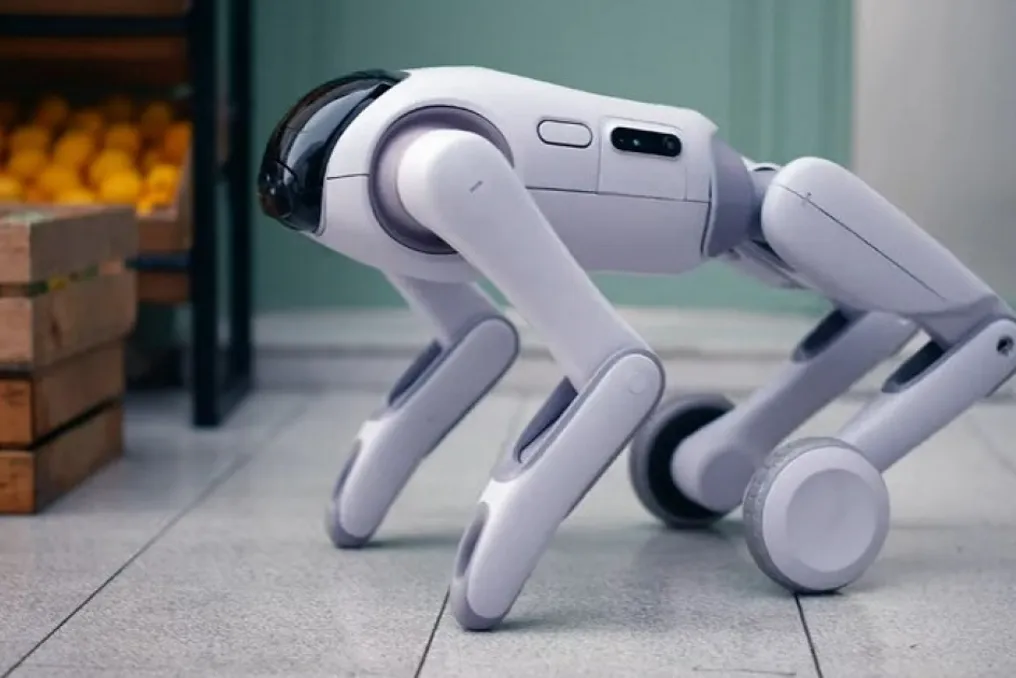
The Chinese startup PrimeBOT demonstrated the Qiyuan T1 robot at the WAIC 2026 exhibition in Shanghai. This model possesses the ability to independently change its configuration, transitioning from a quadrupedal state to a bipedal mode.
Functionality of the Qiyuan T1 Robot
The design of the robotic dog is intended to traverse complex terrain, including stairs. When interaction with humans is necessary, the robot can transform into an android, assuming an upright posture. In this mode, the back becomes the chest, and the front limbs function as arms. Additionally, the camera block rotates by an angle of 45 degrees.
In android mode, the T1 uses wheels mounted on its hind legs to maintain balance. The robot is capable of transporting small loads and performing video operator functions, supporting voice control for filming and keeping the subject in frame.
Previous Robotics Developments
The Qiyuan T1 is not the first development in this field. Previously, the Chinese robotics startup Limx Dynamics showcased its wheeled robotic dog, the W1, which could stand on its hind legs and move in that position. Furthermore, the company Swiss-Mile, whose engineers are affiliated with the Swiss Federal Institute of Technology Zurich, presented a wheeled version of the ANYmal robotic dog, which could balance on its rear wheels and move like a bipedal robot, although this remained only a research project.
Presentation of the U145 Unmanned Helicopter
Separate attention should be paid to the presentation of the full-scale U145 mockup by the Airbus consortium, which is an unmanned version of the popular H145 helicopter. Engineers modified it by removing the pilot cabin and installing an automatic control system based on artificial intelligence and a set of sensors.
Instead of a traditional cockpit, doors with a folding table are placed at the front to simplify the loading and unloading process. Access to the entire cargo compartment, which occupies the full useful volume of the fuselage, is provided through side and rear doors. Despite the aircraft's complete autonomy, a pilot will be present onboard during test flights as a backup. The first flight is scheduled for the end of 2026, with full launch expected in the beginning of the next decade. The presentation of this aircraft is planned for the ILA air show in Berlin, according to the company's press release.