Bugatti has confirmed the end of production for the W16 Mistral hypercar, marking the end of an era for this model. The last of the 99 units was completed in the brand's workshop located in Molsheim, concluding the line of the roadster equipped with an eight-liter, four-turbo, 16-cylinder engine, based on the Bugatti Chiron.
Details of the last Mistral
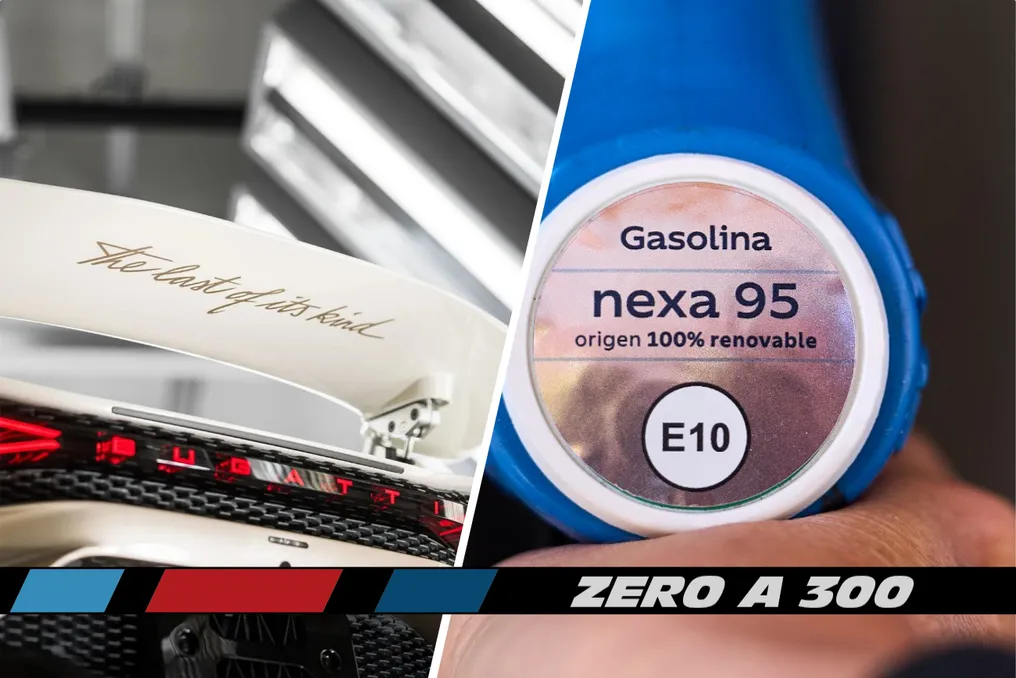
This last Mistral features a relatively subtle color palette, combining two shades of off-white (Pearl and Sparkle) on the body, while the interior uses beige leather called 'Magnolia' and 'Grey Carbon Matt' gray. The vehicle received exclusive touches ordered by the owner through the Bugatti Sur Mesure program, such as a falcon sculpture on the gear lever (replacing the usual elephant) and hand embroidery on the door trims, which pay homage to the front ends of the Veyron and the Mistral itself, referencing the manufacturer's W-configuration 16-cylinder lineage.
On the center console and the movable rear wing, the phrase 'The last of its kind — The last of its species' was engraved. Although the Mistral number 99 is the last of the official series, the Bugatti Solitaire program allows customers to order a unique one-off unit using the Chiron monocoque or the eight-liter quad-turbo W16 engine, while stock is available. These customized models have a power output of 1,600 hp and a torque of 163.1 kgfm.
Renewable fuel testing
In parallel, Toyota and BMW are testing a renewable gasoline developed in partnership between the oil company Repsol and Bosch. This fuel, called Nexa 95, aims to help address the ban on combustion cars in Europe, differing from synthetic e-fuels because it is produced from organic waste.
The logic behind Nexa 95 is that the carbon dioxide emitted from the exhaust would be offset by what the organic raw material absorbed during its life cycle, resulting in a reduction of over 70% in greenhouse gas emissions compared to traditional fossil gasoline. A significant advantage is that Nexa 95 is a 'drop-in' fuel, capable of directly replacing gasoline at the pump without the need for mechanical modifications or reprogramming of existing engines. For six months, a fleet of approximately 20 vehicles will be fueled exclusively with this new fuel, under monitoring by a digital telemetry system provided by Bosch.
The text reflects on the situation, pointing out that Brazil has had a similar solution for decades with ethanol, a green fuel used since the 1970s, which today makes up more than 30% of the national fleet, making it one of the cleanest in the world, even before the global climate concern.
Launch of the MG4 Urban in Brazil
At an event held on the 16th, MG introduced the electric hatchback MG4 Urban to the Brazilian market. With an initial price of R$ 129,990, the vehicle is positioned at the base of the brand's lineup, competing with models such as Dolphin Mini, Geely EX2, and GAC Aion UT.
Manufactured in Horizonte (CE), the MG4 Urban has dimensions of 4.39 meters in length, 1.84 m in width, and a wheelbase of 2.75 m, making it larger than the standard MG4, which starts at R$ 169,990 in the Comfort version. It also surpasses its competitors in trunk space, offering 477 liters, compared to 230 liters for the Dolphin Mini and 375 liters for the EX2.
MG4 Urban options and specifications
MG offers the MG4 Urban only with an electric motor, but with two battery options. The 42 kWh version generates 150 hp, accelerates from 0 to 100 km/h in 9.6 seconds, and achieves up to 299 km of range. The 54 kWh battery delivers 160 hp, completes acceleration in 9.5 seconds, and travels up to 358 km on a single charge (Inmetro data). In European WLTP tests, the figures are 320 km and 415 km, respectively. Both batteries support fast DC charging, allowing travel from 10% to 80% in about 30 minutes.
There are three trim levels. The entry-level version, MG4 Urban Comfort 43 kWh, costs R$ 129,990 and includes LED headlights and taillights, a roof rack, 16-inch wheels, and automatic one-zone air conditioning. In terms of technology and safety, it features a 7-inch digital dashboard, a 12.8-inch multimedia center, 7 airbags, and the ADAS package with 15 driving assistants.
Above it, the MG4 Urban Luxury 43 kWh, for R$ 139,990, adds 17-inch wheels, heated front seats and steering wheel, ambient LED lighting, and a 360-degree camera system, in addition to electric seat adjustment and wireless charging.
At the top of the line, the MG4 Urban Luxury 54 kWh, valued at R$ 149,990, maintains the same comfort and safety features as the 43 kWh Luxury version, differing only in the larger battery capacity.
Resurgence of V12 engines
V12 engines seem to be in a comeback phase, and the newcomer Nilu27 serves as proof of this. Two years ago, the manufacturer presented the Nilu, a futuristic-looking hypercar with a classic proposal: naturally aspirated V12 engine, no hybrid assistance, manual gearbox, rear-wheel drive, and a light weight estimated at 1,200 kg.
Expectations were high, given that the Nilu27 had disclosed impressive figures at the time: over 1,000 hp, 11,000 rpm, and 1,200 kg. Although technically possible, the figures seemed excessive. However, a recent video published on the Nilu27 YouTube channel shows the V12 running on the workshop bench, demonstrating a powerful sound.
The V12 engine was developed by Hartley Engines, a company based in New Zealand. Configured in a 'hot V' with an exhaust manifold between the cylinders and individual throttle bodies, the 6.5-liter engine appears robust and represents an auditory alternative to the growing wave of electric hypercars. The project is led by designer Sasha Selipanov, who has prior experience at Lamborghini, Bugatti, and Koenigsegg.
The Nilu features a minimalist cockpit, with analog gauges, many metal components, seats integrated into the carbon fiber monocoque, and a highlight on the seven-speed manual gearbox. Nilu27 plans to send the engines from New Zealand to its factory in Germany, where the development and testing of the Nilu take place. Initially, 15 track units will be produced, with the possibility of homologation for 54 street models if the process is successful.
Aston Martin in games and in real life
Aston Martin has also collaborated with developer Infinity Ward and publisher Activision to include an exclusive vehicle in the first-person shooter game Call of Duty: Modern Warfare 4. This vehicle is the Aston Martin Dreadnought, described by the brand as the 'ultimate high-performance tactical SUV.'
Visually, the Dreadnought resembles a futuristic Humvee, incorporating design elements inspired by Aston Martins, such as the front reminiscent of the late 1970s V8 Vantage, notably in the grille shape and headlight arrangement. Although it is a virtual vehicle, Aston Martin ensured that it has the sound of its V12 engine and that its physics were developed in conjunction with the brand's engineering department to realistically simulate the behavior of an Aston Martin, even in war scenarios.
The name of the car also originates from historical British combat vehicles, such as the HMS Dreadnought ship. Like the ship, the Dreadnought in CoD: MW4 includes reserve fuel tanks, ammunition compartments, and armor against heavy ordnance. Beyond the gaming universe, Aston Martin will present a full-size replica of the Dreadnought at the Fanatics Fest, a sporting event held in New York this weekend, while the game will be released in October of this year.