Highland Europe has successfully completed another funding round, raising a total of $1.25 billion. This capital is intended to strengthen the company's position as a leading investor in European technology startups at the growth stage.
Highland Europe has successfully completed another funding round, raising a total of $1.25 billion. This capital is intended to strengthen the company's position as a leading investor in European technology startups at the growth stage.
The new fund marks the completion of the sixth fund, which was established in the region and has attracted approximately €3.75 billion since Highland Europe's founding in 2012. The company also noted impressive results, returning over $1 billion to its limited partners through major portfolio company sales over the year.
The company's investment strategy focuses on supporting technology enterprises that have already achieved product-market fit. Investors include both existing limited partners and new participants. The funds will be directed towards financing companies in the fields of enterprise software, financial technology (FinTech), healthcare, artificial intelligence (AI), and consumer technology.
The attraction of new capital followed a strong year of asset realization. Among the most notable deals was the sale of the Nexthink employee digital experience platform for approximately $3 billion. Furthermore, the portfolio company Bending Spoons reached a market capitalization exceeding $18 billion after listing on Nasdaq, highlighting the growing international status of European tech firms.
Since its inception, Highland Europe has supported over 80 companies and executed about 30 exits. Portfolio companies generate annual revenues exceeding $6 billion and employ more than 15,000 people worldwide. Partner Sam Brooks noted that the continuous commitment of limited partners allows for the continued support of promising European founders amid transformative changes in the use of AI in the global economy.
Highland Europe specializes in investing in companies that already have stable demand and revenue. The provided capital helps businesses expand internationally, strengthen leadership teams, and accelerate product innovation. Recent investments include leading a funding round for the AI-based legal platform Wordsmith and the AI-powered workflow company Unframe for the corporate sector. The company also participated in a major funding round for Ecorobotix, which specializes in precision agriculture technologies.
The company believes that artificial intelligence will create significant opportunities in enterprise software and industry technologies. Highland intends to support firms using AI to transform sectors such as healthcare, financial services, and industrial activities. Previously, the company invested in firms like n8n, Nabla, 9fin, Nothing, Camunda, and Zwift, operating in fast-growing technology markets. Additionally, the consumer food brand Huel agreed to an acquisition by Danone.
Alongside the new fund, Highland Europe promoted Helena Richardson and Jacob Bernstein to partner level. Richardson joined the firm in 2016 and closely collaborated with companies in the consumer and fintech sectors, including Huel, Modulr, ME+EM, and Ffern. Bernstein, who joined the company in 2017, primarily focuses on investments in enterprise technologies such as Unframe, Zero Networks, Oritain, and Descartes Underwriting. These promotions expand Highland's senior management while maintaining a flat partnership structure. With fresh capital from Fund VI, Highland Europe plans to continue supporting growth-stage technology companies through their international scaling and competition in increasingly AI-driven markets.
Gritt has successfully raised $26 million in investments that will be used to scale infrastructure automation using artificial intelligence. Obvious Ventures led the round, with participation from Union Square Ventures, Active Impact Investments, and existing investors, including First Round Capital, Climactic, Congruent Ventures, and VSC Ventures.
With this new injection of capital, Gritt's total funding has reached $32.4 million. The company plans to use the acquired capital to expand its operations and further develop an intelligent robotic platform designed for complex outdoor construction environments.
Founded by Punith Puri and Vishal Dugar, Gritt develops robotic systems to automate construction equipment. Its AI-based system can autonomously perform tasks such as material handling, assembly, placement, inspection, and project planning. Gritt's technology integrates with existing equipment on sites, allowing contractors to apply automation to their machinery and ensuring safe collaboration between robots and humans.
CEO Punith Puri noted that automating outdoor construction is more complex due to changing weather conditions, terrain specifics, and other unforeseen factors. He emphasized that their 'Physical AI' is specifically designed for such tasks, enabling the acceleration of construction for solar, bridge, and road projects, as well as large infrastructure projects like data centers, with robot support.
The company's platform continuously improves through learning from every completed project. Tasks that previously required months of system setup can now be adapted in just a few days, allowing robots to perform high-precision work on various construction sites. In addition to automation, Gritt collects real-time data from sites, including information on completed work, material movement, and changes in site conditions. This information helps project managers make faster decisions and optimize schedules.
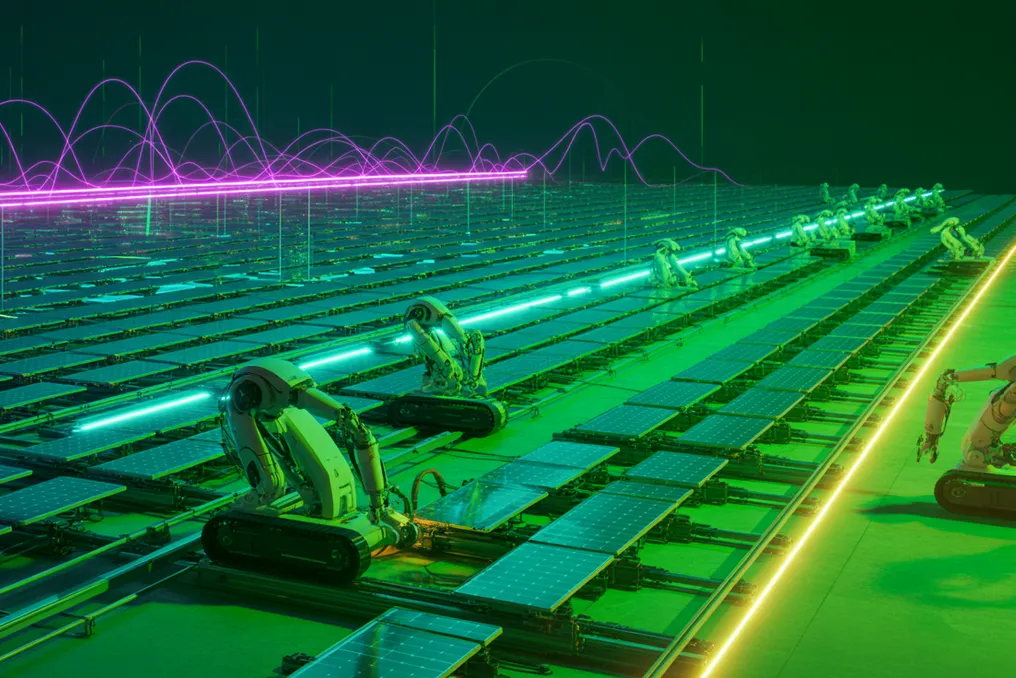
The company has already implemented its systems in several large American construction firms involved in industrial-scale solar panel installation. According to Gritt, their robots have independently installed tens of thousands of solar panels without a single failure. Demand for automation is supported by industry challenges: it is expected that over 40% of the US construction workforce will retire by 2031, and the sector's overall productivity is declining, forcing companies to turn to AI and robotics to solve labor shortages.
Obvious Ventures stated that Gritt is creating a new category of physical AI by implementing intelligent automation in one of the most demanding industrial environments. Investors believe that the company's ability to learn after each deployment gives it a long-term competitive advantage. Gritt's long-term goal is to transform AI into a comprehensive object condition analysis platform that tracks resource usage, identifies potential workflow obstacles, and assists project managers in making real-time decisions. Ultimately, the startup aims to reduce manual labor for construction workers and allow contractors to accelerate the implementation of large-scale infrastructure projects, believing that intelligent robotics will become an integral part of modern construction.