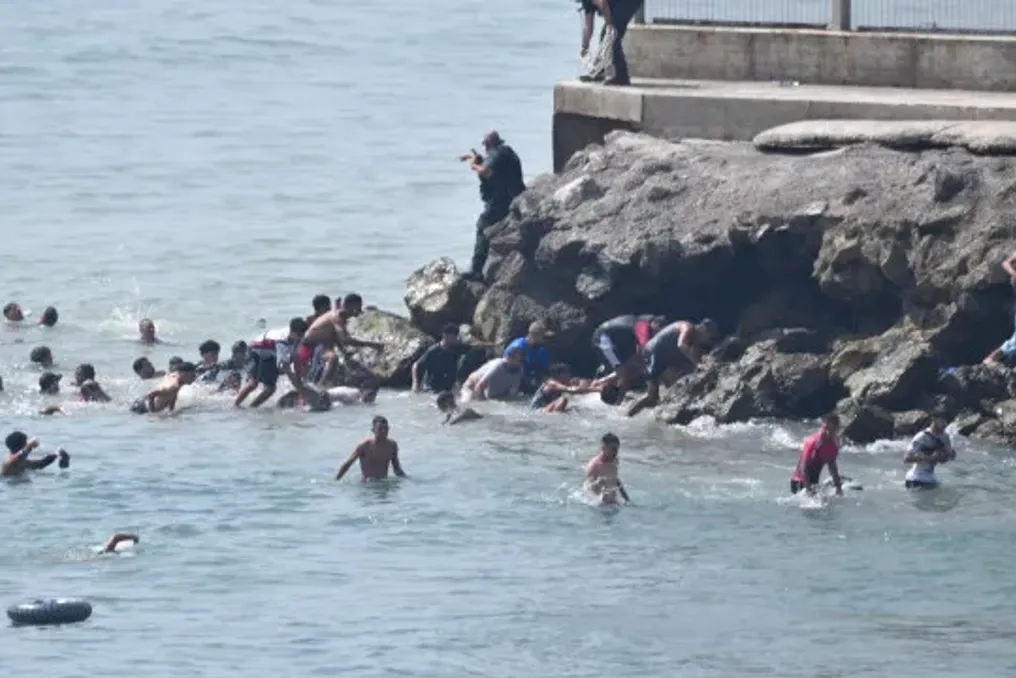
According to Spanish media outlets such as the EFE agency and the newspaper El Pais, thousands of migrants are entering Ceuta on foot through the border outpost.
Border Services Reaction
Agents of the Spanish Civil Guard are merely observing and allowing the crowd crossing the border, surprised by the large number of people crossing it. The crossing takes place near the so-called 'outpost'—a wide stone barrier that separates Ceuta from Morocco and has a fence.
Border Crossing Mechanisms
According to data from EFE and El Pais, hundreds of young people jumped over the unsecured fence, while others walked around the 'outpost' on foot, ending up in Ceuta territory. Security personnel interviewed by EFE stated that they do not know the reason for the mass gathering of youth to cross the Ceuta fence, which coincides with the celebration of the Royal Holiday in Morocco—a national public holiday marking the accession of King Mohammed VI to the throne in 1999.
Declaration of Emergency
Ceuta declared itself to be in a state of 'absolute humanitarian and social emergency' after more than 1500 people who were thrown into the sea in Morocco arrived in this North African enclave over the last ten days. The President of the Autonomous City of Ceuta, Juan Jesús Vivás, appealed to the Government of Spain to declare a state of 'national emergency' in the territory and to send central government resources to manage the 'migration crisis.'
Scale of Migration Flow
Juan Jesús Vivás stated in interviews with various Spanish media outlets: 'We are in a situation of absolute humanitarian and social emergency that requires consistent action through a unified command ensuring an energetic, decisive, and immediate response.' According to city authorities, between 1500 and 2000 people managed to reach Ceuta in the last ten days after being thrown into the sea in Morocco and swimming towards Spanish waters.
Vivás noted that this is equivalent to 2% of Ceuta's entire population and compared it to what would happen if one million people illegally reached Spain by sea in the last ten days. Although migration pressure in Ceuta is constant, especially in the summer, due to sea conditions and weather, the city president emphasized that there have been 'peaks of special intensity' in the last ten days, which have turned into a 'national emergency.'
Current Situation and Causes
According to local authorities, approximately 700 people are currently in the city's temporary migrant reception centers, which have 512 beds, and another 400 are waiting for a decision on the street. Most arrivals in Ceuta are young people under 30, including hundreds of minors, according to the same sources. The city government and police sources indicate that 30 bodies of people who died attempting to reach Ceuta by swimming have been recovered from the sea this year.
Reports from migrants who arrived in Ceuta over the last ten days, quoted by Spanish media, speak of a 'call effect' caused by a ruling of the Supreme Court of Spain at the beginning of this month. According to this ruling, migrants arriving in the country by sea illegally cannot be immediately returned to the authorities of another state. However, the court ruled that this rule does not apply in the case of the sea, but only to those who enter Spain 'by overcoming established border containment elements, such as fences.'
>