Physicists from the University of Wits have demonstrated that light-carried information can pass through turbulent air completely undamaged, even if the light itself arrives severely distorted beyond recognition. This discovery is significant as it could lead to the creation of so-called 'unbreakable' quantum communication channels.
The essence of quantum communication
Quantum communication is valued primarily because any attempt to eavesdrop disrupts the light signal and leaves a trace, making undetected data interception impossible. However, current systems transmit very little information per photon and operate optimally either through fiber optic cables or in clean, still air.
The property that the Wits team managed to make resistant to weather conditions allows a single photon to carry significantly more data and do so in open air. This is critically important for transmitting quantum-protected traffic between buildings or to a satellite on a normal cloudy day. The researchers overcame the problem of fragility, which is also an obstacle to connecting quantum computers in a network, as such connections depend on delicate links between particles.
Research method: Topology
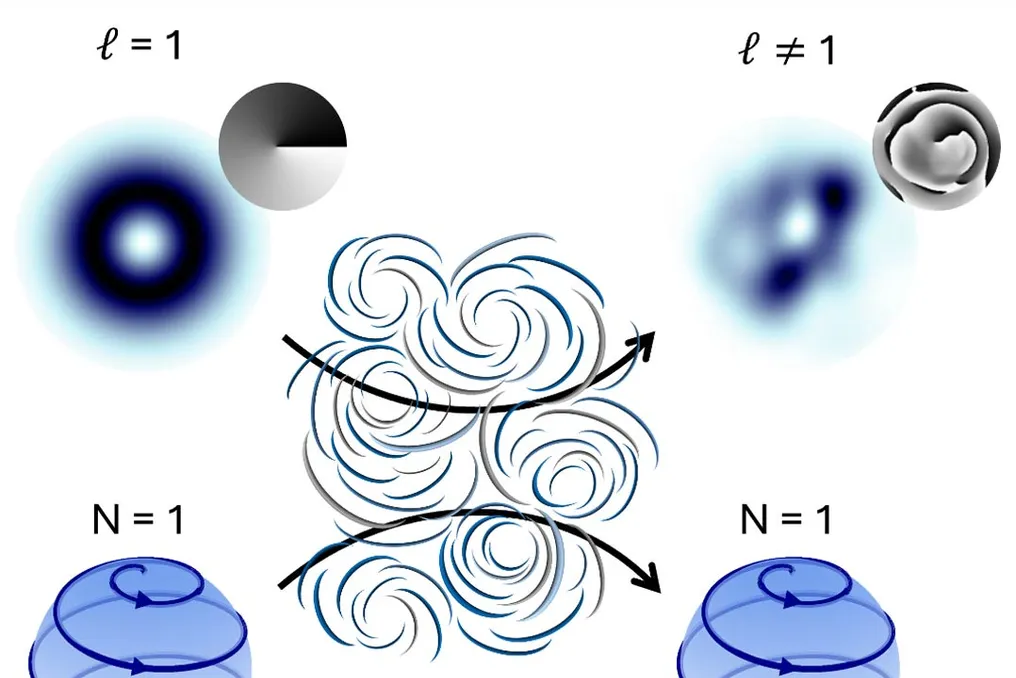
The results of the work were published in the journal Physical Review Letters on Tuesday. The lead author, Tatiana Kleine from the Wits School of Physics, collaborated with colleagues from Nanyang Technological University in Singapore and the University of Naples Federico II in Italy. The work focuses on a property of light known as its 'spiral' or orbital angular momentum. Light can be shaped to spiral forward, similar to the thread on a screw, and the number of turns in this spiral is used to encode information.
Since there is no practical limit to the number of turns that can be imparted to a beam, this provides engineers with a vast set of symbols to work with—much larger than the simple on-off pulses used in conventional optical communication—and allows for more data to be transmitted per photon. The problem was that this spiral is very sensitive: when passing through the atmosphere, bad weather, or water, its pattern is almost instantly destroyed, which kept this idea confined to the laboratory for decades.
Application of topological properties
The Wits team abandoned attempts to protect the shape of the light and instead focused on what is inside it—its topology. Topology is defined as a branch of mathematics that studies the properties of an object that remain unchanged despite stretching, compressing, or deforming it. For example, a knot in a rope remains a knot even if the rope is crumpled or thrown in the mud.
Previously, physicists assumed that creating a topological structure in light required using only the robust properties of light. The Wits group asked what would happen if they built a structure based on a fragile spiral. They were motivated by a practical consideration: such spiral structures arise naturally when generating quantum light, so the topology is obtained 'for free,' without additional engineering effort.
To test the hypothesis, the team sent pairs of entangled photons—light particles whose properties remain linked regardless of distance—through a channel with varying levels of turbulence and measured the result. Although the spiral patterns degraded significantly, and the entanglement between the photons weakened, as expected, the topological number, or 'knot count,' remained unchanged. Kleine noted: 'We observed how physical patterns were distorted under extreme turbulence, and traditional quantum communication reached a point of severe degradation. However, because the topology is inherently embedded in the entanglement itself, it remained completely intact.'
Professor Andrew Forbes, head of the Structured Light Laboratory at the Wits School of Physics and corresponding author of the paper, stated: 'Now we have access again to this huge alphabet of spatial modes, provided we look at the topology rather than the state itself.'
Significance and limitations of the discovery
Forbes is a key figure in South Africa's quantum efforts. He led the development of the national roadmap for quantum technologies, and his laboratory released Button Optics—the first product to emerge from South Africa's quantum technology initiative. It is important to understand that this was a controlled experiment with regulated turbulence, not an operational city-wide link, and the ability to read the topological number is not yet equivalent to the ability to send a message using it. A suitable communication protocol needs to be developed and tested.
The authors describe their result more modestly than the university press release, calling it a 'new perspective on using OAM entanglement in noisy channels' and suggesting it may extend to other spatial bases and channels. If true, this falls into the area warned about by South African researchers: physics-protected communication, not mathematically protected, at a time when encryption protecting banks and critical infrastructure is coming to an end. Longer quantum links are already being demonstrated from South Africa, including a 12,900 km satellite link between Beijing and Stellenbosch in October 2024.