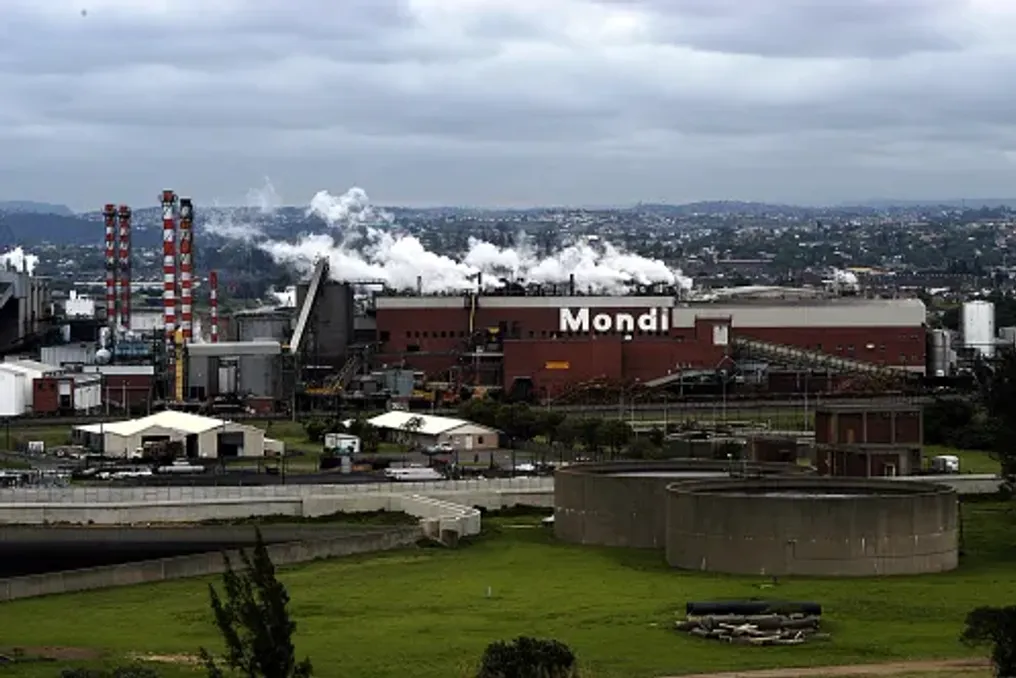
Mondi's dividend for the first period significantly decreased to 9.42 euro cents per share compared to 23.33 euro cents the previous year. This was due to margin pressure in the sustainable packaging and paper segments, caused by increased raw material costs and lower selling prices.
Financial Results and Operations
The UK-based group, listed on the JSE and London exchanges, which operates in approximately 30 countries, reported on Thursday that its earnings before interest, taxes, depreciation, and amortization (EBITDA) for the first half of the year fell to 379 million euros. This figure includes a loss on the fair value of forestry amounting to 35 million euros, compared to 564 million euros the previous year, which included a capital gain of 18 million euros.
CEO Andrew King noted that the company has made significant progress in strengthening performance, cash generation, and competitiveness. He emphasized that decisive pricing actions have been taken and cost discipline maintained, alongside the advancement of a production network optimization program.
Price Pressure and Cost Management
Although growth in sales volumes and price increases partially offset margin pressure, paper product prices declined in the second half of 2025 and early 2026. Consequently, in 2026, the group began operating at prices below the average levels observed in the first half of the previous year.
King stated that while price increases were implemented, the initial benefits have not yet been fully realized, and the full effect of these increases is expected in the third quarter of 2026. Cash generated from operations amounted to 347 million euros (compared to 416 million euros), supported by a strong focus on working capital management.
Network Optimization and Geopolitical Factors
Planned capital expenditures for the entire year 2026 are expected to decrease to approximately 500 million euros from the previous 550 million euros. Progress has been made in network optimization: six sites have been closed or are in the process of being closed. A preliminary tax write-off of 320 million euros to cover impairment and restructuring had an expected cash impact of 24 million euros.
King explained that heightened geopolitical tensions in the Middle East led to supply chain disruptions and increased raw material costs. The group's teams have taken action to maintain operational continuity, support customers, and implement price increases for packaging and paper products.
Structural Changes and Outlook
The CEO also mentioned an improvement in trading momentum and higher prices for packaging paper in the second half, aided by strong orders. However, an increase in timber costs in Central and Eastern Europe is anticipated, and management of volatile energy-related costs continues. Major expansion investments are largely complete, and the focus is now on disciplined growth and strengthening price competitiveness.
As part of measures to strengthen productivity and competitiveness, network optimization, workforce reductions, productivity improvements, working capital management, debt maturity extensions, and disciplined capital allocation have been implemented. Network optimization included three additional closures in April, bringing the total to six recently announced closures in the corrugated and flexible packaging segments.
Of the six closed sites, four production facilities—one in Germany, one in Poland, and one in Turkey, as well as a consumer flexible plant in Hungary—were planned for closure by the end of the year. These six closures are expected to lead to the reduction of approximately 580 jobs by year-end. Furthermore, the Group's organizational structures were optimized by merging Corrugated Packaging and Unbleached Fine Paper, and the staff in Group Functions was reduced by approximately 70 employees.