The passage of an intense cold front resulted in winds reaching up to 124.9 km/h, generating an extensive trail of destruction across Southern and Southeastern Brazil between Tuesday, the 28th, and Wednesday, the 29th. This weather event caused at least three fatalities in São Paulo, led to power supply interruptions, paralyzed operations at airports, ports, subways, trains, and ferries, and also resulted in the formation of a tornado in Rio Grande do Sul.
Fatal impacts in São Paulo
Three deaths were confirmed in the state of São Paulo. In Santos, one person died after being struck by a falling tree in the Canal 5 area, in the East Zone, and the victim was a homeless resident. In Cesário Lange, in the Metropolitan Region of Sorocaba, a 62-year-old man died after a large tree fell on his vehicle while he was driving on José Ricci Road, despite receiving aid.
The third victim was found in São Sebastião, in the northern coast of São Paulo, where they perished on a fishing boat that sank during the storm. Four other people were aboard: two were rescued in shock, and two emerged unharmed. Additionally, in Laranjal Paulista, a tree fell on an elderly woman and her caregiver during mass, resulting in a leg fracture for the elderly woman and abrasions for the companion, both of whom were taken to the hospital in stable condition.
Record extreme winds
Wind speed peaks were reported in the interior of São Paulo. According to Civil Defense, Itaí and Itaporanga registered gusts of 124.9 km/h. Winds of 117 km/h were also recorded in Taquarituba, 113 km/h in Paranapanema, 111 km/h in Itanhaém, and 104.8 km/h in Itaberá.
In the capital city of São Paulo, gusts reached about 70 km/h at Congonhas Airport, forcing the diversion of six flights. In Guarulhos, winds registered 62 km/h. The arrival of the cold air mass also caused a sharp drop in temperature; in certain parts of the Metropolitan Region of São Paulo, thermometers dropped from approximately 29°C to about 20°C in just one hour.
Structural damage and power outages
The intensity of the winds resulted in the falling of poles, trees, and traffic lights, in addition to causing damage to buildings and compromising the electrical supply in several São Paulo cities. In Cubatão, 14 tree falls were documented, and 15 schools had to suspend activities due to lack of power. Mongaguá suffered from roof damage, fallen trees, and losses in public and residential buildings. In São Vicente, a traffic light overturned, requiring intervention from municipal teams.
Around 5:20 PM, approximately 30,000 residences in the capital city were without electricity. In São Bernardo do Campo, more than 9,400 locations lost power, and Santo André registered another 3,700 affected properties. Civil Defense advised the population to avoid open areas, proximity to trees, poles, metal structures, and billboards during the strong winds. Lieutenant Maxwel Souza, from Civil Defense, warned: 'Do not stay in open areas, do not stay in streets and avenues during the strong winds. Protect yourself! Never stand next to trees, because they can fall and you can get hurt.'
Maritime transport disruptions
Water transport was also impacted by the wind. The Port Authority of Santos temporarily suspended navigation in the port channel for safety reasons. Operations at Barnabé Island, focused on fuels and liquid chemical bulk, were preemptively halted and then resumed. An Alemoa terminal had a large tree fall, and a wall collapsed onto two trucks in the port area, with no casualties.
Ferry crossings between Santos and Guarujá, Vicente de Carvalho and Santos, Bertioga and Guarujá, as well as the link between São Sebastião and Ilhabela, were suspended. In Ilhabela, vessels had to reinforce their moorings to prevent being swept away by the rough sea. In São Sebastião, in addition to the sinking of the fishing boat, another tourist vessel sank in the channel. Furthermore, trees fell, school roofs were damaged, and windows were broken.
Situation in Rio de Janeiro
In the state of Rio de Janeiro, the cold front also caused problems. Gusts exceeding 100 km/h hit the Green Coast, with winds reaching 104 km/h in Angra dos Reis and 105 km/h at Galeão Air Base. In the capital, Santa Cruz registered gusts of up to 92 km/h, leading the city to Alert Stage 2.
The strong winds caused the falling of branches, poles, and trees in numerous points of the capital, in addition to power cuts in various neighborhoods and municipalities of Baixada Fluminense. The utility company Light attributed the failure to an external problem to its system. The lack of power affected urban mobility: subway lines 1, 2, and 4 had their circulation temporarily interrupted, trapping passengers, and trains stopped operating part of the afternoon. Santos Dumont Airport suspended takeoffs and landings, while Galeão International Airport maintained operations, diverting five flights. The Rio-Niterói Bridge operated in convoy mode, with interruptions as the gusts increased.
According to Civil Defense and the Fire Department, about 30 incidents of fallen trees, 26 rescues, and four collapses were recorded, with no deaths linked to the wind. A Fiocruz collaborator sustained minor injuries after being hit by a tree. The acting mayor, Eduardo Cavaliere, requested the population to avoid unnecessary travel, warning about reports of fallen trees throughout the city, the impact on traffic, and the power supply in the entire state of RJ.
Tornado in Rio Grande do Sul
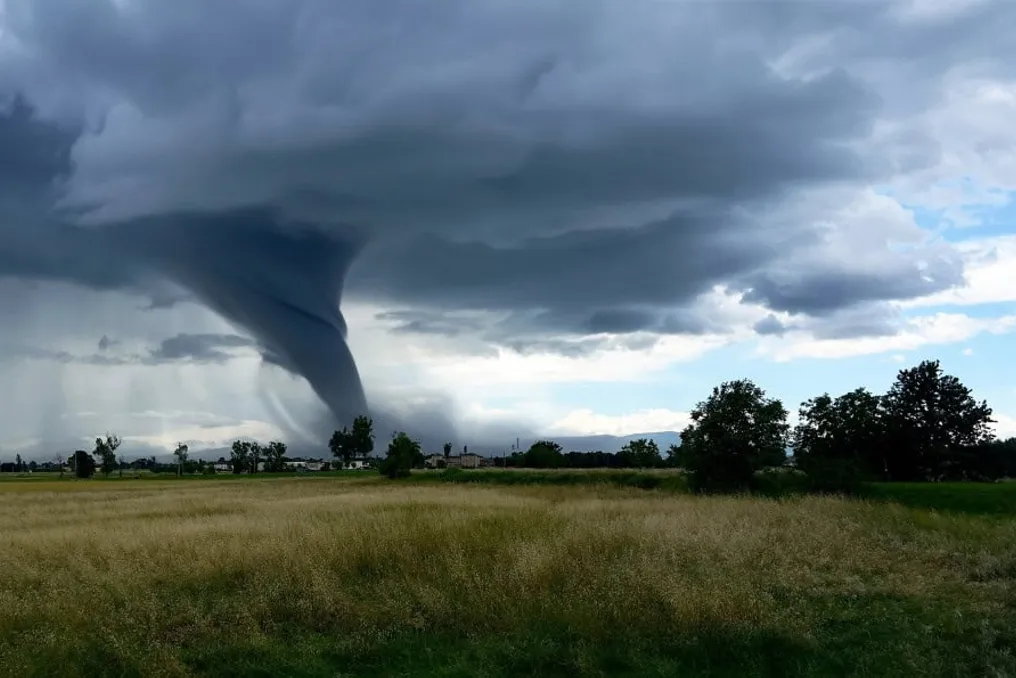
In Rio Grande do Sul, a tornado hit the municipalities of Giruá, Sete de Setembro, and Senador Salgado Filho on Tuesday night (28). Civil Defense explained that the phenomenon was generated by a supercell, a type of storm with a rotating updraft, which becomes a tornado upon touching the ground.
Seven people were injured, one of whom required surgery and remained hospitalized without risk to life. In Senador Salgado Filho, one residence was completely destroyed, 15 others suffered damage, and three residents were displaced. In Sete de Setembro, two houses were destroyed and 15 more were damaged. In Giruá, three properties sustained damage.
Impacts in Paraná
Paraná also felt the effects of the same meteorological system, which generated winds exceeding 80 km/h, causing roof damage and fallen trees, and leaving over 108,000 properties without power. In Curitiba, a man was injured after being hit by a gate knocked down by the force of the wind.