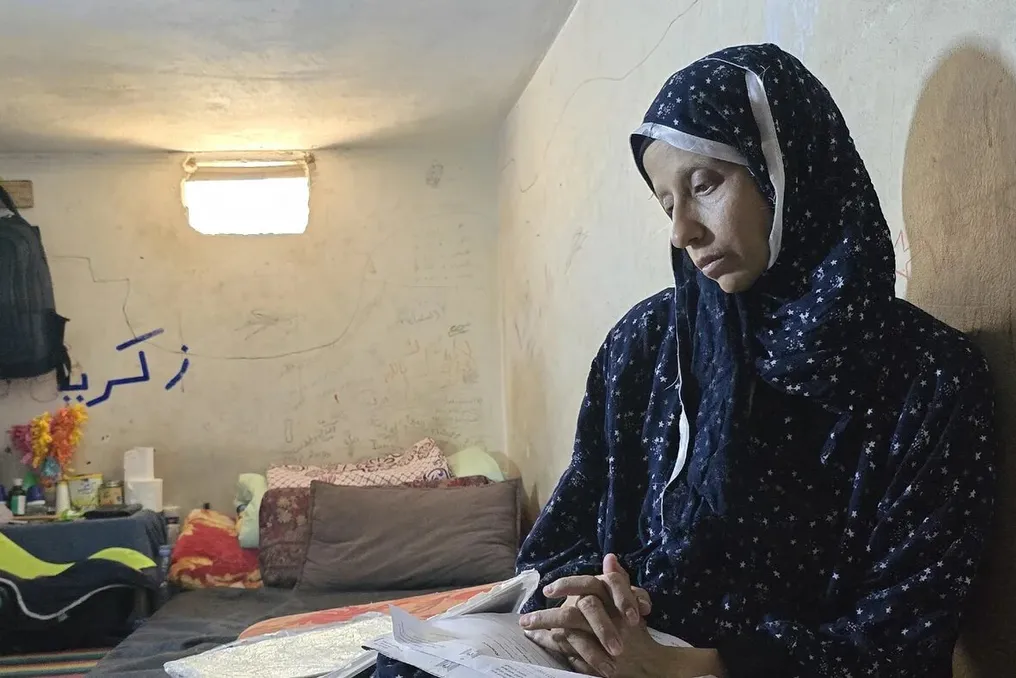
Professor Holoud Abu Sahmad from southern Gaza is slowly fading while battling cancer, residing in a cramped shelter under a school staircase. After fifteen courses of chemotherapy, she was informed that further treatment is impossible because the medications available in the war-affected enclave are not suitable for her type of cancer.
Popular
Diagnosis and Deterioration
The 33-year-old Palestinian mother of two told Middle East Eye that she was diagnosed with liver cancer approximately nine months ago, immediately after giving birth to her daughter. Despite several rounds of chemotherapy, her condition only worsened. According to Abu Sahmad, the doctor stated that the treatment was ineffective for her body and condition, and chemotherapy only caused hair and nail loss.
Limitations of Medical Supplies
Nearly ten months after the ceasefire agreement in October 2025, Israeli authorities continue to restrict the import of vital medicines and medical supplies into Gaza, including anti-cancer drugs, chemotherapy agents, antibiotics, anesthetics, laboratory consumables, diagnostic equipment, and surgical supplies. According to UN agencies and international organizations, by March, stocks of essential medicines had decreased by approximately 46 percent, and medical consumables by 66 percent.
Cancer Treatment Crisis
This month, the Ministry of Health in Palestine in Gaza announced that the treatment for several types of cancer, including breast, colorectal, and gastrointestinal cancer, head and neck tumors, as well as sarcomas, has practically stopped due to critically low levels of specialized oncological drugs. The Ministry reported that out of nearly 11,000 cancer patients in Gaza, at least 4,000 have received medical referrals but are still awaiting permission to leave the Strip for treatment.
Dr. Mohammed Abu Nada, director of the Gaza Cancer Center, told MEE that due to acute shortages, even expired medications had to be used, and these supplies have also run out. He emphasized that this clearly increases the mortality rate. Abu Nada noted that Gaza is facing the worst shortage of chemotherapy drugs in recent years, and the existing drugs for breast cancer barely suffice for current patients, leaving new patients without treatment.
Alternative Treatment Methods
Instead of following standard treatment protocols, doctors are increasingly resorting to monotherapy, which, according to Abu Nada, reduces therapy effectiveness, worsens outcomes, and can lead to additional complications. Furthermore, there is a shortage of immunotherapy drugs, which increases risks for patients.
Awaiting Medical Evacuation
Abu Sahmad's medical referral was approved shortly after her diagnosis because the necessary treatment is unavailable in Gaza, yet after nine months, she is still waiting to leave. She told MEE that doctors indicated the availability of necessary treatment in Jordan or Turkey, and her condition cannot be improved there. She has been awaiting urgent medical evacuation for nine months.
Medical referrals allow patients from Gaza to receive specialized treatment unavailable within the Strip, with routes leading to hospitals in the occupied West Bank, East Jerusalem, Egypt, and Jordan. Although referrals are usually processed and funded by the Palestinian Authority Ministry of Health, patients still require exit permits through checkpoints controlled by Israel or Egypt. Since the genocide in Gaza began in October 2023, Israel has significantly restricted medical referrals and evacuations from the Strip, preventing thousands of seriously ill and wounded Palestinians from receiving necessary care.
Border Situation and Personal Suffering
Four months after the October ceasefire agreement, Israel partially restored the Rafah crossing with Egypt for medical evacuation under a strictly controlled mechanism, allowing about 50 patients to leave daily subject to Israeli approval. According to the Palestinian Ministry of Health, over 20,000 people in Gaza, including about 4,000 children, are awaiting urgent medical evacuation. Since Rafah resumed operations in February, only 1,655 patients have been evacuated as of June 30, and since October 2023, more than 1,570 people have died while waiting for exit permission.
Abu Sahmad shared that her health deteriorates every day due to endless waiting. She suffers from shortness of breath and abdominal bloating due to fluid retention, and her weight has dropped abnormally—she has lost about 20 kg. Due to fluid accumulation in her abdomen, there are long periods when she cannot eat, and food causes fluid retention. The mother of a five-year-old boy and a nine-month-old girl recounted that since childbirth, she has been unable to hold her younger daughter. Due to her illness, she has become bedridden and never gets up, unable to exert the slightest effort. She added that even short walks cause extreme fatigue, and she is slowly dying.
Life in Displacement
Many patients awaiting evacuation are seeing their condition worsen because Israeli attacks have undermined Gaza's healthcare system and forced them to move repeatedly into overcrowded shelters with limited access to clean water and sanitation. Abu Sahmad reported that her home was destroyed since the start of the genocide, and she has been forcibly displaced about 30 times. Recently, she was forced to move to a tent in Mawasi al-Karara, west of Khan Younis. Shortly after moving, her health began to decline, and she sought help from her older sister, who lives under the staircase of Ahmed bin Abdul Aziz School, because the conditions in the tent were extremely unhealthy.
Currently, two families, totaling about 10 people, live together. Abu Sahmad described the environment as completely unsuitable for someone in her condition. Next to her mattress is a box of medicine carefully protected from rats, and next to it is a bag containing almost 50 academic certificates earned over the years. Before cancer changed her life, family and friends knew her as a 'book lover.' After graduating with a Master's degree from the Islamic University of Gaza, she became the first student in the university's history to complete a two-year master's program in just one year and four months. She then began doctoral studies and became an assistant professor at the same university, specializing in teaching methods and curricula. She always loved learning and dreamed of becoming a professor. However, illness has deprived her of all these aspirations, and the hardest part is the seemingly endless wait for treatment.