Researchers studying 21 tracks left by ancient hominins in the Kenyan area of Koobi Fora have determined that these footprints were made by Paranthropus boisei. These hominins inhabited the region at the same time as bipedal humans.
Unexpected characteristics of the individuals
According to scientists' calculations, the size and weight of these massive Australopithecines from Koobi Fora significantly exceeded the indicators determined based on the bones of representatives of this species. The research results were presented in the journal Proceedings of the National Academy of Sciences.
Context of ancient hominin findings
Recently, there has been a growing number of studies dedicated to the footprints of ancient hominins, which are sometimes preserved for millions of years. The most famous similar finds are associated with Tanzania, where numerous foot and paw prints belonging to presumed ancestors of Homo—Afar Australopithecus (Australopithecus afarensis) and other hominins who walked through volcanic ash about 3.66 million years ago—were discovered in Laetoli back in the 1970s.
Analysis of the Laetoli tracks showed that Afar Australopithecines, including Lucy, were already confidently walking upright. A more recent discovery concerned findings specifically from the Kenyan formation of Koobi Fora. In 2024, an article was published reporting the presence of tracks of both bipedal humans (H. erectus) and Paranthropus boisei in one area, which presumably coexisted in East Africa about 1.5 million years ago, traversing the same territory within an interval of only a few hours or days.
Details of excavations in Koobi Fora
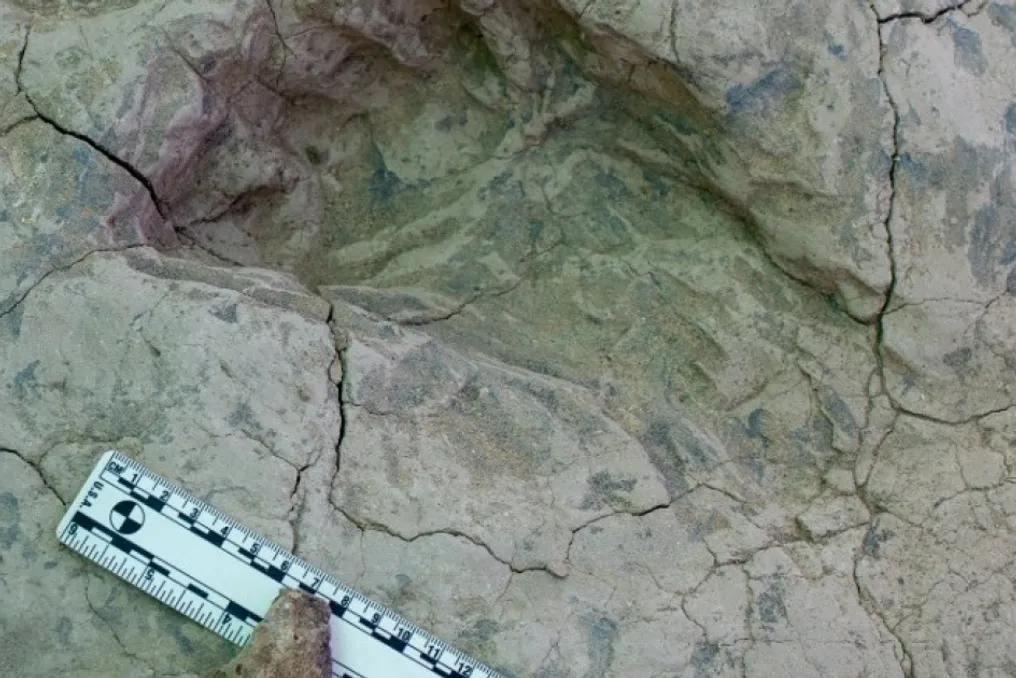
Kevin Hatale from Chatham University and the Max Planck Institute for Evolutionary Anthropology, together with colleagues from Kenya and the USA, shared data on further investigations in the Koobi Fora formation, but in another location—GaJi10. Initial small excavations were conducted in this section in 1978–1979, resulting in the discovery of seven ancient hominin tracks and 82 paw prints of other animals, including birds and large horned animals, as well as hippos. Additional excavations carried out in 2016 and 2023 allowed for the discovery of another 14 hominin tracks and numerous prints of other creatures.
According to the authors, two of the seven hominin tracks recorded in the 1970s were damaged, but they were carefully documented with photographs and casts. Ultimately, scientists analyzed all 21 tracks and concluded that they likely belonged to eight different individuals. The characteristics of the prints indicate that they are probably the tracks of Paranthropus boisei, who lived in this area approximately 1.43 million years ago.
Conclusions on social behavior
A deeper analysis of the tracks led to unexpected conclusions. If these tracks truly belonged to Paranthropus, calculations showed that several large individuals, presumably males, moved slowly along the bank of an ancient lake at a speed of about one to two kilometers per hour. This suggests a social structure for these hominins, implying peaceful coexistence of males in one group.
The most striking finding was the comparison of the estimated height and body mass of these individuals with data obtained from bones. The authors refer to 2017 statistics, according to which the average height of known Paranthropus boisei at that time was 131.1 centimeters (ranging from 116 to 161.3 centimeters). However, estimates made from the Koobi Fora tracks ranged from 130.6 to 180.9 centimeters, with four individuals exceeding 161.3 centimeters. The average body mass of Paranthropus in the 2017 study was estimated at 36.6–52.5 kilograms (depending on the methodology). For the individuals from Koobi Fora, however, scientists calculated a weight between 39.8 and 74.6 kilograms, with six out of seven individuals exceeding 52.5 kilograms.
Alternative hypotheses
Despite the scientists' inclination to believe that Paranthropus boisei left the tracks 1.43 million years ago in Kenya, other versions were considered. The first hypothesis suggests that the tracks could belong to bipedal humans, which would imply variability in foot structure among members of the genus Homo, about which researchers currently have no data. The second alternative version is that another unknown paleoanthropological and archaeological species of ancient hominins existed in East Africa during that period, although this idea is considered least likely due to the well-studied nature of the region.
Comparison with other finds
Other species of Paranthropus were also found in Southern Africa. Recently, a small representative of this genus was reported, whose bones were found in Swartkrans. This individual, P. robustus, lived between 2.3 and 1.7 million years ago, and its height apparently barely exceeded a meter, while its body mass was about 27 kilograms.