Researchers from Austria, Canada, and Switzerland reported a clinical case where a man needing a kidney transplant successfully underwent the procedure despite having antibodies against all available donors. This operation was made possible by pretreatment with bispecific monoclonal antibodies, which are used for multiple myeloma therapy. The details of this case were published in The New England Journal of Medicine.
Sensitization to human leukocyte antigens (HLA), the major histocompatibility complex, is the process of forming and circulating antibodies against any tissue from another person. This condition can arise after pregnancy, blood transfusion, or organ transplantation itself and creates a serious, sometimes insurmountable obstacle to transplanting any solid organ, even when using desensitization methods and careful donor matching. Existing treatment methods do not always yield stable and effective results.
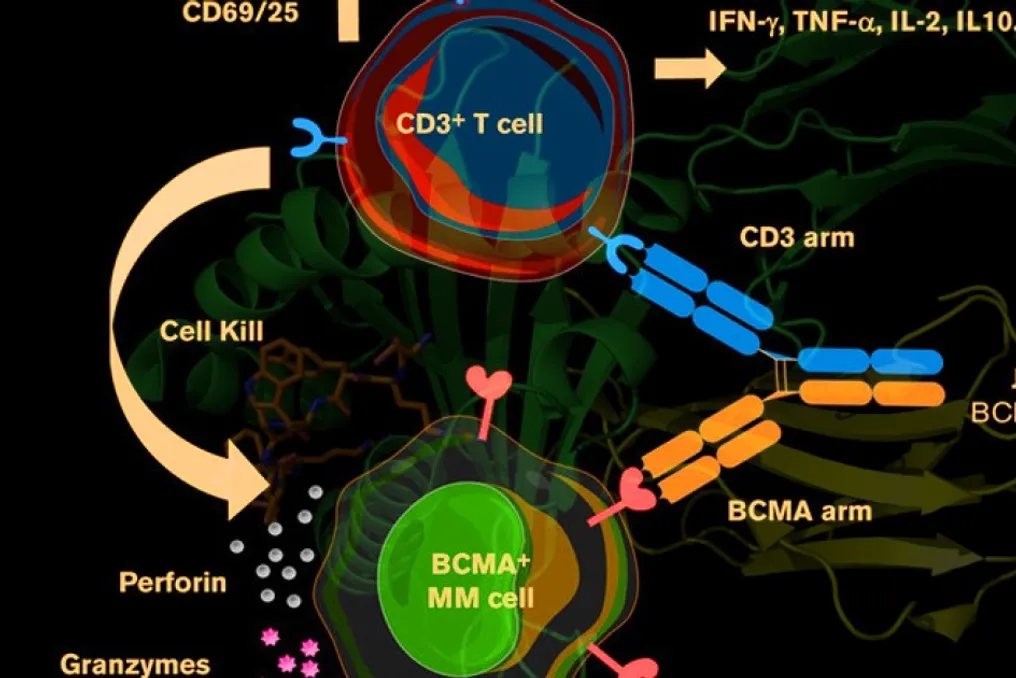
The drug Tecilizumab belongs to the class of bispecific monoclonal antibodies. It functions by recruiting T-lymphocytes. These antibodies are capable of simultaneously binding to the CD3 T-cell receptor and the B-cell maturation antigen (BCMA), thereby prompting T-cells to attack mature B-cells and plasma cells responsible for antibody production.
Martina Schatzl from the University of Vienna and her colleagues presented the story of a 37-year-old man who suffered from end-stage renal failure and was on hemodialysis. He had already undergone two unsuccessful kidney transplant attempts and suffered from HLA sensitization, awaiting the next transplant for 12.5 years. His panel reactive antibody (PRA) level reached 100 percent, and the proportion of donors compatible with the AB0 system was zero percent, making finding a suitable donor theoretically impossible. The researchers decided to use Tecilizumab to prepare the patient for the third operation.
The patient received Tecilizumab for 31 weeks. The treatment led to a significant reduction in HLA antibodies and rapid depletion of naive and transitional B-cells, as well as memory B-cells, plasmablasts, and plasma cells in both blood and bone marrow. This depletion process was accompanied by hypogammaglobulinemia, which was compensated for by intravenous immunoglobulin administration. A decrease in AB0 reactivity and a reduction in xenoreactive antibodies to galactose-α-1,3-galactose (alpha-gal) were noted. As a result, the frequency of compatible donors increased to 1.35 percent. Soon a donor kidney was found for the man, but the surgery was postponed for technical reasons. A month later, the patient was involved in an accident on an electric scooter, which required stopping the Tecilizumab course.
Four months after the accident, another suitable organ was found and successfully transplanted. Vascular inflammation developed in the new organ, but it was not accompanied by donor-specific antibodies or complement activation product C4d. The inflammation was related to molecular markers and a slightly increased amount of non-cellular donor DNA (66 copies per milliliter of blood), and it was managed with daratumumab therapy targeting anti-CD38. Tecilizumab treatment caused a mild cytokine release syndrome, transient cytomegalovirus and BK virus viremia, mild urinary tract infections, and an increase in torque tenovirus (TTV) levels, indicating weakened overall immunity.
The presented case demonstrates the high efficacy of BCMA-targeted HLA desensitization for organ transplantation preparation. However, sustained destruction of B-lymphocytes and plasma cells can lead to decreased immunity, prolonged dependence on intravenous immunoglobulin, and slowed immune system recovery. These issues may be exacerbated when combining this therapy with desensitization targeting the D-cell antigen CD20. Further research is needed to determine maximum benefit, as well as to clarify optimal dosages and monitoring methods for safety.
Previously, German scientists published information on the successful experimental application of Tecilizumab for two patients with severe chronic autoimmune polyneuropathy. These patients showed disappearance of autoantibodies, reduced nerve tissue damage, and significant improvement in motor function.
A 45-year-old man was admitted to the hospital with complaints of progressive pain and swelling in his right shoulder, which had persisted for two months. The man, who worked on a construction site, had experienced intermittent pain in his right shoulder joint for a long time. Examination revealed swelling of the right shoulder and restricted mobility in that joint. Radiological examination showed complete destruction of the head and an unattached diaphysis of the right humerus. MRI revealed destructive arthropathy of the shoulder joint with the presence of voluminous effusion and freely floating calcified fragments, as well as tendon ruptures throughout the thickness of the supraspinatus, subscapularis, and infraspinatus tendons. John Waller from the Johns Hopkins School of Medicine and Ayşe Yülger from Hacettepe University in Ankara shared this information in The New England Journal of Medicine.