The city of Dongguan, previously known as a major center for low-cost assembly manufacturing in China, is transforming into a global hub for intelligent production thanks to the boom in artificial intelligence hardware. In 2025, Dongguan produced half of the world's smart glasses volume, supplying 870 million units globally, with over 400 million manufactured in Dongguan factories, representing a 322% increase compared to the previous year.
Dominance and Development Plans
Meta holds a dominant position in the global market, controlling 85.2% of the market, with its main OEM factories located precisely in Dongguan. This large-scale transformation is enshrined in the Global Intelligent Manufacturing Center plan, approved in May 2026, where AI-based production is defined as a priority among six key initiatives.
Currently, the city operates 24,000 industrial enterprises, over 10,000 high-tech firms, and 195 million market entities. Industrial output reached 2.6 trillion yuan in 2025, ranking second in Guangdong province.
Ecosystem and Supply Chains
The AI hardware ecosystem benefits from an exceptional supply chain density. Within the city area of 2,460 square kilometers, 90% of key components for smart glasses can be found within a one-hour radius. A single supply chain concentrates optics from Depute and Gaowei, acoustics from Goertek and Jiahe, structural elements from Changying and Lens, storage from Biwin, and batteries from New Energy Technology.
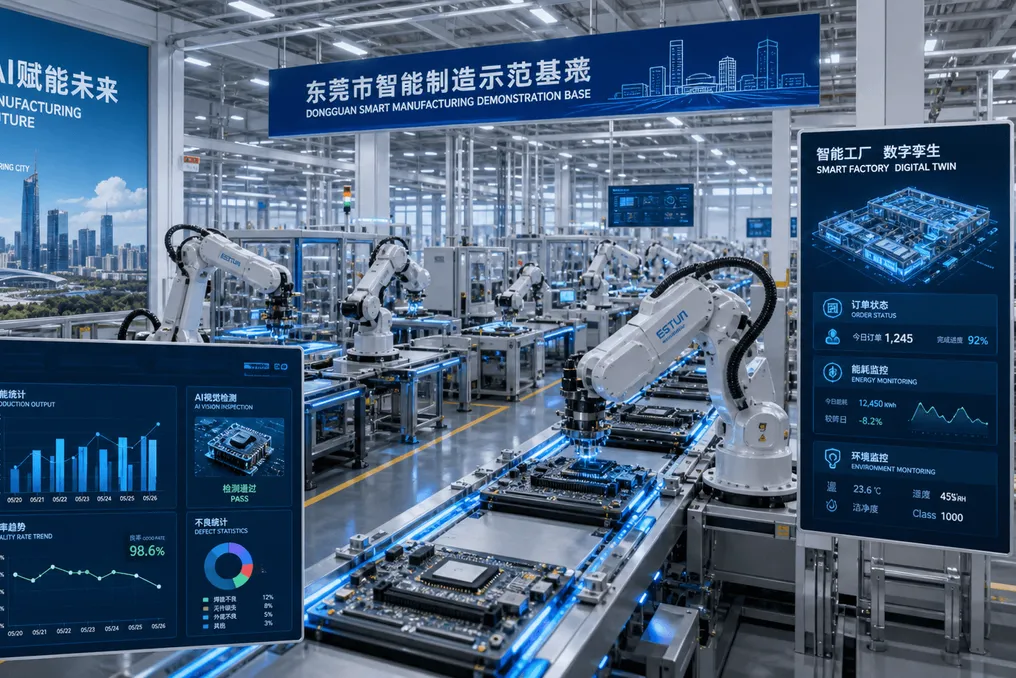
The OPPO factory in Dongguan Bei achieves 98% automation on assembly lines, which is one of the highest rates in Chinese smartphone manufacturing, where material transportation and assembly are performed using robotic manipulators and AGVs.
Innovation and Business Support
The National AI Pilot Base, the only national base for consumer AI mobile terminals, provides chip adaptation, HarmonyOS integration, and AI model testing services for small and medium-sized enterprises that cannot afford their own verification production lines, thereby eliminating a critical bottleneck for over 30,000 firms involved in intelligent equipment in the city.
Companies such as Slike have undergone significant changes: they transformed from a USB flash drive workshop established in 2005 into an AI smart glasses manufacturer, supplying over 100 million units annually as an exclusive supplier for MINISO AI translation glasses and an ODM provider for Lenovo and Coolpad.
Huayan New Materials, the world's largest producer of AI smart glasses hinges, supplies 60% of Meta's hinge orders, and its production capacity for 2025 corresponds to 7 million pairs. Siqian New Materials produces ultra-thin synthetic graphite film for heat dissipation with a thickness of 0.05 mm.
Computing Industry Development
In 2025, the city launched China's first urban center for large-scale production models, adding over 10,000 petabytes of available intelligent computing power. Furthermore, a computing industrial island is under construction on Shazhou Nichou Island with investments of 100 billion yuan over five years, aimed at achieving a server industry volume of 500 billion yuan by 2030. Dongguan already produces nearly 60 million servers annually, accounting for one-tenth of China's servers, with 95% of components sourced locally. The city has also implemented the first XR policy specific to prefectural cities in China, offering one-time grants of up to 60 million yuan for relevant OEM enterprises.