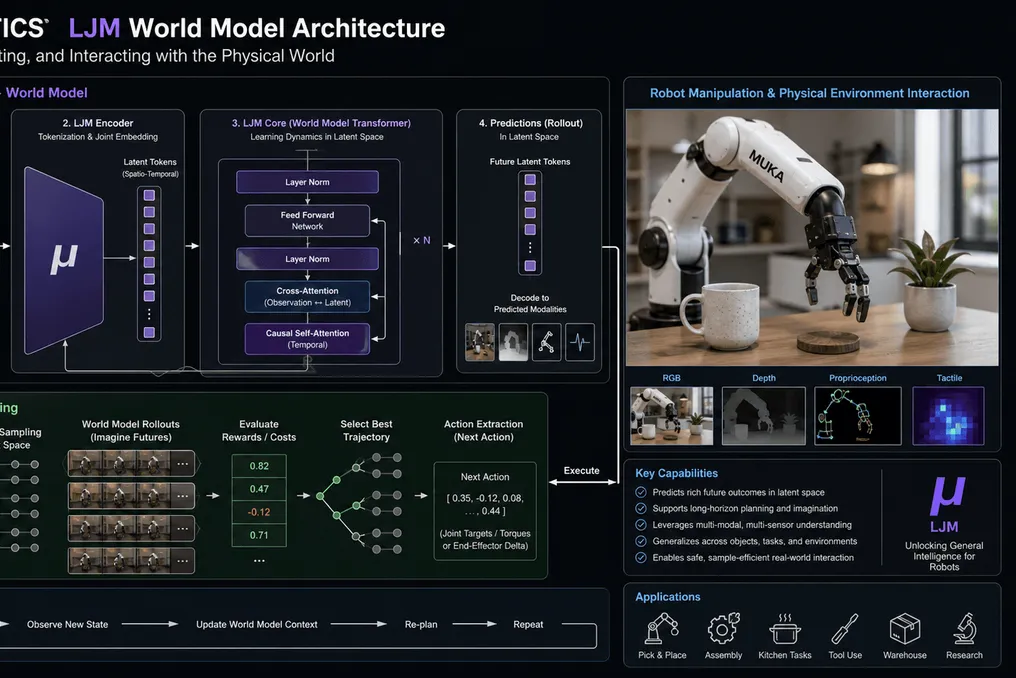
Muka Robotics, a startup founded just four months ago, achieved second place in the global WorldArena ranking with its LJM Latent Joint-conditional Model. This model demonstrated a movement quality of 89.17 while utilizing only 32 Zhenwu 810E GPUs.
Muka Robotics, a startup founded just four months ago, achieved second place in the global WorldArena ranking with its LJM Latent Joint-conditional Model. This model demonstrated a movement quality of 89.17 while utilizing only 32 Zhenwu 810E GPUs.
The LJM model received high scores across various metrics on the LIBERO benchmark, scoring 92.60 for 3D Accuracy and 85.93 for Controllability. These results allowed it to surpass competitors that used 10 to 100 times more computational power. The model was presented anonymously under the name SisyphusWorld.
LJM solves a fundamental problem where pixel-level optimization negatively impacts physical understanding. Standard diffusion models tend to prioritize pixel texture (99%), ignoring critically important moments of contact between the gripper and the object (1%). LJM introduces a two-expert architecture that separates the reasoning process from the rendering process.
The reasoning expert, based on Qwen3-VL-2B, operates in a continuous latent space. It simulates interactions based on language instructions, visual history, and planned action sequences. Concurrently, the world modeling expert, using Wan2.2-TI2V-5B, translates this meaningful interaction into realistic video frames. The key difference is that the reasoning expert must first understand what will happen when the gripper closes and the object moves, and then the rendering expert visualizes this understood interaction, thereby refuting the standard 'generate first, then understand' approach.
The LJM architecture imposes three physical constraints on every latent token. Each reasoning token must simultaneously predict three future parameters: the end-effector position in three-dimensional space (robot state), changes in the visual state of scene objects (visual dynamics), and the direction of movement at the pixel level (pre-calculated optical flow). These constraints are derived directly from real training data and prevent the models from generating physically impossible results while maintaining high visual quality.
The two experts exchange information through a Mixture-of-Transformers attention mechanism, where reasoning and video tokens interact at every Transformer layer. This ensures a bidirectional flow of information throughout the generation process, replacing a sequential pipeline where reasoning outputs a result passed to rendering only once. Thus, visual generation is constantly constrained by physical reasoning.
LJM demonstrates that the ability to model the world depends on correct architecture, not massive computational power. Architectural innovations compensate for the limitations of Chinese computing resources. Previous methods attempted to teach physics to video models, which is structurally impossible. By providing physics with its own expert with clear objectives, LJM achieves high physical accuracy and visual quality without needing to compromise.
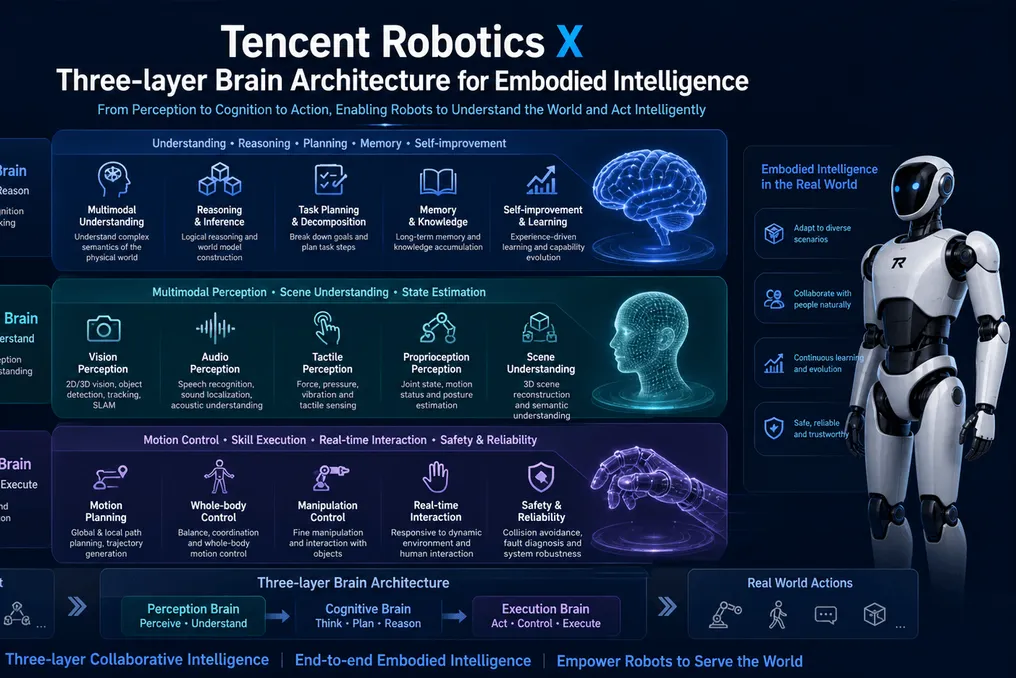
Tencent Robotics introduced three embodied fundamental models during the WAIC 2026 event. These models include a VLM for scene understanding, the cognitive model RxBrain for planning considering visual states, and VLA for continuous actions at a frequency of 500–1000 Hz.
Chief Scientist Dr. Zhang Zhengyou presented this architecture as a solution to a fundamental problem that current VLA approaches do not adequately address. He noted that different types of robotic intelligence must operate at different frequencies because the physical world itself operates across multiple timescales.
Understanding this issue arose after a failed experiment transferring robot capabilities to OpenClaw, which caused a delay of tens of seconds—unacceptable for physical robots where even a cognitive delay of 2–3 seconds is problematic.
The three-layer architecture solves this problem by separating frequencies. The Hy-Embodied-VLM model is responsible for spatial understanding at a lower frequency, interpreting visual scenes and object relationships. Hy-Embodied-RxBrain represents a significant innovation in cognitive architecture: it not only generates task steps in language but also visualizes how the physical world should look after each subtask is completed, using visual state representations instead of textual descriptions.
This eliminates the main limitation of language-only planning systems, as textual descriptions cannot effectively convey spatial relationships and physical constraints that can be instantly communicated through vision. The Hy-Embodied-VLA model operates at the highest frequency, translating high-level goals into continuous low-level action commands at a speed sufficient for real-time interaction with the physical world.
Tencent reported that Hy-Embodied-VLA underwent production testing at a chemical plant. The model handles highly mixed, low-batch, SKU-intensive assembly lines, achieving a cycle time of less than 6 seconds per part. Furthermore, the model can adapt to new SKUs in just 8 hours of data collection and fine-tuning.
The testing conditions differ significantly from laboratory demonstrations: objects are placed randomly, lighting changes, production interruptions occur, and the robot must achieve an almost zero failure rate. Dr. Zhang emphasized that a demonstration scoring 80–90 points without actual deployment holds little value, and factory testing reflects a commitment to measurable industrial performance rather than benchmarking metrics.
The RxBrain cognitive model addresses a second complex challenge—the linguistic bottleneck in robotic reasoning. Previous Tairos systems relied on text for inter-brain communication, but describing object spatial relationships in words can be verbose and ambiguous. By incorporating a visual state representation into the planning loop, RxBrain ensures higher information throughput between perception and action.
The model is described as an embodied cognitive world model, not a complete world model, as a consensus architecture for a unified world model has not yet been reached in this field. Together, the three models and the Tairos platform form Tencent's complete embodied intelligence stack, available for any developer or manufacturer to use. Thus, the robotics community can now build upon the same frequency-sensitive architecture developed by Tencent through real failures and iterative refinement.