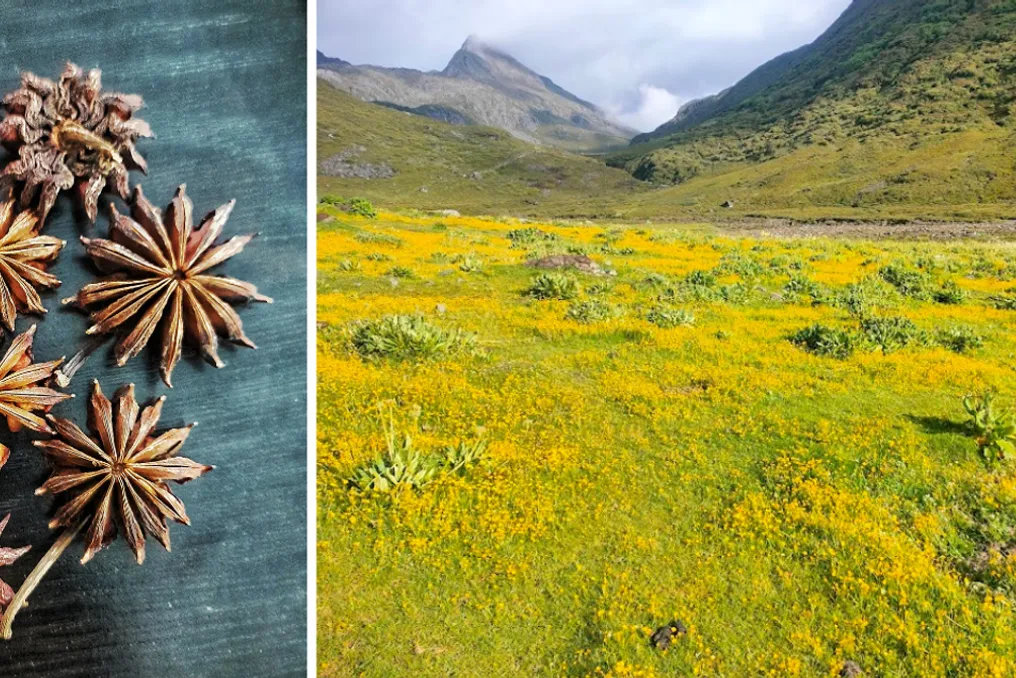
In the autumn mornings in the West Kameng region of Arunachal Pradesh, families head into the forest using woven bamboo baskets. Their target is not timber or firewood, but a prickly shrub that has shaped local cuisine, medicine, and trade for generations.
The Value of Wild Spice
This shrub, known by local names such as Khagi, Erma, Shyein, or Yarma depending on the tribe and region, is the wild Himalayan spice Zanthoxylum. Its tiny fruits release a sharp citrus aroma followed by a tingling numbness on the tongue. Before the spice became known to buyers outside the mountains, it was used in tribal home dishes, adding flavor to meat curries, chutneys, and millet dishes. The bark, fruits, and seeds were also used in traditional healing methods.
Conserving Forests Through Economy
Today, this same spice contributes to the conservation of over 100 square kilometers of community-owned forests. This transition did not happen overnight. Over the past few years, WWF India has been collaborating with indigenous communities and traditional village institutions to strengthen Community Conservation Areas (CCAs) across Arunachal Pradesh.
Community Conservation Areas are natural ecosystems, such as forests, wetlands, and grasslands, that are voluntarily protected and managed by indigenous and local communities. Their care helps preserve habitat, wildlife, and biodiversity while supporting local livelihoods.
A Case Study in Mandala Pudung Khellong
One of the most striking examples is the Mandala Pudung Khellong Community Conservation Area (CCA) in the West Kameng district. Here, residents linked the future of their forests to the future of Khagi. By creating a community-managed system for sustainable harvesting, collection, and sale of the spice, they transformed a local forest species into a source of income that encourages conservation rather than resource extraction.
Today, every kilogram of sold Khagi goes towards funding forest patrols, biodiversity monitoring, and community welfare, providing people with a direct economic incentive to conserve thousands of hectares of forest.
Forests Belonging to the People
Arunachal Pradesh differs from most Indian states in terms of forest cover: nearly 80% of its territory is covered by forests, more than 60% of which are classified as Unclassified State Forests, effectively under the care of indigenous communities and traditional institutions. The state is also one of India's richest biodiversity landscapes, home to two global biodiversity hotspots, over a quarter of India's plant species, the country's highest mammalian species base, and more than 1600 high-altitude lakes.
This community ownership makes local decisions particularly significant. Zanthoxylum, known locally as Khagei or Zabrang, is an integral spice in the Monpa region of West Arunachal Pradesh and is used in the local diet as chutney and marinade.
The History of Spice Trade
Khagi did not emerge from a conservation project; the shrub has always grown naturally in abandoned agricultural fields and adjacent forests around the Mandala. For generations, families collected enough for their kitchens and sold the surplus in nearby markets. The history of this plant runs even deeper: communities in Kalaktang and Dirang once supplied the aromatic spice as tribute to Tsong Dzong and the Tawang monastery. From there, it traveled through mountain passes like Bumla to Tibet, becoming part of ancient Himalayan trade routes.
Despite its cultural and commercial significance, the trade remained fragmented. Families collected individually, and traders from Tezpur, Guwahati, and other places bought the produce directly from villages, often offering varying prices. Commercial demand was only for the outer shell; seeds were usually discarded as there was no market for them. As a result, families had limited bargaining power, little added value, and no collective investment in the forests where the spice grew naturally.
Transforming Collection into Conservation
Changes began in 2019. With support from WWF India within the Community Conservation Area framework, residents organized for the collective harvesting, collection, and sale of Khagi. This initiative also established direct market links with companies like Dabur India, allowing communities to sell both the shells and the seeds instead of considering part of the harvest as waste.
The change went far beyond marketing. Every August, when the harvest season begins, families go into the forests to manually collect ripe Khagi fruits from shrubs growing on abandoned cultivated lands and adjacent forest patches. At home, the fruits are spread out in the sun for several days to dry, after which they are sorted and sold. However, not all the harvest reaches the market; many families keep some for personal use, where Khagi has long been a staple ingredient. It is ground into chutney with tomatoes, local onions, fermented soy beans, chhurpi, and chili, lending a signature citrus spiciness to rice, smoked meat, and seasonal vegetables. Today, this familiar seasonal ritual also supports the protection of the forests that have sustained these communities for generations.
Over the last two harvest seasons, between 2024 and 2026, communities have sold over 10 metric tons of Zanthoxylum, benefiting more than 200 households and generating a turnover of about 39 lakh rupees. Approximately 6 lakh rupees was contributed to the Community Conservation Area Management Fund. This is a cycle designed by the community itself.
Furpu, a member of the Mandala Pudung Khellong CCA Management Committee, notes: 'Our partnership with companies has played a significant role by providing a reliable market for Khagi right at our doorstep. Previously, traders from Assam and other parts of the state offered different prices. Now, community members can sell their harvest within the village at a fair and uniform price through one transparent transaction.'
Additional Income Sources
However, benefits vary from one household to another. Families in Mandala Pudung Khellong do not rely solely on Khagi; most also grow kiwi, tomatoes, cabbage, beans, and other seasonal crops, making the spice just part of a broader livelihood source. According to community members who spoke with The Better India, households primarily relying on agriculture earn about 5,000–10,000 rupees from Khagi during the harvest season, while their annual farming income typically ranges from 20,000 to 30,000 rupees, depending on the scale of cultivation. For families collecting larger volumes, the income is higher. The additional income helps cover household expenses and purchase seeds and agricultural resources for the next season. Instead of replacing agriculture, Khagi has become an important supplementary income source—one that also gives communities a direct stake in maintaining the health of their forests.
Village-Created Rules
Income alone is not enough for forest conservation. Alongside the new value chain, the community developed a management plan to protect biodiversity. Working with the traditional Mangma institution and Panchayati Raj Institutions, the CCA Management Committee established rules restricting hunting, regulating resource use, and prohibiting commercial extraction unless sustainable management practices were approved.
Funds generated from Khagi marketing, along with technical and financial support from WWF India and the Forest Department, now support regular forest patrols and biodiversity monitoring. For the village elders, transparency was as important as income. Pem Choidjang, Gaonburah (traditional village elder) of Mandala Pudung, says: 'For years, each family sold Khagi independently, and we never knew what price others were getting or where the product ultimately ended up. Different traders offered different prices, so there was little transparency and very little bargaining power. I have seen how everything has changed over the years. Now we can collectively sell Khagi at a single price through a transparent process agreed upon by Mangma and the CCA Management Committee. The income does not stop at individual households. It also supports forest protection, biodiversity monitoring, and village welfare. This has changed people's view of our forests. They are no longer just places where we gather resources—they are something we all have a responsibility to protect.'
The Value of Intact Forest
The Mandala Pudung Khellong Community Conservation Area borders the Saktenge Wildlife Sanctuary in Bhutan, creating an important transboundary conservation landscape. Its forests serve as habitat and migration corridors for species such as the cloud leopard, Asiatic golden cat, marbled cat, Himalayan black bear, red panda, large Indian civet, Arunachal macaque, capuchin langur, goral, and Himalayan grey sheep. Pheasants have also been recorded in the landscape.
The forests are equally important to people. Medicinally and economically valuable plants such as Swertia chirayita, Illicium griffithii, Rubia cordifolia, Paris polyphylla, and Zanthoxylum continue to support traditional healthcare systems and local livelihoods. WWF India is working to study the potential of Non-Timber Forest Products (NTFPs) collected in the MPKCCA, Mandala Pudung Khellong CCA, and establish market linkages. Six main NTFPs have been identified as species and collected for commercial purposes.
Although formal impact studies are still underway, communities report more frequent sightings of wildlife, including red pandas, as well as visible forest regeneration. Equally important is that the livelihoods linked to conservation have strengthened local governance. Income from sustainable harvesting is now reinvested in patrolling, biodiversity monitoring, and the implementation of community rules. Instead of viewing forests merely as land that can be converted, communities increasingly see intact ecosystems as assets that continue to generate livelihoods year after year.
An Alternative Conservation Story
For decades, conservation was often presented as a choice between protecting forests and supporting local livelihoods. Mandala Pudung Khellong tells a completely different story. The community did not introduce an exotic culture or replace forests with plantations. Instead, it built an economy around a species that already belonged to the landscape and had long been part of the local culture. This decision transformed Khagi from a household spice into a reason to keep the forests standing.