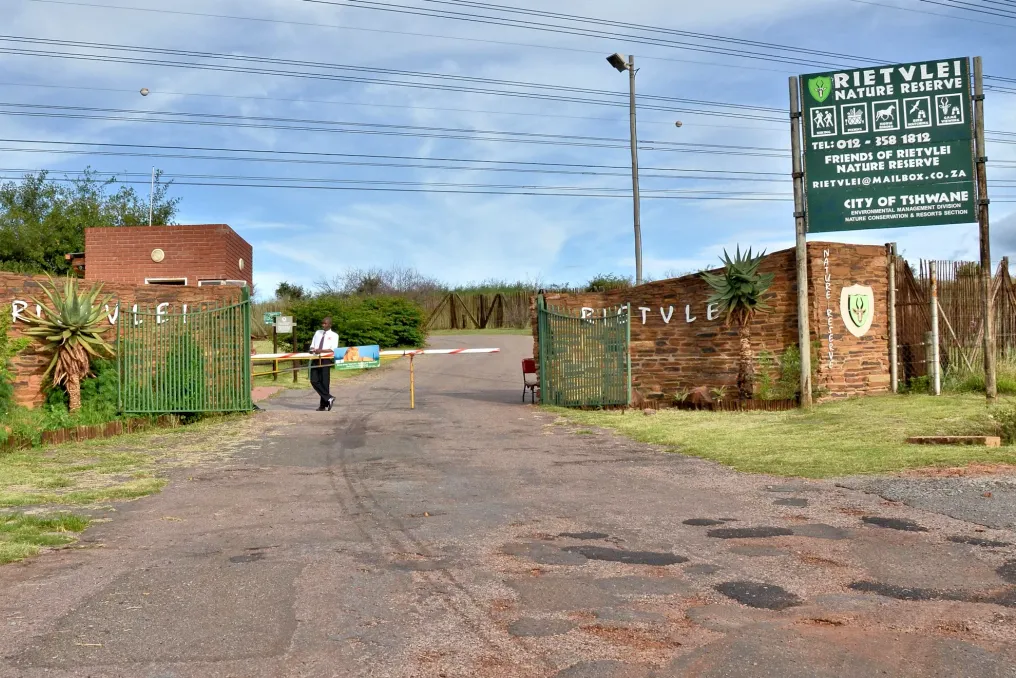
Visitors planning a trip to the Rietvlei Nature Reserve in Gauteng should know that the popular picnic area near the Marey's Dam has been closed due to alarmingly high levels of water contamination.
Visitors planning a trip to the Rietvlei Nature Reserve in Gauteng should know that the popular picnic area near the Marey's Dam has been closed due to alarmingly high levels of water contamination.
According to research conducted by the publication Rekord, recent investigations revealed persistently high concentrations of phosphorus in the reserve's waterways, raising concerns about the long-term condition of one of Gauteng's leading conservation areas.
In a June report, water resource specialist Dr. Michael van der Laan established that all sampling points inside and around the reserve exceeded the limits set by South African law for phosphorus discharge into waterways. The study also showed that contamination was present even before the Riet River entered the reserve and worsened as it flowed downstream.
The highest concentration of phosphorus was recorded at Marey's Dam, where the level reached 5.1 mg/L—approximately five times the legal discharge limit and about twenty times higher than the concentration associated with severe algal blooms. Van der Laan noted that similar high readings were registered in October 2025, indicating that the pollution is part of an ongoing problem, not an isolated incident.
Although phosphorus levels decreased during the summer rainy season, he suggested this was likely due to dilution from increased water runoff rather than an improvement in water quality. The report warns that constant nutrient pollution can trigger harmful algal blooms, reduce oxygen levels, and damage aquatic ecosystems.
Members of BirdLife South Africa also reported a decline in bird populations and reduced species diversity within the reserve. The environmental group Friends of Rietvlei demanded urgent action to prevent nutrient-rich pollutants from entering the Riet River before further ecological damage occurs.
The pollution has also negatively affected the visitor experience. In Van der Laan's report, Marey's Dam was identified as the most affected area, where visitors noticed unpleasant odors near the water. As a precaution, the Tshwane municipality fenced off the picnic area to exclude public access.
A representative from the City of Tshwane, Lindela Mashigo, told Rekord that investigations show the source of the pollution is upstream of the Rietvlei system, outside the municipality's jurisdiction. He added that the city continues to cooperate with relevant authorities and stakeholders to mitigate the impact on the reserve and protect Pretoria's water supply infrastructure.
The water flowing through the reserve eventually enters the Rietvlei Dam, which is used for recreation before becoming raw water for treatment. Mashigo clarified that the temporary closure of the Rietvlei treatment works did not affect residents' drinking water, as alternative treatment facilities and water sources are being used. He also emphasized that the water supplied to homes meets required drinking water standards. Although timelines for water quality recovery have not been provided, the city stated its commitment to working with Rand Water and other agencies to address the pollution entering the catchment basin.
There is no doubt that plastic pollution represents a serious problem. The author argues that international ambitions played an important role in bringing this issue to the global agenda.
More than 460 million tons of plastic are produced annually, of which about 19 million tons end up in the environment. This contributes to greenhouse gas emissions, damages biodiversity, and affects livelihoods and public health. If current trends continue, global plastic consumption could triple by 2060.
Thus, the transition to a circular economy for plastics becomes a strategic, ecological, and economic necessity. There is a growing understanding that building a circular plastic economy will require transformation, not just gradual changes. This goes beyond the waste problem, as plastic pollution is a systemic failure caused by inefficiency at all stages of the material's life cycle—from design and production to use and recovery.
By viewing plastic only as waste, its broader economic dimension is ignored: lost material value, rising systemic costs, and increased pressure on natural resources. Together, these challenges represent a missed economic opportunity worth $4.5 trillion.
The next task is to transform international ambitions into coordinated actions, investments, and systemic changes. This means moving beyond waste management and rethinking modern models of consumption, product design, policy frameworks, and value retention systems that can foster a self-sustaining circular economy.
Although negotiations on the Global Plastics Treaty did not conclude in 2025, their continuation offers an opportunity to study successful practical examples. Many countries demonstrate that significant progress is achievable right now, despite ongoing negotiations. These experiences offer valuable lessons for the next phase of the treaty process and show how national efforts can influence global action.
Existing solutions are already being implemented. Governments, businesses, and communities worldwide are strengthening collection systems, improving recycling infrastructure, and redesigning products to ensure circularity.
For example, the lack of harmonized regional standards for recycled food-grade plastic in Africa has slowed down investment and innovation. Collaboration between the African Standardization Organization (ARSO), the African Circular Economy Alliance (ACEA), the African Union, the UN Environment Programme (UNEP), and Circularium Africa Advisory led to the development of an African standard for recycled polyethylene terephthalate (rPET) for food contact. This standard sets common testing and safety requirements, helping to attract investment, support regional trade, and accelerate circularity.
In the Philippines, where 163 million flexible plastic bags are generated daily and about $890 million in recyclable materials are lost annually, a new plastic recycling working group brings together government, business, civil society, and development partners. This initiative supports innovative recycling technologies, strengthens collection systems, and promotes a whole-chain approach, including food-grade recycling.
Under the World Economic Forum's Plastic Action Partnership network, 25 countries are developing National Plastic Action Roadmaps tailored to their national conditions. While countries bring different perspectives to the treaty negotiations, many agree on practical priorities: improving waste management and product design, strengthening recycled material markets, attracting investment, creating jobs, and reducing pollution. This proves that there is already significant consensus on many necessary measures to accelerate the transition to a circular plastic economy.
Nigeria's roadmap, for instance, shows that a comprehensive circular economy package could increase plastic circularity to 58%, reduce plastic pollution by 67%, decrease greenhouse gas emissions by 39%, and create nearly 97,000 jobs by 2040 compared to a 'business-as-usual' scenario.
Common to these examples is not only innovation but also coordination among governments, businesses, and financial institutions. The greatest progress is made by those countries and organizations that align policy, finance, and industry action to create long-term value. Innovation is not the bottleneck—it is coordinated multilateral models that pave the way for progress, as even the most ambitious leaders face systemic barriers that cannot be overcome alone.
Coordinated action is the critical link that enables policy changes across different regions and ensures greater access to much-needed finance, which in turn sends clear and consistent market signals capable of stimulating rapid and large-scale adoption of successful initiatives.
The treaty negotiation process has attracted unprecedented attention and momentum to the plastic pollution issue. The next stage provides an opportunity to build on this momentum by studying the actions already underway in various countries and regions.
Phased and isolated approaches remain insufficient to solve the plastic pollution problem at the required scale. Future progress will depend on structures that strengthen collaboration, build sustainable economies, protect ecosystems, and unlock the potential for sustainable growth.
As the treaty process resumes, leaders must build upon what is already working, using proven methods as a foundation for global scaling. Plastic pollution is a systemic problem, and it must be treated as such—no other approach will provide the necessary changes upon which our environment, economy, health, and well-being depend.