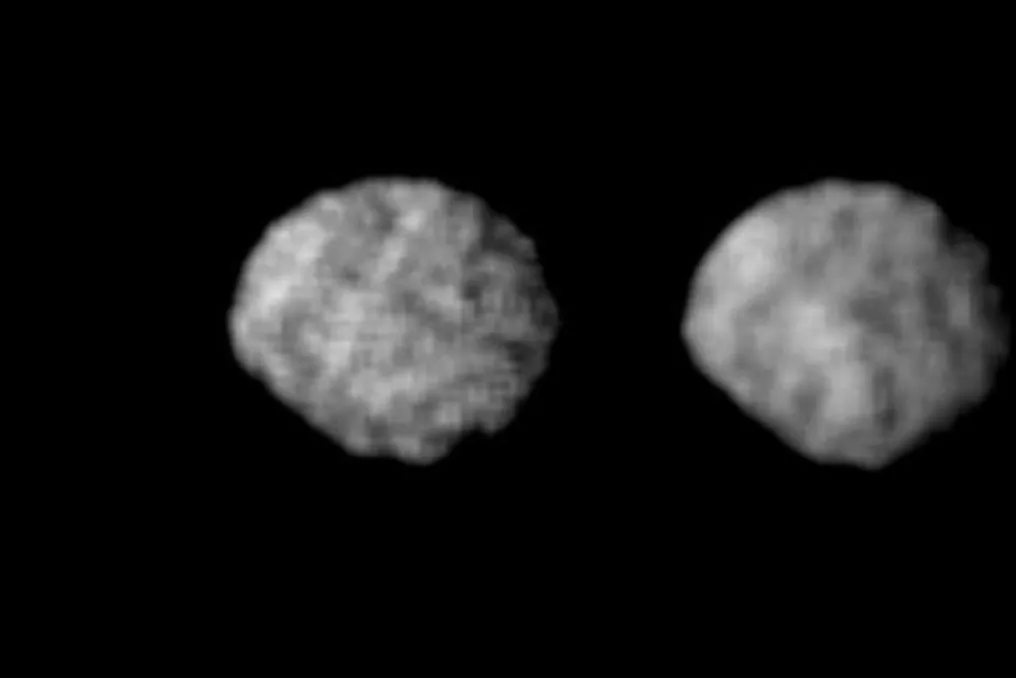
Planetologists used data from the James Webb Space Telescope to determine that the chemical composition of the surfaces of Neptune's moons Proteus, Larissa, and Galatea, as well as the particles of its rings, differs significantly from the composition of other objects in the outer Solar System.
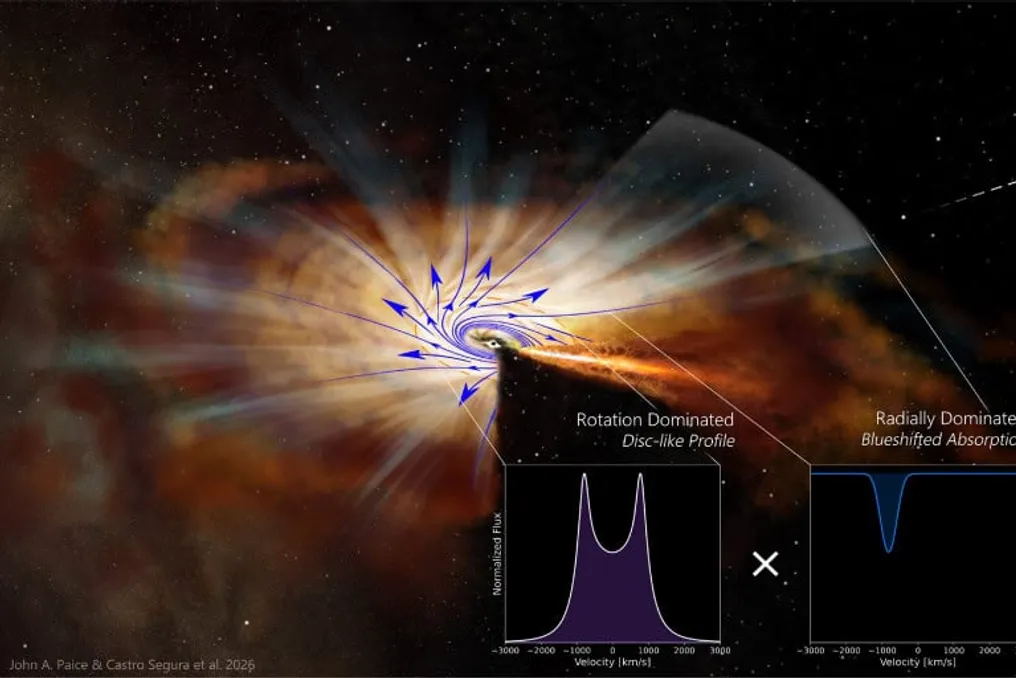
Model of Moon Origin
The findings best align with the hypothesis that these inner moons and rings contain material taken from the interiors of destroyed original moons or from a dwarf planet that passed by Neptune.
The nature of Neptune's ring and moon system remains a subject of scientific debate. Triton accounts for over 99% of the total mass of all moons, possessing a retrograde and highly inclined orbit relative to the planet. The remaining one percent consists of small moons, many of which also move along irregular trajectories.
There is a suggestion that Neptune initially had an ordered system of regular moons. After the capture of Triton, which arrived from the Kuiper Belt, this system may have disintegrated, and small moons and rings formed from the resulting debris. Another theory suggests that the moons and rings originated from the remnants of a dwarf planet from the Kuiper Belt that passed near Neptune and was torn apart by tidal forces.
Research Methodology
To test these models, scientists required detailed data on the composition of the moons, but only the Voyager 2 spacecraft had previously visited near Neptune. A group of planetary scientists led by Riley Davis from the University of California, San Diego, presented the results of analyzing spectra collected by the James Webb's NIRSpec spectrograph in the near-infrared range.
The instrument recorded spectra of sunlight reflected from the particles of the rings and the surfaces of the moons Proteus, Larissa, and Galatea, which allowed for information about the mineralogical composition to be obtained. The researchers then compared this data with spectra of terrestrial meteorites, asteroids, Uranus and Saturn's moons, as well as objects in the Kuiper Belt and Neptune's Trojan 2006 RJ103.
Mineralogical Composition of Bodies
It was found that none of the three studied moons of Neptune, nor its rings, show obvious signs of water ice, although traces of hydroxyl groups were detected. Magnesium-bearing serpentine-like phyllosilicate clays were identified on Larissa, Galatea, and in the ring particles. In the case of Proteus, such minerals are either very scarce or completely absent, but instead, signs of carbon dioxide presence were observed on both hemispheres.
For all studied objects and rings, the presence of ammonia-containing minerals cannot be ruled out. The discovery of phyllosilicate clay minerals in Neptune's rings and moons is the first of its kind among bodies outside Jupiter; typically, such minerals are found in carbonaceous chondrites and Main Belt asteroids.
Conclusions on Material Origin
It is believed that these minerals form inside parent asteroid and meteorite bodies in the presence of liquid water, at moderate temperatures (less than 300–400 Kelvin), and over a long period (more than 1–10 million years). However, the sizes of Larissa and Galatea (less than two hundred kilometers) did not allow for the creation of the necessary conditions for such reactions.
Therefore, the most probable concept is that Neptune's moons and rings consist of material from the interiors of one or more bodies that had a complex structure, including a rocky core and a mantle with ice and clay minerals. The depletion of water ice may be a consequence of the initial material being poor in volatile components, or the ice being lost subsequently.
As for Proteus, it is possible that it formed from material that never came into contact with liquid water, or it survived a collision that caused its heating and dehydration of phyllosilicates. The presence of ammonia and the abundance of phyllosilicates on Larissa and Galatea can be explained by moderate heating of the fragments (up to 700 Kelvin), indicating a relatively low impact velocity during the destruction of Neptune's original system and its subsequent evolution.