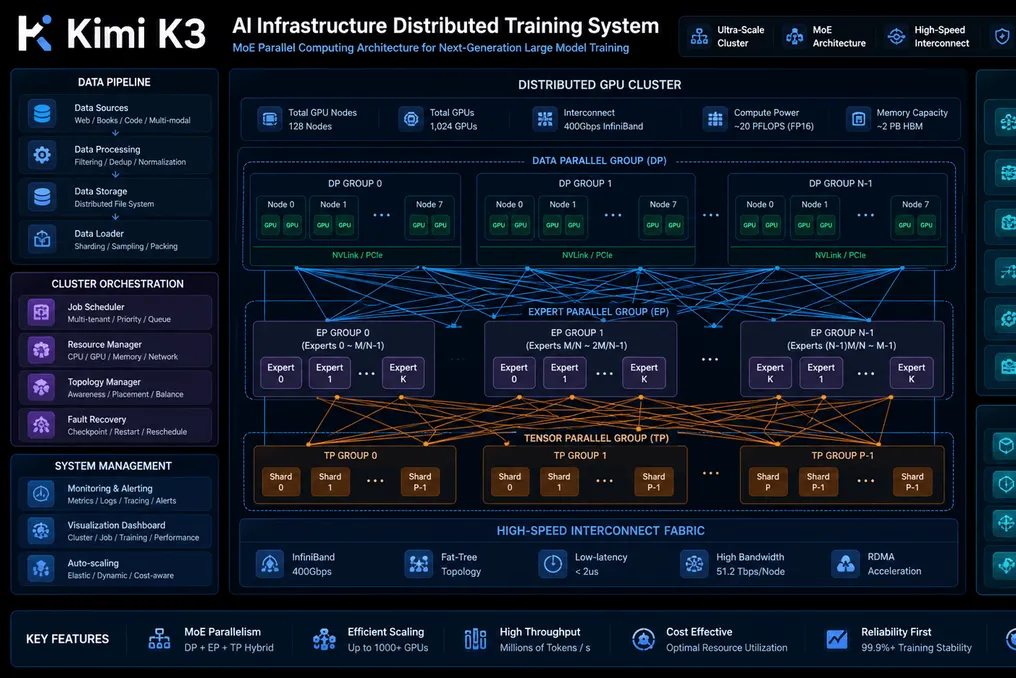
The Kimi K3 technical report details infrastructure, including MoonEP, KDA, and AttnRes. However, the true differentiator remains the engineering expertise behind the implementation of MFU, expert parallelism, and shared experts.
The Significance of Infrastructure in AI
Artificial intelligence infrastructure acts as an operating system connecting hardware and applications. When developers use proprietary models, costs are significantly lower than using third-party solutions, which is due to the gap in infrastructure experience. OpenAI engineer Weng Jiayi noted that the main problem in training is precisely related to infrastructure, and engineers are primarily engaged in debugging this area.
Training Efficiency and Challenges
As architectures converge and distillation lowers reproduction barriers, it is infrastructure engineering that determines training cost, deployment efficiency, and stability. One hundred companies utilizing Kimi K3 can achieve one hundred different levels of efficiency. Infrastructure errors include both traditional flaws affecting correctness and stability, and systemic issues that do not violate mathematical accuracy but lead to GPU downtime, memory loss, communication blocking, and reduced throughput.
Performance Metrics
The model's FLOPs utilization rate measures training efficiency as the ratio of observed throughput to theoretical maximum. Publicly verifiable large-scale training cases demonstrate that ByteDance MegaScale achieved an MFU of 55.2%, which is one of the highest recorded results. As a counterargument, information is provided that xAI, using about 550,000 H100 GPUs, reported an MFU of only 11% according to internal memos, which is significantly below the industry standard of 35–45% and the figures from competitors Meta (43%) and Google (46%). Higher training efficiency directly leads to shorter training cycles, reduced costs, increased experimentation, and scaling of data or models.
Distributed System Mechanisms
The Kimi K3 distributed system employs classic parallelization methods such as pipeline parallelism, expert parallelism, and ZeRO sharding. Pipeline parallelism distributes model layers across GPUs using micro-batch processing to reduce downtime caused by pipeline 'bubbles'. Tensor parallelism splits weight matrices and operations across GPUs, requiring high GPU interconnect bandwidth. A crucial detail is that MoE layers use shared experts replicated across EP ranks, meaning each GPU contains identical shared experts plus various routed experts, allowing shared experts to learn common features in the data. The KDA and AttnRes architectural mechanisms combine with corresponding infrastructure design, while MoonEP addresses unique challenges of expert parallelism in MoE architectures. When working with larger models, problems appear that are unnoticed in smaller models, as previously unrecognized computational processes or memory objects become significant relative to GPU capacity upon scaling.
Conclusion on Competitive Advantage
Open access to weights democratizes model usage, but not infrastructure competence. Differences in deployment costs, amounting to several orders of magnitude, create a structural advantage for the developer in the training and inference economy. This report serves as both a knowledge exchange and a signal of competitive capabilities: the architecture can be studied, but engineering experience at a scale of 2.8 trillion cannot be conveyed through documentation. Model capabilities are increasingly becoming a commodity, while infrastructure perfection transforms into a long-term defensive advantage.