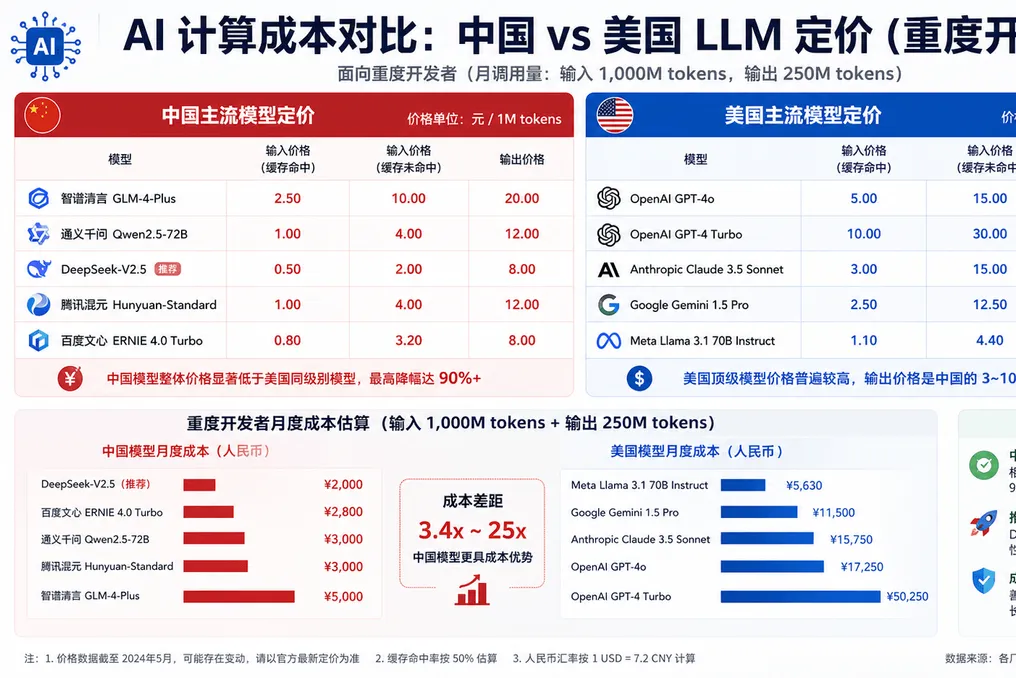
Despite the seemingly lower cost per token, domestic Chinese large language models (LLMs) prove too expensive for heavy users in development scenarios when daily consumption reaches tens of billions of tokens.
Despite the seemingly lower cost per token, domestic Chinese large language models (LLMs) prove too expensive for heavy users in development scenarios when daily consumption reaches tens of billions of tokens.
Chinese users engaged in intensive AI coding spend 300 yuan per week on Codex, whereas using local models like GLM-5.2 costs them 7800 yuan daily. The actual cost is determined not by the per-token pricing, but by the fact that foreign models offer bundled subscriptions that cap expenses for the most active users.
When consuming tens of billions of tokens daily, using the GLM-5.2 API costs about 7800 yuan per day, equivalent to 1084 US dollars. A similar load through the GPT Codex Pro subscription costs approximately 300 yuan per week. This paradox arises because foreign models include token consumption in fixed monthly subscriptions, effectively limiting costs for the most demanding users, while Chinese models charge strictly per token without fixed rate offers.
In terms of price per token, GLM-5.2 shows a lower rate ($1.4/$4.4 USD per million input/output tokens) compared to GPT-5.6 Sol ($5/$30 USD). However, with daily consumption in the billions of tokens, the advantage of the bundled plan completely changes the comparison. For instance, Codex Plus costs $20 USD per month, and Pro starts from $100 USD per month with 5 or 20 times the quota, plus overage charges via API.
Claude Code offers Pro for $20 USD per month and Max plans from $100 to $200 USD per month.
The situation with Alibaba Qoder CN also presents challenges: individual plans cost 59–169 yuan per month for 2000–6000 credits, which heavy users deplete in a matter of days. It is reported that about 20–30 corporate clients stopped renewing after the price restructuring. The corporate version of Qoder costs 199 yuan per seat per month and is consumed in 3 days with moderate use or 1 day with intensive use.
Access to the GLM-5.2 subscription has become extremely difficult. The daily limit, released at 10 am, is bought up within minutes, and the available volume since January 2026 has been reduced to 20% of the original due to computational power constraints. Triple token deduction is applied during peak load hours, which one developer compared to playing roulette. Similarly, Kimi Code offers tariffs from 49 to 699 yuan per month with weekly updates but also lacks a bundled plan that makes foreign subscriptions advantageous for heavy users.
Providers of Chinese models attribute this barrier to high inference computation costs. Unlike cloud services for inference optimized for batch processing with caching, Chinese providers face higher maintenance costs per token due to smaller context caching windows and insufficient cross-user batching efficiency at scale. Furthermore, the economic reality is that bundled plans require excessive allocation of computing power, which Chinese companies cannot afford under current constrained computational resources.
This pricing strategy leads to market segmentation: light users benefit from the lower cost per token in China, but the most valuable segment of developers is effectively subsidized in favor of foreign models due to the bundled plan advantage. Chinese models account for 63.5% of global inference volume through light users and price-sensitive applications, while highly intensive AI coding streams are directed towards GPT and Claude subscriptions. To capture developer share, a fixed-rate coding plan matching the weekly cost of Codex is needed, but this requires computational power that is currently limited for AI companies.
Meta's CEO, Mark Zuckerberg, commented on the issue of artificial intelligence (AI) models created in China, arguing that the United States government should not impose prohibitions on this technology.
In a conversation given to the Financial Times, the executive argued that restricting the use of Chinese technology would not be able to solve the technological competition occurring on a global scale. He emphasized the need for American companies to conduct a specific mapping.
For those who do not yet have a smart speaker at home or wish to buy a gift, there is a good opportunity. Three versions of the latest generation Echo Dot have been gathered, available in different shades on Amazon. All these devices include the integrated Alexa assistant, as well as Wi-Fi and Bluetooth connectivity, and offer early access to the Alexa+ service.
The black Echo Dot model provides strong and vibrant audio for daily use. With Alexa always available to execute voice commands, play music, manage smart home devices, and other functions, it also features the convenience of Wi-Fi and Bluetooth. Additionally, early access to Alexa+ is a benefit for those who want to test the assistant's latest features.
The blue variant of the Echo Dot shares the same set of capabilities as the black model—powerful sound, integrated Alexa, and support for Wi-Fi and Bluetooth—but stands out for its distinct design, making it perfect for those looking to personalize their environment. It is suggested for bedrooms, living rooms, or offices that need a pop of color.
The white Echo Dot, meanwhile, represents the most traditional alternative and harmonizes with almost all types of decor. This model maintains all the line's functionalities, including vibrant sound, Alexa assistance with voice control, Wi-Fi and Bluetooth connectivity, and the privilege of early access to Alexa+. It is considered a safe choice for those looking for a discreet and multifunctional smart speaker.
It is important to note that stock levels on Amazon tend to fluctuate considerably; therefore, it is recommended to check the links immediately to ensure the availability of the desired model and color. Users can click on the selected product button to check the conditions directly in the store.
Google has launched Gemini Robotics 2, an update to its artificial intelligence model specifically designed for robotics. This technology aims to enable machines to understand their surroundings, plan sequences of actions, and perform more intricate movements, reducing the need for strictly pre-programmed commands.
The system integrates computer vision, natural language processing, and motor control. This combination allows robots to handle a wider range of activities, such as full body locomotion, item handling, and interaction with other equipment.
Currently, many robots rely on meticulous programming or human supervision, which restricts their effectiveness in dynamic environments where there are constant changes, misaligned objects, or unforeseen events. Gemini Robotics 2 seeks to mitigate this problem by allowing the robot to analyze an instruction, assess the scenario, and determine the best series of movements to complete the task.
During a demonstration, the model commanded the Apollo 2 humanoid robot, manufactured by Apptronik, to locate a watering can, travel to a shelf, and place it in a designated container. Google itself acknowledged that obstacles persist, such as the need to accelerate movement speed.
The company stated: 'Now, our model can control complete humanoid robots for the first time, translating commands into intelligent whole-body control.'
The new generation of models consists of three distinct versions, each with a specific function: Gemini Robotics 2 converts visual data and verbal commands into physical actions; Gemini Robotics ER 2 focuses on planning, understanding the environment, and coordinating multi-phase tasks; and Gemini Robotics On-Device 2 operates directly on the hardware, minimizing dependence on internet connection.
According to Google, the model executed locally on the robot can quickly adapt to new platforms, requiring fewer than 200 training examples, even when there are variations in sensors, shape, or movement capability.
To be truly useful in daily life, besides moving, robots must manipulate objects with great delicacy. In the tests conducted, the system controlled five-fingered robotic hands and mechanical grippers to perform tasks such as closing packages, fitting components, and organizing materials.
The results point to significant progress but also reveal limitations. Tasks requiring extremely fine finger movements remain more challenging compared to operations performed by conventional grippers. Google reported that 'We are still advancing in the level of precision and speed to achieve near-human dexterity.'
Additionally, the company introduced safety features, including mechanisms capable of detecting risks, suspending operations, and requesting human assistance when necessary.