Three major Chinese tech giants—Alibaba, Tencent, and ByteDance—have simultaneously focused their efforts on one strategic goal: the desktop office AI agent. According to a report by the analytics firm Analysys for the second quarter of 2026, covering 17 main desktop AI agents, the total number of visits in June 2026 reached 60.62 million. Of this, the three leaders—Alibaba, Tencent, and ByteDance—collectively accounted for 56.22 million of these visits, leaving only 4.4 million for all other competitors.
AI Agent Market Dynamics
This data confirms that the platform economy applies to office AI agents, just as it did with browsers and search engines: users tend to install one primary desktop agent, which forms a natural oligopolistic dynamic.
Restructuring Company Portfolios
In July 2026, all three companies restructured their AI agent portfolios. Alibaba merged three existing products—QoderWork (for local desktop operations), Wukong (for corporate security and permissions), and MuleRun (for complex workflow templates)—into a single product tentatively named Qianwen Office. This project is led by Chen Yusen, the new CEO of DingTalk, a technical founder born in 1992 whose startup Chaitin Technology was acquired by Alibaba Cloud.
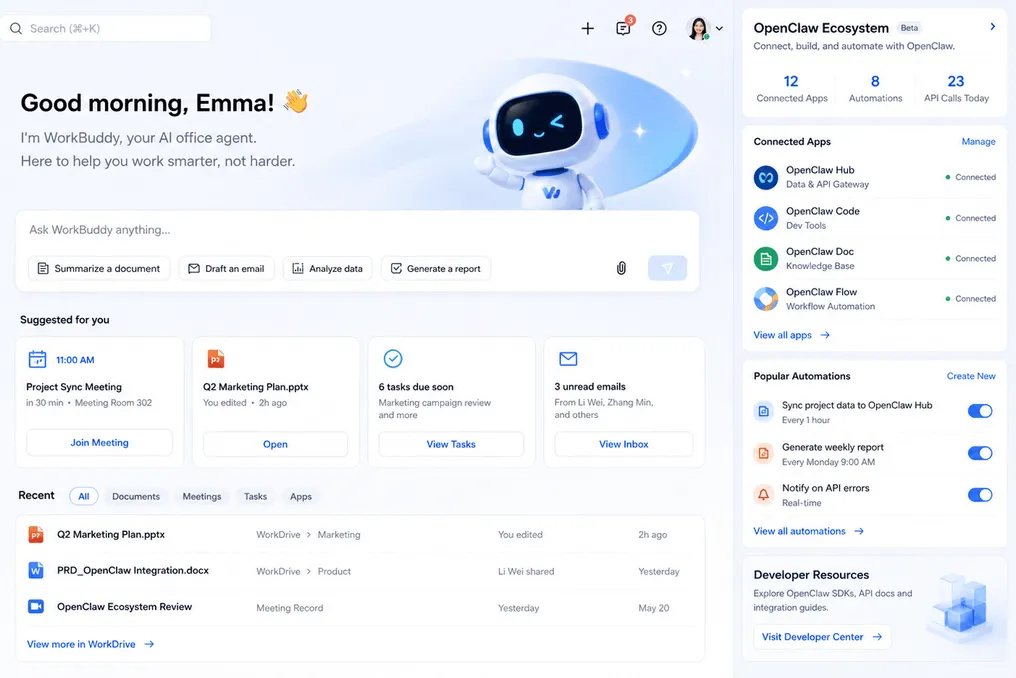
Tencent reportedly moved its QClaw product center team to the Cloud Products Department 6 and integrated it with WorkBuddy under unified management. ByteDance, meanwhile, transformed Doubao into its flagship office agent brand.
Prospects and Player Advantages
The Chinese AI agent market is projected to grow from 80.4 billion yuan in 2025 to 696.8 billion by 2030. The most convertible segment consists of single-employee companies requiring AI assistance as an assistant, accountant, or designer. Nearly 60% of users are willing to pay because increased office productivity provides a direct return on investment: saved time translates into earned money.
Alibaba's strategy under Chen Yusen involves integrating three layers: QoderWork acts as the interaction layer for natural language desktop control, Wukong serves as the permission layer operating within corporate security boundaries, and MuleRun functions as the execution layer for reusable workflow templates. This approach is similar to Anthropic's methodology, where Claude Chat, Claude Code, and Claude Cowork utilize one base model under a unified interface. The goal of the unified product is to eliminate user confusion, which previously forced customers to choose between three incompatible Alibaba products.
Tencent's advantage lies in its deep integration with the WeChat ecosystem and cloud services. WorkBuddy already maintains a close connection with Tencent Docs, WeCom, and Tencent Meeting, offering a corporate workflow deeply embedded in China's dominant business communication ecosystem, WeChat. ByteDance Doubao leverages the company's experience in recommendation algorithms and content generation. This three-way competition boils down to which company can offer the most comprehensive office experience, from the start of user intent to task completion. The outcome of this battle will likely determine the direction of enterprise software in China for the next decade, as the desktop agent becomes the primary interface for knowledge workers interacting with digital tools, replacing the traditional office suite model with an AI-centric workflow paradigm.