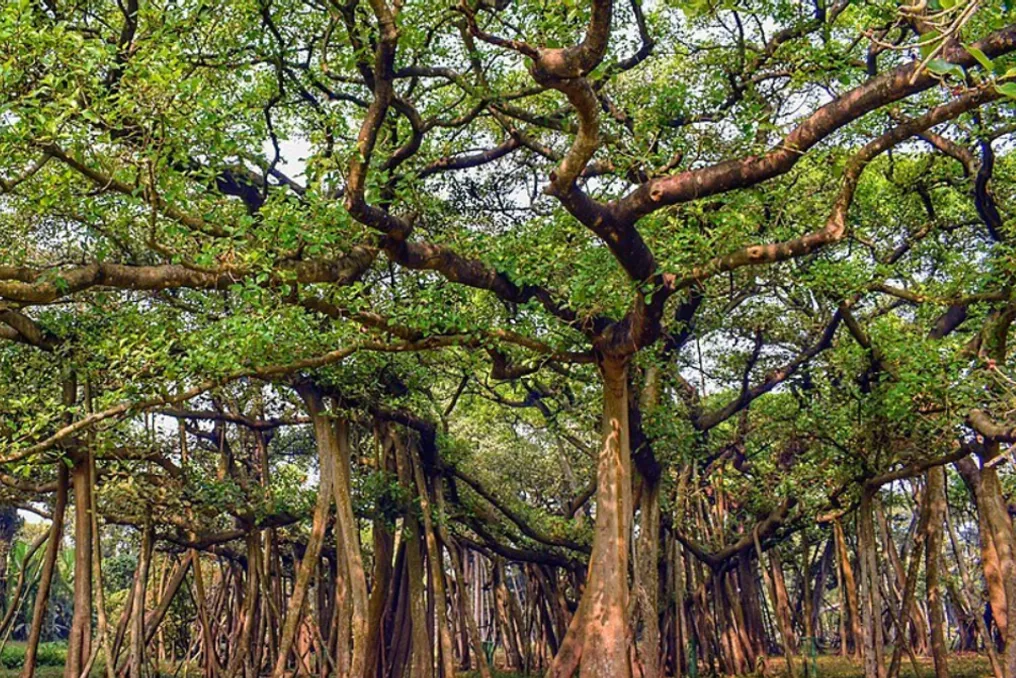
Along a busy road near Bengaluru grows a banyan tree so enormous that it resembles an entire grove rather than a single tree. In West Bengal, hundreds of kilometers from this location, another banyan survived its original trunk but continues to grow thanks to thousands of aerial roots.
Examples of Ancient Trees
In Telangana, majestic banyans annually attract birds, bats, and insects under their branches. In Bihar, scientists have confirmed that one banyan has existed for nearly 700 years, silently observing the change of generations.
Across India, these ancient giants are much more than just landmarks. Scientists classify mature banyans as keystone species—organisms that support entire ecosystems. Over its lifetime, one such tree can feed, provide shelter, and help sustain hundreds of birds, mammals, insects, and other living creatures.
Scientific Confirmation of Banyan's Role
This concept received new scientific confirmation this year. A recent study conducted in Kanya Shanti Vanam in Telangana, along with radiocarbon dating of an ancient banyan in Mundher (Bihar), reinforces long-known facts among ecologists: preserving old banyans protects a rich web of life that depends on them.
More Than Just Shade
Earlier this month, it was established that the banyan in the Mundher area (Bihar) is approximately 700 years old, making it the oldest precisely dated banyan (Ficus benghalensis) to date. Unlike previous estimates based on folklore or historical records, researchers used high-precision radiocarbon dating to determine the tree's age.
This discovery is not only a milestone in tree science. It demonstrates how tropical trees can preserve centuries of ecological history while continuing to support wildlife across generations.
The Great Banyan in Kolkata
This role is most vividly demonstrated by the Great Banyan in Acharya Jagadish Chandra Bose Botanical Garden near Kolkata. Spreading over an area of almost 4.7 acres through more than 3700 aerial roots, this tree no longer depends on the trunk from which it originally grew. Although the original trunk died decades ago, the extensive network continues to thrive, resembling a living forest more than a single tree.
Its canopy serves as a refuge for fruit bats, palm squirrels, barbets, bulbuls, parrots, koels, mynas, and countless insects. Mosses, orchids, lichens, and other epiphytes cover its branches, creating homes for spiders, reptiles, and pollinators. Each new aerial root slightly expands this miniature ecosystem.
Dodda Alada Mara in Bengaluru
Dodda Alada Mara, located near Bengaluru and about 400 years old, tells a similar story. Its sprawling canopy attracts pink-crested parrots, white-cheeked barbets, jungle mynas, black drongos, and Asian koels year-round. In the evening, Indian flying foxes arrive to eat ripe figs, and then disperse their seeds across the landscape. Palm squirrels, butterflies, and bees occupy different parts of the tree simultaneously, with each relying on this living structure in different ways.
Observations in Telangana
At Kanya Shanti Vanam, near Hyderabad, researchers recently got to examine these ecological connections up close. Scientists Ananthanenini Srinath and Ratinasabapati Bhuvaragasami studied six mature banyans growing among more than 1000 restored plant species, including 26 local Ficus varieties. Their research, published in International Journal of Phytology Research (2026), showed that when the banyans fruited from February to May, they became magnets for wildlife.
Common mynas, red bulbuls, Asian koels, copper-green barbets, golden orioles, rusty munias, and other animals arrived to feed. After sunset, Indian flying foxes took over, and during the day, three-striped palm squirrels fed. Unlike many forest trees that fruit only for a short time, various Ficus species fruit at different times of the year. This provides a reliable food source for wildlife throughout all seasons, helping to maintain what ecologists call trophic continuity—a continuous flow of energy in the ecosystem.
Researchers also made another important discovery. Seeds extracted from the excrement of birds and bats germinated significantly better than fruits that simply fell beneath the trees. In other words, every bird, bat, and squirrel that ate figs also helped plant the next generation of forests. Young saplings of banyan, pepal, and Indian fig were already naturally appearing in quiet corners of the reserve.
Conservation of Indian Biodiversity
India is home to 115 registered Ficus taxa, including 89 recognized species. While many of these are widespread, others, such as Ficus beddomei, Ficus krishnae, and Ficus anamalayana, are considered rare, vulnerable, or insufficiently studied. Researchers note that protecting this biodiversity also means protecting the ecological connections built around these trees.
In Gujarat, on the Narmada River, Kabirvad supports river birds, fruit bats, macaques, and countless insects. In Andhra Pradesh, Thimma Marimanu, whose canopy spreads over an area of more than five acres, functions almost like a forest, providing habitat for parrots, owls, reptiles, butterflies, bees, and small mammals. As the oldest banyans continue to stand in the cities, villages, and forests of India, they remind us that conserving nature is not always about planting new trees. Sometimes it begins with protecting the ancient ones that have quietly sustained life for centuries.