Mass extinctions, giant volcanic eruptions, sudden ocean deoxygenation, and other large-scale geological changes on the planet may be linked to a common recurring pattern observed over tens of millions of years.
Cyclicity of Geological Events
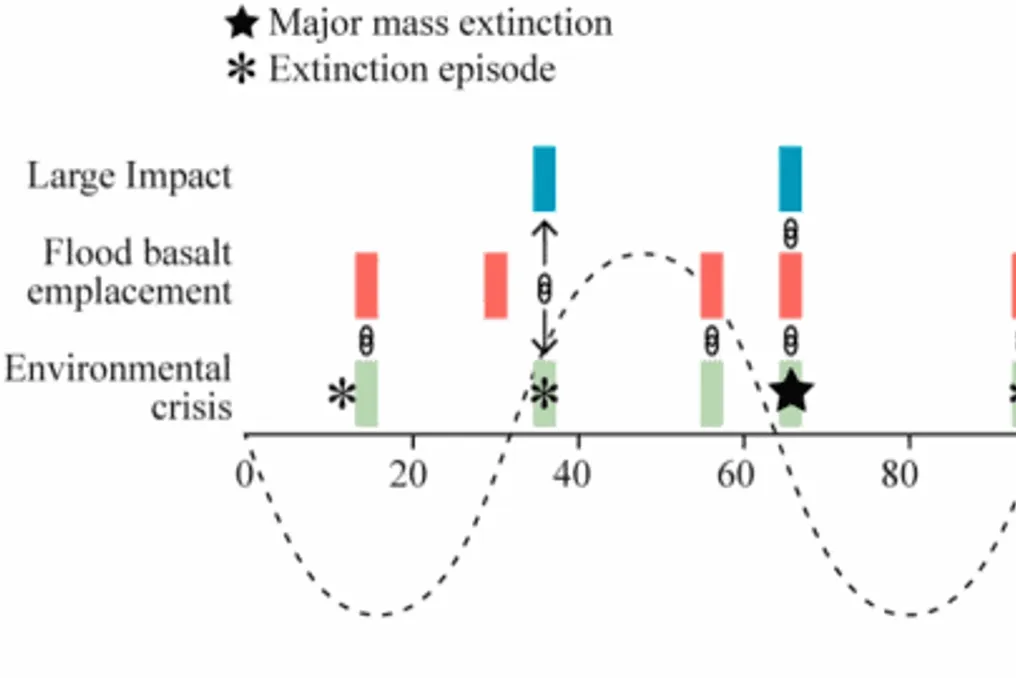
This conclusion is based on a new study published in the scientific journal Evolving Earth. The analysis confirms the hypothesis that the most grandiose catastrophes in the planet's history follow a cycle lasting approximately 27.5 million years. The idea of periodicity in extreme geological phenomena is not new; it emerged back in the 1980s when scientists suggested that mass extinctions and other major events might repeat at relatively regular intervals. Despite this, the hypothesis remains a subject of debate within the scientific community.
Review of 89 Major Events
Geologist Michael Rampino from New York University reviewed existing evidence using updated geological timescales and modern statistical methods, concluding that this pattern persists. To conduct the research, Rampino examined 89 significant geological events recorded over the last 260 million years, relying on previously published datasets.
The analysis included mass marine extinctions, episodes of oceanic anoxia (when oceans lose oxygen), eruptions of large basaltic provinces, sea-level fluctuations, terrestrial tetrapod extinctions, changes in the rate of seafloor spreading, and intraplate volcanism. According to the researcher, all these records demonstrate a dominant periodicity of approximately 27.5 million years. Furthermore, a weaker secondary cycling with a period of about 8.9 million years was identified.
The study does not assert that one catastrophe directly causes another; instead, it suggests that different Earth systems periodically respond to the same long-term geological processes. However, the nature of these processes remains an open question.
Possible Causes for Earth's Rhythm
One discussed hypothesis relates to the planet's internal structure. The Earth's mantle is in constant motion due to extremely slow convective currents. According to Rampino, periodic changes in this process or the appearance of mantle plumes could influence phenomena such as volcanism, plate tectonics, and mountain building. Since these systems are interconnected, disturbances originating from the deep layers of the Earth can affect the surface, oceans, climate, and even the biosphere over millions of years.
Another possibility involves the interaction between the surface and the planet's interior. Long-term orbital changes can alter climate and sea level by redistributing vast amounts of water, ice, and sediment. Such mass movement can change stresses in the Earth's crust and upper mantle, thereby influencing volcanic and tectonic activity.
Cosmic Influence and the Galaxy
Rampino also considers hypotheses related to astronomical processes. As the Solar System orbits the center of the Milky Way, it oscillates above and below the galactic plane. The researcher notes that moments of these passages coincide with various major catastrophes recorded on Earth. Other scientists suggest that these crossings might gravitationally disrupt comets in the distant Oort Cloud, increasing the probability of impacts with large asteroids.
Another, more speculative hypothesis suggests that dark matter is concentrated near the galactic plane. In such a scenario, a small portion of this matter could be captured by Earth, generating additional heat in the planet's inner core over millions of years and influencing its geological activity. Nevertheless, the study emphasizes that there is currently no direct evidence supporting any of these mechanisms, so they remain highly debatable.
Asteroid Correspondence with the Cycle
Although asteroid impacts were not included in the statistical analysis of the 89 events, Rampino observes that the age of many of the largest known craters on Earth largely corresponds to the cycle proposed in previous studies of 27.5 million years. The researcher believes this coincidence warrants further investigation but refrains from concluding a causal link.
Ongoing Scientific Dialogue
Despite the new findings, the author acknowledges that defining cycles over hundreds of millions of years is a complex task. Geological records are incomplete, dating ancient events has constantly increasing errors, and statistical analysis may point to patterns that disappear as new data emerges. Nevertheless, Rampino stresses that the periodicity near 27.5 million years remained stable even after decades of refining geological scales and expanding databases.
In his view, if future research confirms this pattern, the largest catastrophes in Earth's history will cease to be viewed as isolated events and will begin to be interpreted as recurring manifestations of natural processes shaping the planet over hundreds of millions of years. Rampino concludes: 'Although these ideas are largely outside the mainstream of current geological thinking, they could be the first steps toward a significant conceptual breakthrough in Earth sciences, one that recognizes the global correlation of major geological events, the inherently periodic nature of the geological record over millions of years, and the astronomical connections that can more firmly place our planet in its true cosmic context.'