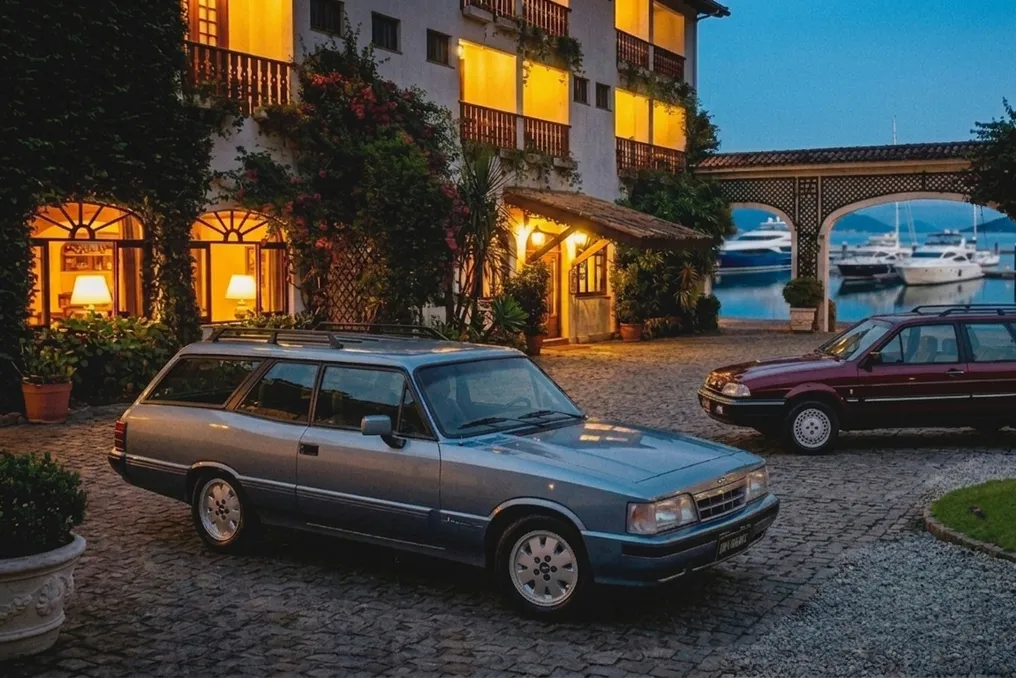
When analyzing automotive comparisons, it is noticeable that the most striking debates in enthusiasts' memories involve beloved models, a phenomenon that spans generations. Whether evoking emotional memories with comparisons like Opala SS versus Maverick GT, or sparking interest in a younger audience with tests between Chinese electric or hybrid compact SUVs, the recurrence of reviews defines which parallels will be most remembered.
Evolution of the Automotive Market
In the past, the market was more restricted, before the arrival of imported cars, and the most emblematic vehicles were constantly tested by major national publications and specialized newspapers. Currently, the market is more fragmented, but comparisons continue to be a constant element in the press, both nationally and internationally. These tests serve both the consumer looking for an economical and practical vehicle for daily life, and the enthusiast who wishes to debate the qualities of their favorite car against competitors, keeping the flame of passion alive.
Lost Topics of the 80s and 90s
Even in more limited periods, there were topics of great interest that were never published, possibly due to the unavailability of vehicles in press fleets or the lack of editorial vision from the magazines of the time. The author specifically focuses on the 80s and 90s, a period considered magical by many enthusiasts, to reimagine a comparison that could have been a commercial success and generated discussion.
Market Convergence
Despite the generational and technical differences, the Caravan Diplomata and Ford Royale competed in the same market segment and attracted a similar audience: people willing to invest in luxurious vehicles that went beyond basic transportation. The confrontation between these two vans never materialized for a curious logistical reason: the Caravan was ending its production in April 1992, while the Ford Royale arrived on the market in the same month.
Analysis of the Caravan Diplomata
Even in its final moments, the Caravan received significant improvements in 1991, encompassing technical enhancements and visual changes. These changes helped extend the van's lifespan before being succeeded by the Chevrolet Omega. Improvements included four-wheel disc brakes, 15-inch wheels, lower profile tires, Servotronic hydraulic steering, new pressurized shock absorbers, and suspension adjustments, making it more stable on bad roads.
With the addition of the fifth gear in the 1992 model, the engine also gained more leeway for long-distance travel, reducing revolutions and optimizing consumption. The six-cylinder engine had been improved since 1990 for greater efficiency, especially in the gasoline version. Although the increase from 118 to 121 hp was modest, modifications to rings, pistons, and carburetor brought a consumption of almost 10 km/l on highways with moderate driving. Due to the aerodynamics not being excellent, the 4100 engine presented performance limitations, but its real top speed approached 170 km/h, which was considerable for the early 90s.
The Caravan still pleased its traditional audience, who valued silence, superior finish, and power across all RPM ranges more than pure performance. Despite being technologically outdated, not using electronic injection, it was a potential competitor to the Ford Royale.
Ford Context and the Royale
In 1992, Ford was going through an important year, closely linked to Volkswagen through Autolatina. Ford's portfolio was being renewed, including the adoption of German engines in 1989 and the use of platforms similar to those of its rival in mid-to-large luxury segments. Ford's CHT engines competed with VW engines of the same displacement in gasoline versions. There were notable advances, such as the Escort XR3, which surpassed the two-liter Kadett GS, and the Del Rey line becoming more suitable.
In that same year, Ford also reformulated the F-1000, creating the 'Ram Cab' version, which quickly made the Chevrolet D20 obsolete. Unlike the pickup truck, the Ram Cab looked imported from the US, with few obvious Brazilian markings. Simultaneously, the Escort line gained the MK5 generation, and the revamped XR3 was Ford's main sporting bet, combining interior luxury with aggressive design and solid performance with the AP 2000 engine.
Stylistic Similarities and Differences
To reinforce the emotional appeal, the American manufacturer kept the two doors on the new Royale van, following the tradition of the Belina. This differentiated it from its sister, the Santana Quantum, but also brought it closer to the Caravan, as both were large, two-door cars with a marked conservatism. However, the Caravan had advantages in more expressive wheels and tires, as well as smoked taillights and superior automatic steering and transmission systems.
A modern detail of the Royale was the alignment of the side windows after the B-pillar, similar to the Omega, which gave it a more updated look than the Quantum. Ideally, the Autolatina Oak/Spruce project should have been completely redesigned, replacing the doors with truly modern models.
Compared Performance
Although the confrontation never happened, individual analyses allow speculation about the outcome. A test by Oficina Mecânica magazine showed that the Ford Royale Ghia was undeniably faster than the best Caravan tested by the same publication, both with automatic transmissions. A 1989 alcohol-fueled Caravan reached about 171 km/h with 135 hp. The automatic Royale, limited by an old three-speed gearbox without torque converter lockup, reached 182.7 km/h in its best run, consistently staying above 180 km/h thanks to the long differential.
However, in acceleration runs, the Royale presented difficulties, needing 14.4 seconds to reach 100 km/h, which was slow for a vehicle costing 36 thousand dollars. In this aspect, the Caravan was more agile, as its ZF automatic transmission could better utilize the engine, resulting in faster accelerations.