A new study casts doubt on the predominant theory regarding dinosaur extinction, questioning whether death occurred gradually or suddenly after the collision of a giant asteroid 66 million years ago.
The Chicxulub Event
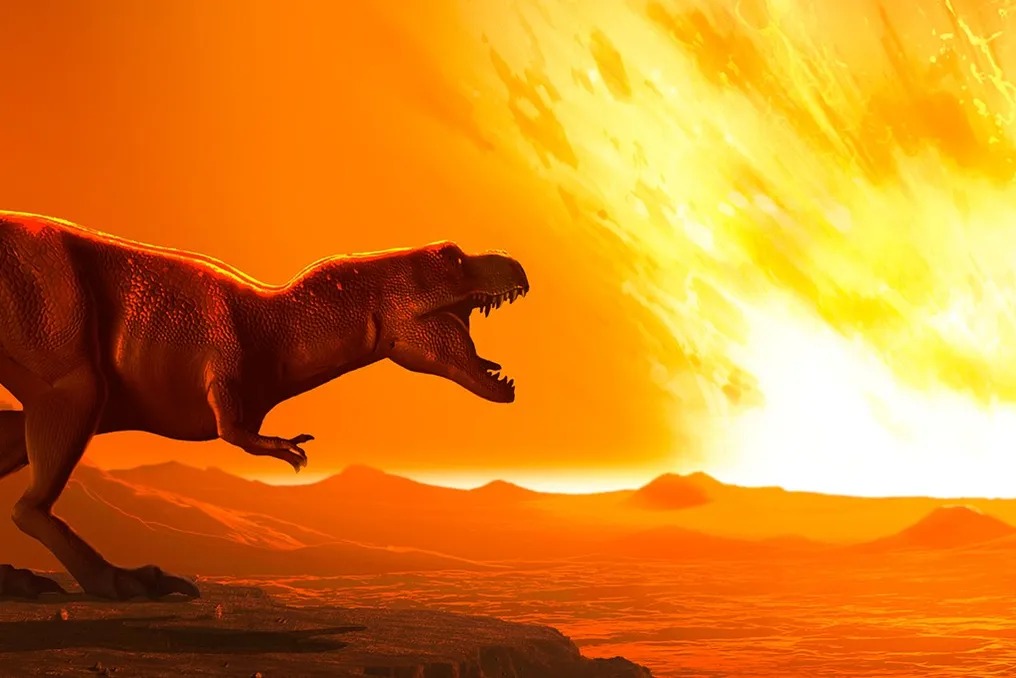
At that time, a colossal asteroid struck Earth, specifically the Yucatán Peninsula in Mexico. This object, named Chicxulub, was moving at approximately 19 kilometers per second. The impact released energy more than a billion times that of the atomic bombs of Hiroshima and Nagasaki, triggering tsunamis, earthquakes, and global fires. Subsequently, an extensive period of darkness followed due to the large amount of dust and soot ejected into the atmosphere.
Extinction Hypotheses
Historically, the most accepted view was that dinosaurs, which dominated the planet, perished over several years. This gradual extinction was attributed to the weakening of plant photosynthesis caused by the lack of sunlight, leading to the collapse of food chains.
Evidence of Rapid Death
However, a recent research, published in the scientific journal Journal of Geophysical Research: Biogeosciences, offers arguments for an alternative: a significant portion of dinosaurs could have died within a few hours after the impact. The researchers indicate that the generated heat and fire were more intense than previously predicted.
To reach this conclusion, scientists analyzed a thin layer of dust found in North America in 2023, aiming to understand atmospheric dust behavior. They integrated data from this modern layer with computational simulations of the Chicxulub event and geological information from that period.
The Role of Atmospheric Dust
The study revisits the initial process: the asteroid collision projected vast amounts of vaporized rock into the air. As this material dispersed through the Earth's atmosphere, it cooled and formed tiny droplets of rock, known as spherules. These particles, upon returning to the surface, released heat and caused planetary fire waves. Although this mechanism was known, the new work points to something different.
The authors discovered that part of this material did not turn into spherules. Instead, it remained suspended in the atmosphere as a cloud of ultrafine dust, several millimeters thick, enveloping the globe. According to the researchers, this dust not only obstructed sunlight but also acted as a thermal insulator, trapping heat from the fires and explosions on the surface. This would result in a 3.5 times greater warming than previously estimated, considering only the spherules—heat capable of rapidly killing many exposed animals.
Conclusion and Future Perspectives
The authors state that 'the heat and fire induced by the Chicxulub impact and the atmospheric reentry of ejected materials acted as a fatal blow to the dinosaurs and other life forms of the Cretaceous.' The research does not invalidate the idea of slow deaths from starvation, but adds a new dimension to the debate. Scientists suggest that both events—sudden death and subsequent starvation—could have occurred sequentially.
After the fires ended and the planet initially cooled, this layer of dust would continue to block sunlight for years or even decades, causing global cooling. The resulting lack of light would lead to the death of plants and the subsequent collapse of food chains, resulting in the death of survivors from starvation. However, more studies are still needed to validate this hypothesis, given that most known evidence of forest fires is concentrated in the Northern Hemisphere, and there is no proof that such fires occurred on a planetary scale.