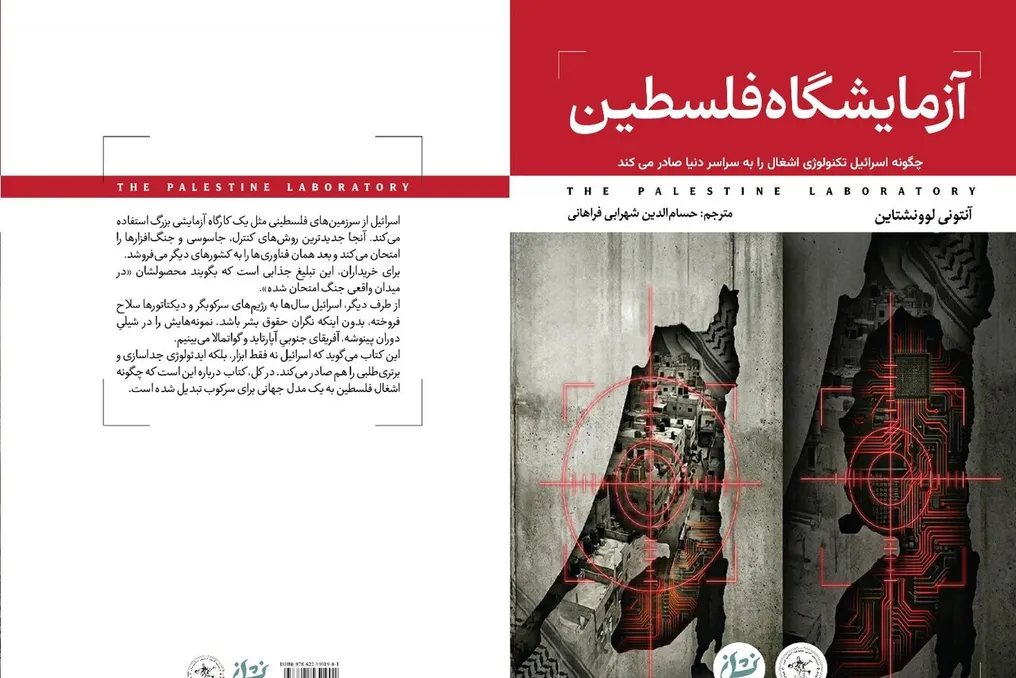
A Persian translation of Anthony Lowenstein's book, 'The Laboratory of Palestine: How Israel Exports Occupation Technology Worldwide,' has been released. This book is available in bookstores across the country.
Book Content
The book, written by bestselling journalist Anthony Lowenstein, was translated by Josemoddin Shahrabi Farahani and published by Neshan Publishing House. The original publication was in 2023 and consists of 376 pages. It reveals the broad commercial use and brutal application of technologies used by Israel to maintain occupation across the globe.
Occupation Experience as a Proving Ground
Over fifty years of occupation in the West Bank and Gaza Strip have provided the Israeli state with invaluable experience in managing a population it deems 'hostile'—Palestinians. It is here that the architecture of control has been refined, using occupied Palestinian territories as a testing ground for weapons and surveillance technologies that are subsequently exported to other countries.
Export of Control Technologies
'The Laboratory of Palestine' details and demonstrates for the first time how Israel has become a leader in developing surveillance technology and defense equipment that fuels some of the world's most brutal conflicts. Examples cited include the Pegasus software, used to hack the phones of Jeff Bezos and Jamal Khashoggi, as well as weapons sold to the Myanmar army, which killed thousands of Rohingya. Furthermore, the book discusses drones used by the European Union to monitor refugees in the Mediterranean Sea.
Commercialization of Military Technology
As part of a global investigation based on secret documents, leaked interviews, and on-the-ground reports, Anthony Lowenstein shows how Israel uses its occupation of Palestine to test and develop military equipment intended for sale on the global market. This process is not a secret but is actively leveraged by Israeli arms manufacturers as an advantage. Lowenstein provides an example where the Israeli company 'Elbit Systems' advertised the capabilities of its new drone using footage of airstrikes in Gaza and the West Bank. Further investigation revealed that the drone strike shown by Elbit resulted in the death of innocent Palestinians, including children.
The Digital Surveillance Industry
In addition to military hardware, Israel exports a vast industry of surveillance software and digital data mining. Since 2005, Lowenstein notes a sharp increase in the use of facial recognition and biometric scanning in occupied Palestinian territory. Although some of this software is no longer state-owned or produced by the state, much of Israel's security apparatus was privatized back in the 1990s.
Private Companies and International Sales
One private company highlighted by Lowenstein is Cellebrite. The company positions itself as a 'leading industry platform for digital intelligence,' yet it actually sells software capable of hacking and tracking smartphones. This software has been sold to allies and adversaries of Israel worldwide. Lowenstein reports that over 140 countries have acquired Cellebrite products, including Pakistan, which has used this software since 2012 despite official embargoes on Israeli products. Southeast Asian countries, such as Singapore, are also included, which signed a five-year contract worth $14 million with Cellebrite in early 2023.
Consequences of Global Instability
The uncontrolled sale of surveillance software means that Israel is not only maintaining apartheid in occupied Palestine but is also undermining democracy abroad. The Committee to Protect Journalists stated that such software poses an 'existential threat to press freedom.' Lowenstein argues that this global destabilization benefits business. He points to the boom in the Israeli surveillance software industry following the September 11th attacks. Israel long positioned itself as an expert in surveillance and an ideally located ally in the war against terrorism, but Lowenstein believes that since 2001, Israeli companies have been able to profit from the world's paranoia.