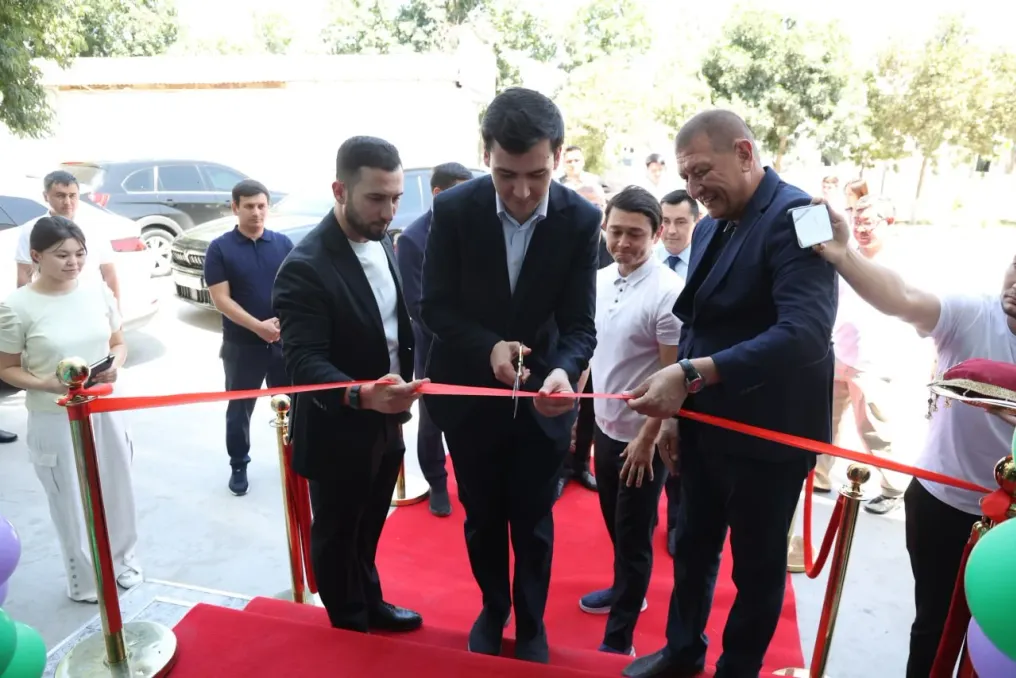
DMGB LOG SERVICE has officially commenced its operations in the Jizzakh region, Uzbekistan, becoming a new resident of IT Park Uzbekistan. The company specializes in business process outsourcing (BPO) services.
DMGB LOG SERVICE has officially commenced its operations in the Jizzakh region, Uzbekistan, becoming a new resident of IT Park Uzbekistan. The company specializes in business process outsourcing (BPO) services.
The opening ceremony was attended by several representatives. Among them were Ozod Bobomuradov, advisor to the governor of the Jizzakh region on digital technologies and artificial intelligence; Zhakhongir Kagirov, Director of Export Development of IT Park Uzbekistan; Mahmud Giyosov, head of the regional department of the Ministry of Digital Technologies of Jizzakh, and industry representatives.
The company's main activity is providing dispatching services to coordinate and manage interstate freight transportation within the United States of America. During the event, guests were shown the working conditions, core business processes, and operational activities of the company.
Currently, the company has 26 specialists and plans to increase its staff to 100 employees. Organizers emphasized that the launch of this new BPO project is another step in expanding export services from the Jizzakh region, contributing to the creation of new high-paying jobs and increasing employment opportunities for youth in the international services market.
The satellite internet service Starlink is constantly expanding in Brazil, consolidating itself as the 13th largest fixed broadband provider in the country, according to Ookla data. Currently, the company has 791 thousand subscribers, although Starlink itself mentions a total of 1 million subscribers.
Starlink's growth is particularly notable in the rural segment, where it surpasses the market share of established competitors like Claro and Vivo. It is estimated that in the first half of 2026, Starlink will hold 9.34% of the fixed broadband market in Brazilian rural regions. In contrast, Claro and Vivo register shares of 6.52% and 5.4%, respectively.
Although Starlink also has a relevant subscriber base in large urban centers, such as São Paulo and Rio de Janeiro, its penetration in these locations is lower (1.34%) compared to the rural scenario. Ookla attributes this difference to the fact that fiber optic deployment is much more extensive in urban areas.
Between May 2025 and May 2026, there was an 8.3% growth in Starlink's rural customers, while Vivo registered an increase of 9.88% in the urban segment. Regarding speed, Starlink presents average download speeds that are below the fiber optic services offered by competitors.
Ookla points out that, in both urban and rural areas, Starlink users frequently find download rates between 50 and 200 Mb/s, rarely exceeding 300 Mb/s. On the other hand, Claro, Vivo, and TIM, which predominantly use fiber optics, can deliver speeds ranging from 300 Mb/s to 1 Gb/s, depending on the contracted plan.
Technically, satellite internet operation is more complex, and Starlink network capabilities tend to decrease as the customer base expands and more devices are connected simultaneously. Specifically, Starlink's average download rate in Brazil was 149.5 Mb/s during the early morning hours, dropping to 90.6 Mb/s at 1:00 PM, according to the first quarter of 2026. Despite this, for many residents in rural areas, the Starlink service represents the only viable option, being considered superior in quality and availability compared to local providers.
GWM has introduced two new configurations for the ORA 5 model in China: the GT and Sport versions. These additions focus on offering a sporty aesthetic appeal and differentiated finishes, although the Chinese manufacturer has not confirmed any modifications to the powertrain or handling adjustments.
The Sport variant features more subtle changes, including a two-tone paint job with a white roof, larger diameter alloy wheels, red painted brake calipers, and a LiDAR sensor positioned on the top of the roof. This component, currently exclusive to purely electric versions sold in China, indicates a more sophisticated suite of driving aids, integrated into GWM's own Coffee Pilot 3 system.
The GT configuration adopts a bolder look. It incorporates a front splitter, side skirts, and a rear spoiler, in addition to red accents applied to the headlights, wheels, brake calipers, and aerodynamic components. The vehicle's electric nature is identified only by the charging port located on the front fender, which raises the possibility that this version might replace the old Ora 03 GT in the Chinese lineup.
Despite the more striking design, GWM has kept silent about the mechanical aspects. No increases in power, suspension revisions, or performance recalibrations have been reported, suggesting that the changes are primarily aesthetic.
In China, the ORA 5 is available in electric versions, equipped with a 204 hp front motor and 45.3 kWh and 58.3 kWh LFP batteries, providing ranges of 480 km and 580 km in the CLTC cycle. Hybrid and combustion options are also available, the latter featuring a 1.5-liter turbo engine producing 184 hp. The starting price for the line begins at 69,800 yuan, approximately R$ 53 thousand, and the prices for the new packages have not yet been disclosed.
In Brazil, the ORA 5 was launched in June in a single version, priced at R$ 159,900. The electric SUV uses the same 204 hp and 26.5 kgfm motor, reaching 100 km/h in 7.7 seconds and having its maximum speed electronically limited to 160 km/h. The 58.3 kWh battery offers a range of up to 349 km according to the INMETRO cycle and supports fast DC charging up to 120 kW, allowing it to go from 20% to 80% in 20 minutes, as informed by the manufacturer.
Domestic production has been confirmed for the brand's second factory in the country, located in Aracruz, Espírito Santo. This plant will receive an investment of R$ 4.6 billion in the first phase, as part of the total R$ 10 billion plan announced for Brazil. The unit will be multi-energy, capable of manufacturing electric, hybrid, and combustion models on the same line. Its projected capacity is 200,000 units annually, four times greater than the Iracemápolis (SP) unit, which produces the Haval H6, Haval H9, and Poer P30, but operations will not begin until 2029. Currently, the GT and Sport versions are only presented in Chinese materials, and GWM has not specified whether these configurations will be exported.
The mergers and acquisitions market showed aggressive warming in the last quarter, moving approximately $1.4 billion. This figure represents the most robust volume in the last twelve months and the second largest in three years. However, a more detailed analysis of this capital indicates a significant shift in the type of acquisitions, signaling that funding for ambitious projects requiring ground-up development is scarce.
Currently, there is a trend of consolidation focused exclusively on cash flow stability. Companies are prioritizing the purchase of already consolidated user bases over the appeal of traditional intellectual property. Recent moves, such as Supercell buying Metacore and Atari incorporating Hipster Whale, illustrate this new business approach.
Instead of investing in creating a new brand, the market shows a preference for paying a premium for proven retention and predictable Lifetime Value, absorbing casual studios specialized in maintaining daily player engagement.
This search for financial security takes on a more critical tone when analyzing the opposite side of the market, where the traditional model of large productions has suffered a major reality check. A notable regulatory event last week was the approval of the purchase of Electronic Arts (EA) for $55 billion. This transaction was led by a Saudi sovereign wealth fund, consolidating the use of soft power to acquire Western infrastructure.
Although a check of this magnitude may seem like a positive capital injection at first glance, the executive perspective reveals that this move functions more as heavy support for a structure that could no longer sustain itself autonomously. The inherent financial risk of leveraged operations of this size is that buyers contract massive loans and transfer this debt directly to the acquired company. As an immediate consequence, EA's balance sheet saw an increase of almost $20 billion in liabilities.
With this financial pressure, the company is suffocated by debt that demands immediate returns, eliminating any room for the patience necessary for innovation. Structural damage has already begun to be perceived internally, as in the case of BioWare, which reduced its staff to fewer than 100 employees after the failure of Dragon Age, now depending entirely on the production of the next Mass Effect to justify its corporate existence under management that no longer tolerates risky investments.
For those who follow the business landscape, the lesson about the reevaluation of digital entertainment is clear. However, the outlook for the sector's future is not pessimistic. While financial capital has lost tolerance for unpredictability, the squeeze on superproductions has created the ideal environment for the expansion of the independent market. In recent years, the global revenue of independent games has grown at double-digit rates, varying between 14% and 16% annually, capturing significant shares of revenue on digital platforms and proving that decentralized creativity is quite profitable.
Independent titles have dominated awards and gained public favor for several seasons. There is a conviction that the true future of game development lies in this dynamic. The independent model provides greater agility in production, complete creative freedom, and requires minimal investment, allowing for a much more equitable distribution of resources. Thus, the collapse of the traditional format under the weight of its own debts should not be seen as a tragedy, but rather as the best news to ensure a healthier and more ventilated gaming ecosystem.