A walk on the beach can bring many surprises: from colorful shells and seaweed to unusual marine animals washed ashore. While some beach finds are completely harmless, others can sting, bite, or release toxins even after they have reached land.
A walk on the beach can bring many surprises: from colorful shells and seaweed to unusual marine animals washed ashore. While some beach finds are completely harmless, others can sting, bite, or release toxins even after they have reached land.
There is a number of sea creatures that should strictly not be touched if spotted on the beach. Among them is the Portuguese man o' war, which is one of the most recognizable and potentially dangerous organisms along the coast of South Africa. Its bright blue or purple, balloon-like floating body conceals long tentacles covered in venomous cells that remain active even after the animal dies. Touching it can cause severe pain, rash, and, in rare cases, severe allergic reactions. If such an organism is found, children and pets must be kept away, and stepping on it should be avoided, even if it looks dried out.
Blue bottles, often mistaken for small jellyfish, are regularly washed ashore in large clusters after strong winds. Like the Portuguese man o' war, they can sting for a long time after landing on the sand; even detached tentacles can cause a painful prick. When walking barefoot, one should carefully watch the shoreline, especially after stormy weather.
Although not all jellyfish are equally dangerous, it is safer to assume that any washed-up jellyfish can sting. Its tentacles often merge with the sand and can extend far beyond the animal itself. Curious children are at increased risk because the gelatinous body looks harmless. One should refrain from poking it with hands or feet.
Viperfish look very attractive, but they are among the most poisonous vertebrates in the world. Although they do not pose a danger simply lying on the beach, they should not be touched. Some species contain tetrodotoxin—an extremely potent poison that retains its danger after death. Pets are particularly vulnerable, so when encountering such fish, pets should be kept at a distance.
Coral snails have beautifully patterned shells that might tempt one to add them to a collection, but this should not be done. Some species have a venomous, harpoon-like tooth used to catch prey. Although not every coral snail is dangerous, it is impossible to determine by appearance whether the animal inside is alive. If the shell is occupied, picking it up could lead to a painful and potentially serious bite.
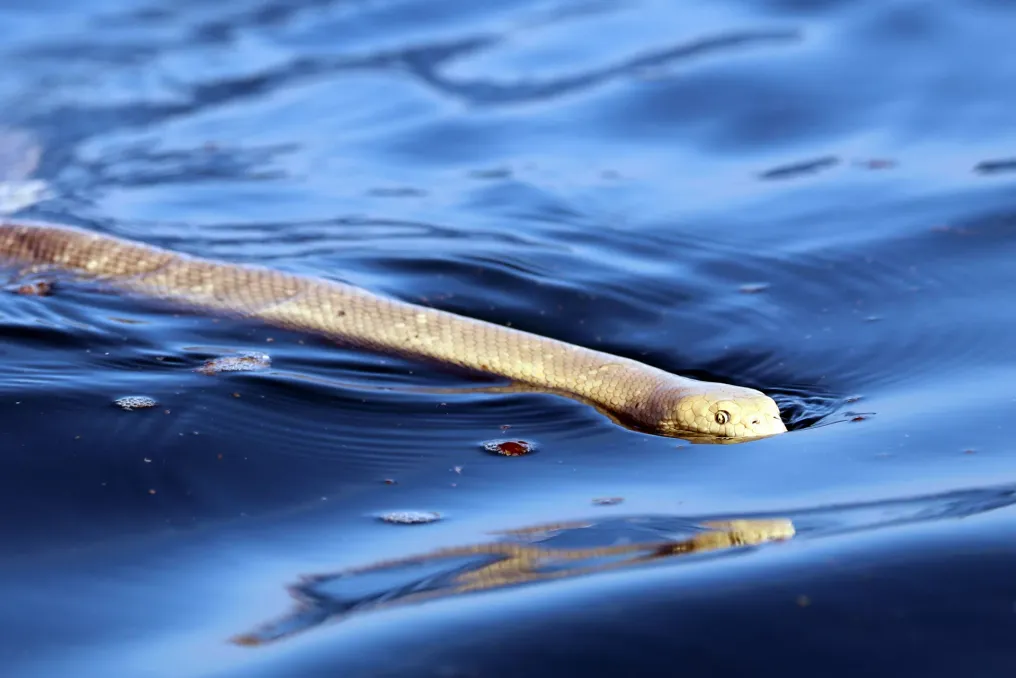
Sea snakes are rarely found along the coast of South Africa, but they are sometimes washed ashore after storms or unusual ocean currents. Even if they appear dead, they can bite as a reflex. Their venom is very strong, so they should be completely avoided. If found, maintain distance and, if necessary, report it to local authorities or marine conservation organizations.
Small sea urchins may sometimes be in shallow water or washed up on beaches. Their jagged tail spines remain sharp and can cause painful injuries. If you find a live stranded urchin, do not attempt to return it to the ocean yourself unless instructed by marine rescue experts.
A stranded sea urchin may look harmless out of water, but its sharp spines can still puncture the skin. Some species also have venomous spines, and fragments of broken spines can get stuck under the skin, causing infection. If you find such an urchin, leave it where it is.
Sea slugs are large marine mollusks that are sometimes washed up after rough seas. Although they are not as dangerous to touch as jellyfish or blue bottles, many species release purple ink when stressed, and some contain toxins that can be harmful upon contact or ingestion. It is best to leave them alone.
If dead marine mammals, such as seals, dolphins, or whales, are found, do not approach or touch them. Decomposing marine mammals can carry bacteria and diseases, and trapped gases inside the carcass make it unstable. Authorities must always be notified for safe assessment and management of the situation.
Not every animal washed ashore is dead. If you discover a stranded marine animal, you must follow these rules: do not touch it, keep children and pets at a distance, take a photograph from a safe distance to aid identification. If the animal appears alive or is in distress, contact the nearest marine wildlife rescue organization, local municipality, or National Sea Rescue Institute (NSRI). Never attempt to return an injured marine animal to the sea without expert advice.
If you receive a sting or injury, immediately move away from the animal. In case of a jellyfish or blue bottle sting, wash the wound with seawater, not fresh water. Seek medical attention if the pain is severe, if there are difficulties breathing, or if signs of swelling, dizziness, or allergic reaction appear. If a pet has come into contact with or eaten a washed-up marine creature, consult a veterinarian as soon as possible.
Visiting the coast allows you to discover amazing marine fauna, but some discoveries are best admired from afar. When in doubt, remember the simple rule: observe, photograph, and admire, but do not touch. This protects both you and the wildlife.
In the UAE lottery draw held on Wednesday evening, two participants received 100,000 dirhams each. This was due to matching five main numbers and the Lucky Number in the latest Lucky Day Draw.
The winning numbers for Lucky Day Draw 260729, which took place on July 29, were 4, 10, 11, 13, 18, and 31, and the lucky number for the month was 7. According to data published by the UAE lottery, no winners were registered in the Grand Prize category of 30 million dirhams or the second prize of 5 million dirhams.
Nevertheless, two players won the third prize of 100,000 dirhams by matching five numbers and the Lucky Number. Additionally, 59 participants won 1,000 dirhams each in the fourth category, and 7,368 players received 100 dirhams in the fifth category. Furthermore, three Lucky Chance participants won 50,000 dirhams each, and their winning IDs were BO3985092, BQ4199067, and DU9779036.
Lucky Day draws are held every Wednesday and Saturday at 9:30 PM, giving participants the chance to win a Grand Prize of 30 million dirhams, a second prize of 5 million dirhams, and three guaranteed Lucky Chance prizes worth 50,000 dirhams each.
The 'Jaloliddin Manguberdi' electric train embodies the aspiration for modernity and speed. This train connects Tashkent and Khorezm over a distance of more than one hundred kilometers, reflecting the ancient magic and vastness of the Khorezm region.
Previously, traveling by conventional passenger train from Khiva took an average of 14 hours. However, today the high-speed 'Jaloliddin Manguberdi' train covers this distance in just 7 hours and 30 minutes.
In recent years, large-scale reforms have been implemented in the country's railway transport system to connect the nation's territories. A key element in this is the President's decree of October 10, 2023, 'On Measures for the Fundamental Reform of the Railway Transport of the Republic of Uzbekistan.'
As part of the implementation of this decision, the Joint Stock Company 'Uzbek Railways' is paying special attention to introducing modern technologies into the system to further develop passenger transport routes and create convenient conditions for the population.
On July 29, a press tour was organized for media representatives at the high-speed electric train service center. During the tour, journalists were able to get a detailed look at the process of preparing the modern 'Jaloliddin Manguberdi' passenger trains for trips, as well as the technical inspections being carried out by highly qualified specialists.
In the first half of this year, the Joint Stock Company 'TemiryulExpress' received modern high-speed 'Jaloliddin Manguberdi' electric trains from 'Hyundai Rotem' of the Republic of Korea and put them into operation. This event is considered an important historical moment in the history of the country's railway industry. The train began regularly running on the 'Tashkent – Khiva' route in Uzbekistan for the first time, elevating the quality of service and passenger convenience to a new level.
An agreement was signed under the project for the supply of a total of six high-speed trains; to date, three of them have been delivered to Uzbekistan and are gradually being commissioned. Specifically, the first train started operating on the 'Tashkent – Khiva – Tashkent' route in May 2026. By that time, the first train had transported about 30 thousand passengers. Subsequently, the second 'Jaloliddin Manguberdi' train also began operating on the 'Tashkent – Khiva – Tashkent' route. The third train brought to the country is currently undergoing technical testing.
As noted during the press tour, the 'Jaloliddin Manguberdi' trains are capable of traveling at speeds of up to 250 km/h. These sets are designed taking into account the climatic conditions of Uzbekistan. Special attention has been paid to modern engineering solutions to ensure reliable operation in the desert regions, strong dust, and high temperatures encountered on the 'Bukhara – Khiva' route. This guarantees the safety, reliability of the trains, and a high level of comfort for passengers.
The train runs from Tashkent, stopping at the railway stations 'Samarkand', 'Navoi', 'Bukhara', and 'Urganch' before arriving in Khiva.
The commissioning of new high-speed trains is a significant step in the development of the country's railway sector, improving the quality of transport services for the population, and modernizing the national transport infrastructure. The new generation of trains reflects the results of industry reforms, contributing not only to creating convenience for residents but also to increasing tourism potential.
During the event, specialists from the Joint Stock Company 'TemiryulExpress' provided journalists with detailed information about the technical capabilities and comfort of the modern trains, as well as about the work being done in the field of industry digitalization.
Chicken and mushroom pie is a dish suitable for both a hectic Tuesday evening and a Sunday lunch. This recipe is included in the list of family dinners for weekdays because it is hearty, uses common ingredients, and allows you to prepare dinner with minimal effort if you have leftover roasted chicken in the fridge.
Using ready-made puff pastry significantly simplifies the cooking process. Instead of spending time making dough from scratch, you can focus on preparing a rich filling of chicken and mushrooms, which is then topped with a creamy béchamel sauce and crispy golden layers.
This recipe is designed for one large pie, which is perfect for a Sunday lunch, a quick weekday dinner, or for meal prepping for the next day.
To make this, you will need 1 roll of puff pastry, 1 beaten egg, sesame seeds (optional), and poppy seeds (optional).
You need to take 4 chicken fillets, cut into cubes, season them with salt, black pepper, garlic powder, and ginger powder. Then, heat vegetable oil in a large skillet over medium heat. Add the chicken and cook for about 10 minutes covered, stirring occasionally.
After that, add the mushrooms, oregano, basil, and grated nutmeg. Stir everything thoroughly and cook for another 10 minutes until the mushrooms are soft and excess liquid has evaporated. Then, remove the mixture from the heat.
To make the béchamel sauce, melt butter in a saucepan over medium heat. Stir in flour, and sauté the mixture for about a minute while stirring constantly. Then, gradually pour in milk or cream until a smooth consistency is achieved. Continue cooking until thickened, then stir in grated Parmesan cheese and season lightly with salt.
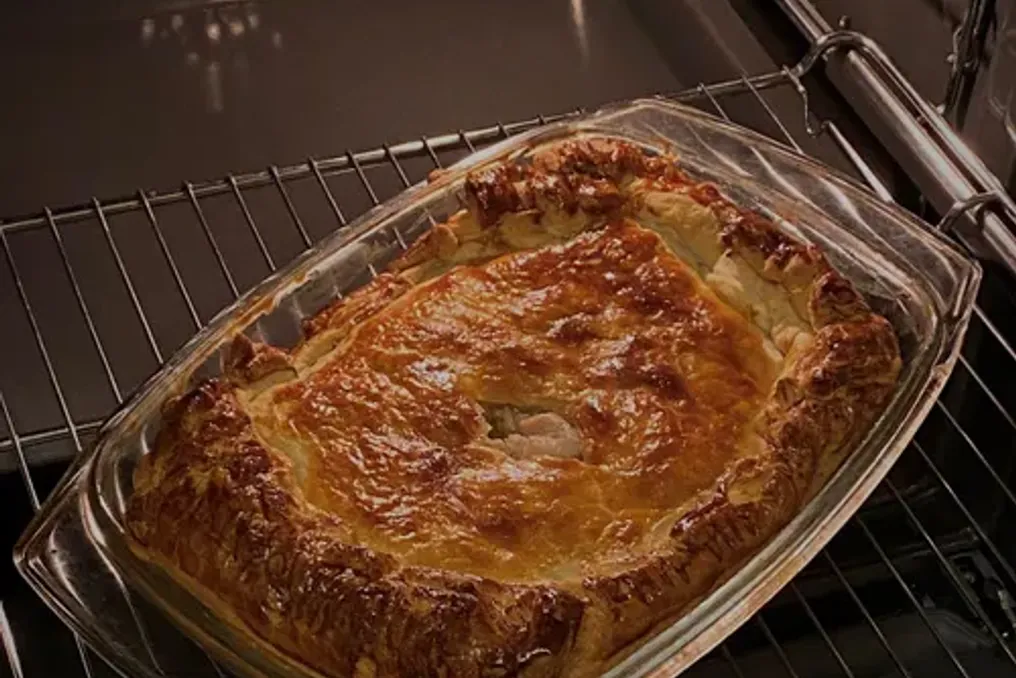
Gently mix the white sauce into the prepared chicken and mushroom mixture until all ingredients are evenly coated. Preheat the oven to 180°C (350°F). Transfer the filling to a pie dish or baking pan. Top with the puff pastry, trimming any excess dough around the edges. Brush the surface with the beaten egg and sprinkle with sesame seeds or poppy seeds, if available.
Bake the pie for 35–40 minutes, or until the pastry is crispy, puffed, and deep golden brown. Let the pie rest for about 10 minutes before serving.
It is entirely possible to use leftover chicken. Leftovers of roasted or stewed chicken work well for this recipe and help save cooking time. You simply need to mince or cut the cooked chicken into cubes and add it after the mushrooms have softened. Since the chicken is already cooked, it only needs to be heated through before mixing with the white sauce. This is an easy way to turn leftovers into a completely new dish while reducing food waste.
To prevent the filling from making the pastry soggy, it is important that it is dense; therefore, any excess moisture from the mushrooms must evaporate completely before adding the white sauce. It is also recommended to let the filling cool slightly before topping it with puff pastry, which helps keep the pastry light and flaky. Brushing the pastry with beaten egg ensures a rich golden crust, and sesame or poppy seeds add extra texture.
If individual portions are preferred, the filling can be divided among ramekins and topped with a square of puff pastry before baking. Furthermore, this chicken pie can be frozen. It is important to allow it to cool completely before freezing, and then reheat it in the oven until fully cooked.