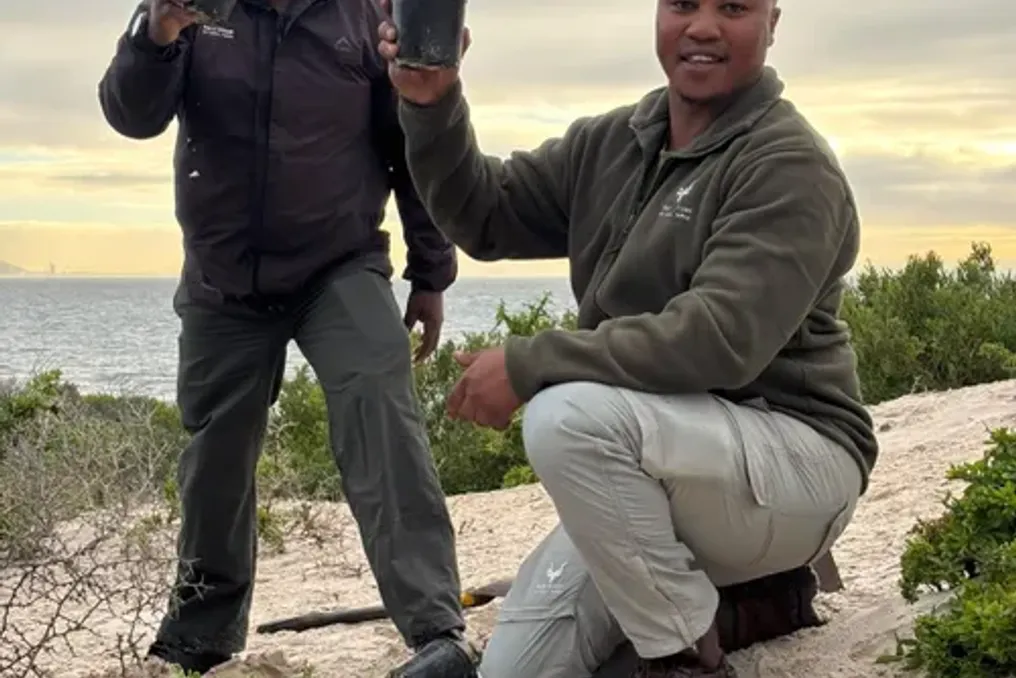
As part of an ongoing habitat restoration initiative, SANParks Honorary Rangers from the Tabl Mountains region planted 1000 shrubs of the species Tetragonia decumbens in the Boulder's penguin colony.
As part of an ongoing habitat restoration initiative, SANParks Honorary Rangers from the Tabl Mountains region planted 1000 shrubs of the species Tetragonia decumbens in the Boulder's penguin colony.
SANParks, in partnership with SANParks Honorary Rangers in the Tabl Mountains region, carried out the planting of these shrubs. The seeds for this campaign were collected directly in the Boulder's penguin colony, then germinated in a Cape Town nursery before being replanted on site.
A SANParks representative, JP Louw, noted that this planting will help restore the natural habitat of the colony and strengthen the sand dunes. Tetragonia decumbens, also known as dune spinach or sea spinach, is a native coastal shrub growing along the South African coast. In addition to its edible leaves, this species plays a vital ecological role in maintaining healthy coastal ecosystems.
The project aims to stabilize and restore the natural environment of the colony. The shrub helps bind and strengthen the sand dunes, thereby reducing erosion and creating favorable conditions for the growth of other local plant species. These efforts contribute to forming a more resilient and healthy environment that supports African penguins and other coastal wildlife.
The initiative underscores SANParks' continuous commitment to biodiversity conservation, habitat restoration, and the long-term protection of one of the most important breeding sites for African penguins in South Africa. Louw reported that Boulder's beach, located within the Tabl Mountains National Park, has international recognition as a critically important conservation area for the endangered African penguin. It is also one of South Africa's most iconic natural attractions, attracting visitors from around the world while serving as a refuge for this species.
During the rainy season or in the summer, venomous snakes often appear near residential areas and houses, emerging from bushes and burrows. The mention of snakes causes strong fear because they pose a danger. However, nature has provided remedies whose sharp and strong smells are completely unsuitable for snakes. These natural methods allow you to drive snakes away from your home and family without using chemicals.
There are four types of scents that can prevent snakes from wandering near a dwelling.
Garlic and onion contain a large amount of sulfurous acids, which gives them a sharp and strong aroma. To use this method, you can mix garlic juice with water or crush it and spray it on doors, windows, and main thresholds of the house. This smell forces the snake to immediately turn back and leave that path.
The odor of Feynol, which people find acceptable, is very poorly tolerated by snakes and many insects. It is recommended to wash the floors of the house daily with a solution of Feynol. Additionally, in areas with high humidity or where there is suspicion of burrows, tablets or a solution of Feynol should be sprayed.
The aroma of essential oils is very powerful. The scent of cinnamon and clove oil is capable of disorienting the olfactory system of snakes, forcing them to move away from the area. To apply, soak cotton pads with cinnamon or clove oil and place them in dark corners of the house, in the basement, and near thresholds.
Ammonia has a dangerous and extremely intense smell, which creates in snakes the feeling of the presence of a large predator or a threat. To use this method, you need to soak pieces of fabric in ammonia and place them in places where there is the highest risk of snakes appearing. It is important to remember to keep ammonia out of reach of children.
The Deputy Minister of Mining and Geology of Uzbekistan, Rustam Yusupov, met with a delegation from the Interstate Water Coordination Commission to discuss expanding joint work on the study and sustainable use of groundwater resources.
Specialists from the state institutions Uzbekhydrogeology and the Institute of HYDROENGINEERING took part in the meeting. Participants reviewed achievements in ensuring the sustainable use and protection of groundwater in Uzbekistan. Furthermore, they exchanged information on projects being implemented in Central Asia aimed at promoting water resource management, climate change adaptation, as well as international and grant projects concerning transboundary waters.
Following the meeting, the parties agreed to prepare and sign a memorandum of understanding between the Ministry of Mining and Geology of the Republic of Uzbekistan and the Interstate Water Coordination Commission. This memorandum provides for cooperation in researching transboundary aquifers and geothermal resources within the water-energy-land (NEXUS) approach, implementing an automated monitoring system, and jointly organizing events for the professional development of hydrogeologists in the fields of international water diplomacy and water law.
A young baboon was safely rescued after spending three days on the run in Durban. Before its rescue, the animal was spotted near the Southway Mall shopping center before disappearing into nearby bushes.
The successful rescue was the result of collective efforts by local residents. Local residents reported the appearance of the baboon, sent video footage, and contacted the CROW emergency line to track the animal's movements.
The young baboon is currently under observation and receiving necessary care at the Centre for Rehabilitation of Wildlife (CROW). CROW expressed gratitude to the public for the support provided, noting that the quick reaction and care of the citizens played a decisive role in returning the baboon to a safe condition.