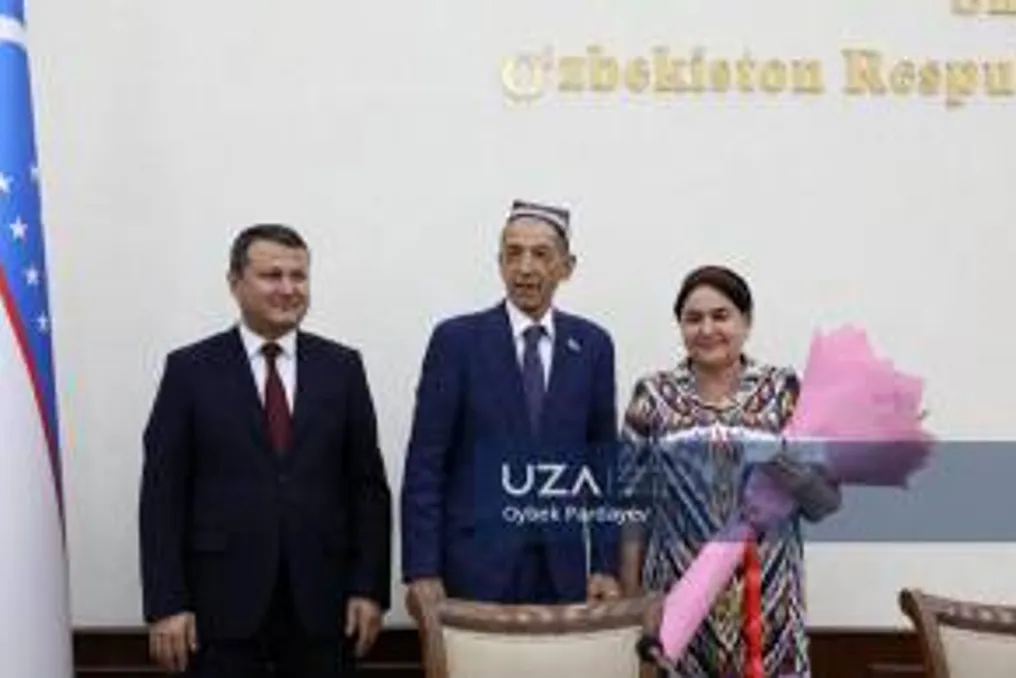
As part of the slogan 'Uzbekistan – a hospitable land,' a literary and educational meeting titled 'Friendship of Peoples in Literature' was held in Uzbekistan, organized by the Uzbek Writers' Union.
As part of the slogan 'Uzbekistan – a hospitable land,' a literary and educational meeting titled 'Friendship of Peoples in Literature' was held in Uzbekistan, organized by the Uzbek Writers' Union.
This event was held at the republican level as part of the 'Friendship' festival, which is celebrated on the occasion of the Day of Friendship of Peoples on July 30. Poets and writers of different nationalities residing in Uzbekistan attended, as well as creative figures from neighboring countries who are honorary members of the Uzbek Writers' Union, literature enthusiasts, and delegates from various national cultural centers.
An exhibition themed 'Literary Friendship – Eternal Friendship' was organized in the Union's building, reflecting the international activities of the Union, which included photographs and books by Union members published in different languages. It was noted that all necessary conditions and opportunities have been created for the free creativity of representatives of all nations in the country.
During the evening, several Uzbek authors, as well as writers from neighboring countries working in the Uzbek language and translators of Uzbek literature, were awarded membership and honorary membership in the Uzbek Writers' Union. A collection of poems by Asadulloh Ismoilzoda, 'Khaol Varraqi,' the documentary novel by Galina Dolgaya, 'Everything Predetermined by Fate' ('Bari taqdirda bor'), as well as works by Kosimkhon Begmanovich translated into Uzbek by honorary members of the Union from Kazakhstan, and the poetic and prose works of Mereke Qulkeneva, 'Shodlik,' were presented.
It was emphasized that Uzbek literature has long been a unique multinational literature. Significant contributions to its development have been made by poets and writers such as Tulepbergen Kaipbergenov, Ibrohim Yusupov, Alexander Feinberg, Yavdat Ilyosov, Mikhail Gar, Jonibek Kuvnoq, Mehmonkul Islomkulov, Raim Farhodiy, and Boris Pak. Today, active creative work is being carried out by authors such as Kaldibek Seydanov, Nikolay Ilin, Galina Dolgaya, Paimon, Lola Yunus Qizi, Abdullo Subhon, Asadulloh Ismoilzoda, and Oysuluv Akhan Qizi, who create works in Kazakh, Russian, and Tajik languages, becoming worthy representatives of Uzbek literature. A new generation follows them.
Participants stressed the importance of literature in assimilating national and hospitable values, as well as the necessity of ensuring the rights and interests of representatives of various nations in Uzbekistan and preserving their national culture and language. The evening concluded with a poetry evening featuring poems in different languages.
The Ministry of Sport of the Islamic Republic of Iran announced the appointment of an Uzbek sports specialist as the head coach of the Iranian women's national wrestling team.
This decision was made following negotiations between representatives of the International Wrestling Federation, the Uzbekistan Wrestling Federation, and the Iranian Ministry of Sport.
According to the agreement, the Uzbek coach Umida Matyukubova will lead the Iranian women's national team until the conclusion of the 2026 Summer Asian Games. At a press conference held in Tehran, the Deputy Minister of Sport of Iran expressed gratitude to all partners who supported this initiative. He also noted with great satisfaction the recruitment of a qualified coach from Uzbekistan.
An analytical article by Alauddin Ne'matov, a researcher at the Imam Bukhari International Scientific Research Center, was published in the influential electronic publication Misq's 'Al-Siyusi'. The article is titled 'Uzbekistan's New Strategy to Combat Ignorance Through Enlightenment.'
The work emphasizes that in the first quarter of the 21st century, alongside rapid technological and scientific progress, there is an intensification of ideological threats, spiritual decline, and a growing sense of hopelessness.
The author elaborates on the essence and practical significance of the principle 'Against Ignorance – Through Enlightenment,' which has been elevated to the level of state policy in New Uzbekistan amid a complex social situation.
It is stressed that the fight against radical and extremist ideas cannot be limited only to administrative measures or the use of force. The most effective and sustainable solution is raising the level of education of the population, especially youth, and instilling the essence of Islam as a religion based on humanism and generosity into people's hearts.
The article pays special attention to the large-scale reforms being carried out in Uzbekistan aimed at studying the rich scientific and spiritual heritage of great ancestors such as Imam Bukhari and Imam Tirmizi, as well as promoting them internationally. The author argues that the model of using science and enlightenment as the main weapon against ignorance, implemented by the country's research centers and educational institutions, can become a role model for the international community, particularly the Muslim world.
Thus, the publication in 'Al-Siyusi' once again demonstrated that the principles of peaceful coexistence and enlightened Islam promoted by Uzbekistan and consistently applied in practice enjoy wide recognition on the international stage.