Coastal regions of South Africa possess a valuable natural resource that remains largely unknown to the general public. This giant kelp, known as Ecklonia maxima, is harvested from the ocean and processed into natural biostimulants that help cultivate stronger and healthier agricultural crops.
Sustainable Seaweed Harvesting
Although many farmers utilize seaweed-based biostimulants to enhance crop resilience and strengthen root systems, few are aware of the complex marine operations involved in harvesting giant kelp (Ecklonia maxima) along the coast of the Western Cape in Mzansi. Christo van der Merwe, a collection manager at Kelpak, explains that each harvesting cycle begins at sea using precise and environmentally friendly methods.
According to Van der Merwe, divers manually cut the kelp with sickles, leaving the base attached to the rocks. This approach allows the underwater forest to naturally regenerate. Harvesting typically occurs early in the morning when sea conditions are calmest. To preserve active compounds and prevent sand from entering the stalk cavity, divers make precise incisions above the base, sealing the plant.
Logistics and Resource Management
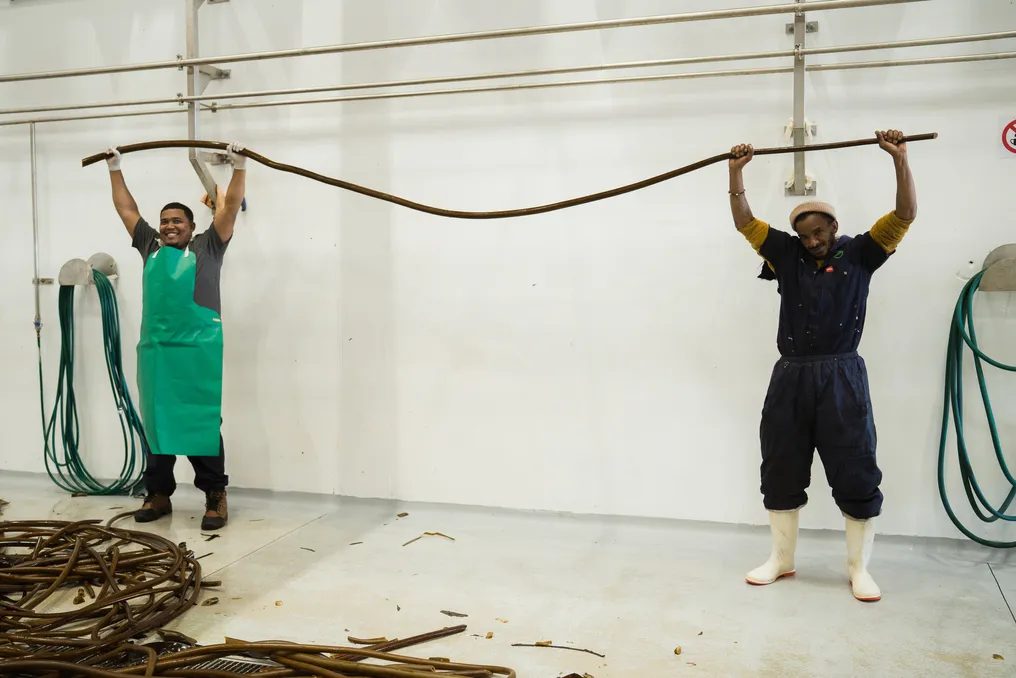
After cutting, the floating kelp is loaded onto collection vessels. Van der Merwe notes that dense leaves are placed on the hull as ballast, while the stalks are packed in nets on top. The harvest collected from the shore is sent to refrigerated chambers, similar to those used in the fruit industry, to maintain freshness before further processing. To ensure long-term supply for farmers, Kelpak implements a harvesting rotation period of 18 months to two years and collects the harvest only according to current production needs.
The Importance of Biostimulants for Agriculture
While biostimulants are becoming increasingly popular among farmers, Linda Greiling, Head of Technical Support at Kelpak, emphasizes that a common misconception is that they can replace fertilizers. Instead, she clarifies that biostimulants support the plant's natural processes by stimulating the development of stronger roots, helping crops absorb water and nutrients more efficiently, and improving their ability to withstand environmental stress.
Greiling states: 'Kelpak is a biostimulant that supports the plant's natural processes. It cannot replace fertilizer.' She adds that farmers apply fertilizers based on a certain expected yield, but drought, heat, and other environmental factors can reduce this potential. Biostimulants help plants better endure such conditions and use existing nutrients more effectively. Company trials have demonstrated increased yields in crops treated with Kelpak, even with reduced nitrogen application, highlighting the role of stronger root systems in enhancing nutrient use efficiency.
Innovation and the Future of Farming
Kelpak has been utilizing the power of local South African giant kelp, Ecklonia maxima, since its founding in 1978. According to Managing Director Carlo Botty, the company's unique cold extraction technology, developed a year earlier, allowed for the production of seaweed-based biostimulants that strengthen root development and increase crop resistance to environmental stress. Decades of scientific research, including work conducted through the University of KwaZulu-Natal, have helped confirm the product's effectiveness. Today, Kelpak's technology is distributed to farmers worldwide through distribution partners.
As farmers face increasing pressure to produce more with fewer resources, Paul Hills, Head of Research and Development at Kelpak, believes that seaweed biostimulants will play an increasingly vital role in agriculture. He notes that large agribusinesses are increasingly taking positions in the biostimulant sector. 'It's not necessarily about replacing traditional fertilizers, but about offering more sustainable and environmentally friendly solutions. That is the direction the industry is moving,' says Hills. Although the company monitors the long-term impact of climate change on its kelp resource, Hills reports that no significant changes have been observed in the cold waters where Ecklonia maxima is harvested. He concludes: 'Farmers still need to plant, and people still need to eat. Our job is to ensure that what we do today remains relevant tomorrow.'