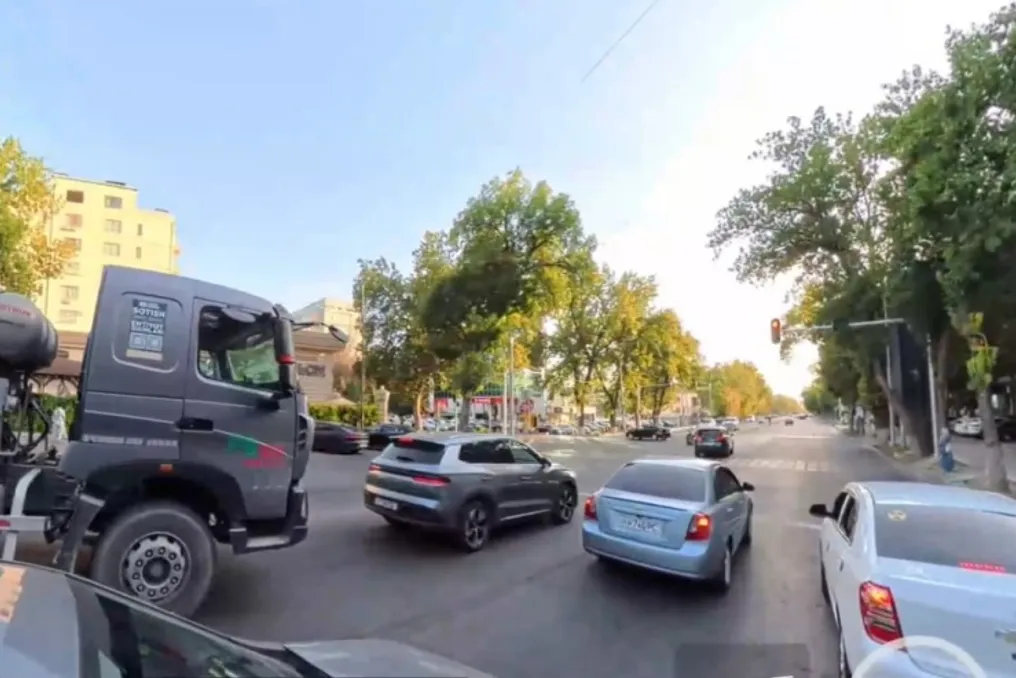
The 'Green Wave' system has been launched in the city of Tashkent, which is designed to synchronize traffic light operation to reduce travel time for drivers. The first implementation site is Buyuk Ipak Yuli street.
The 'Green Wave' system has been launched in the city of Tashkent, which is designed to synchronize traffic light operation to reduce travel time for drivers. The first implementation site is Buyuk Ipak Yuli street.
Specialists from the Center for Road Traffic Organization (CRTO) have configured the joint operation of thirteen traffic lights on a section stretching from the 'Tura Buva' mosque to Salom street. The system automatically adapts to the time of day: during morning hours, it functions towards the city center, and in the evening, in the opposite direction.
Following the start of the system's operation, a significant acceleration of traffic has been observed. Travel time from the 'Tura Buva' mosque to Salom street has been reduced from the previous 8.5 minutes to approximately six minutes, representing a saving of about 30%. In the return direction, travel time decreased from ten minutes to eight, corresponding to a reduction of approximately 20%.
The CRTO emphasized that for the system to operate effectively, drivers must adhere to speed limits and traffic rules. If drivers maintain a speed in the range of 40–60 kilometers per hour, they can pass most intersections without stopping at red lights. Currently, specialists are developing plans to expand the 'Green Wave' to other streets in the capital where intelligent traffic lights are already installed.
Furthermore, local authorities in Tashkent previously unveiled a list of major transport projects, including the construction of a two-level ring road worth about one billion dollars, the erection of seven tunnels, the creation of new interchanges, the laying of dozens of kilometers of BRT lines, and large-scale reconstruction of main arteries. However, most of these initiatives are still in the preliminary preparation stage.
The modernization of road infrastructure continues in the Tashkent region. Modern intelligent traffic light systems have been implemented at regulated pedestrian crossings on the A-373 Tashkent-Osh highway section, between the 3rd and 9th kilometers.
These new systems ensure centralized control of traffic lights, allow for prompt adjustment of traffic flows, reduce the likelihood of congestion, and increase overall road safety.
In addition to improving traffic flow, the installation of 'smart' traffic lights is aimed at strengthening control over compliance with traffic rules and enhancing safety for both drivers and pedestrians.
Authorities emphasized that while modern technologies contribute to improving road safety, the key condition for preventing accidents remains the responsible behavior of all road users. Drivers and pedestrians were advised to carefully observe traffic light signals, remain vigilant, and show mutual respect on the roads.