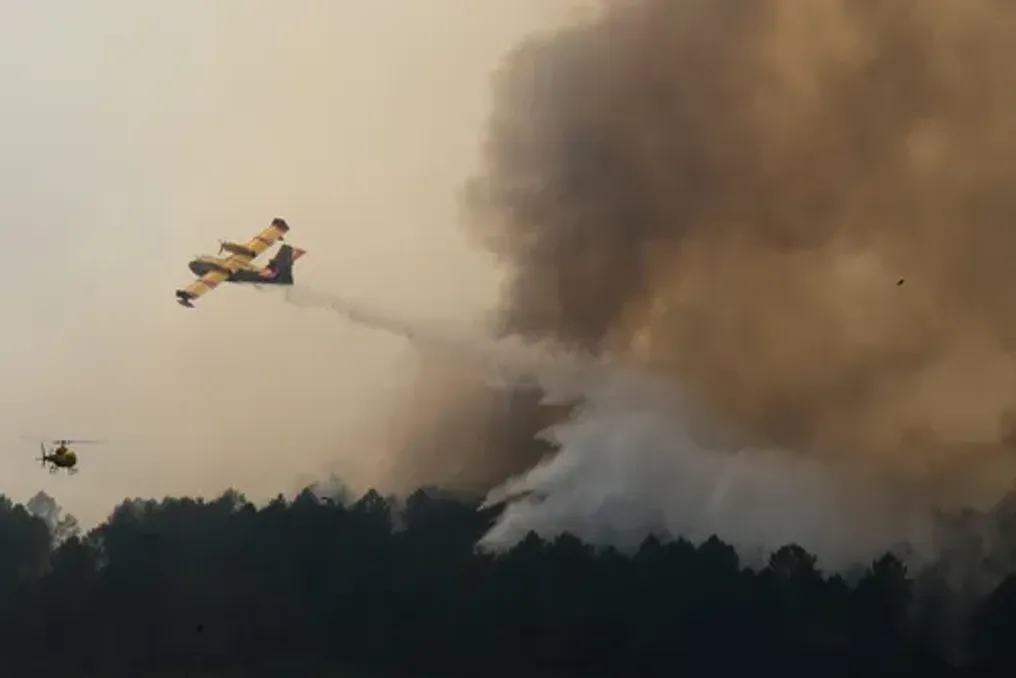
Climate emergencies and heatwaves have demonstrated that there are no isolated structures within the global complex of trade and energy extraction. According to the author, wildfires in France, Spain, and Italy forced the evacuation of about 330,000 people last week.
The wildfire situation in Europe
Spain faced its fourth intense heatwave in Europe this summer, attempting to contain some of the most serious wildfires in the country's history. The largest recorded fire in Spain erupted in the hilly area of Ávila, west of Madrid, covering 50,000 hectares.
As Europe experiences the highest summer temperatures, accompanied by tragic deaths, attention is focused on the continent. For decades, Europe has been a leading 'green' champion, but now it is facing a test of resilience. At last year's UN Climate Change conference in Belém, many EU countries reduced their commitments under Nationally Determined Contributions (NDCs).
Consequences of heat and crisis in countries
Leading scientists link the recent heatwaves in Europe to climate change, noting the astronomical scale of this pandemic. Germany is experiencing severe disruptions due to a strong heatwave spreading across central and eastern parts of the continent after having scorched Western Europe. In France, hospitals were under immense pressure due to heat-related emergencies, including heatstroke, strokes, dehydration, and heat-related fatalities, leading to over a thousand deaths.
On Thursday and Friday, three-quarters of France, home to tens of millions of residents, were placed on red alert due to extreme heat, as temperatures in some areas, including Paris, exceeded 40 degrees Celsius. Britons also struggled with the situation last week when a record June temperature was broken for three consecutive days, and Friday was officially recognized as the hottest day of June in the country's history.
Contrast between climate and energy sector
These events occur against the backdrop of oil and gas production reaching historic highs by European energy giants. According to a recent Global Witness report, six leading European oil companies—BP, Shell, TotalEnergies, Eni, Equinor, and Repsol—recorded their highest quarterly profits since 2022. This growth followed their benefit from the consequences of the Russia-Ukraine war.
In the first quarter of 2026, the combined profit of these five companies—BP, Repsol, TotalEnergies, Eni, and Equinor—amounted to $21.7 billion, which is 43% higher than the same period last year. This reflects a significant gain from the instability of oil prices caused by the US-Israel war in Iran. A Global Witness analysis shows that these six fossil fuel giants did not generate such a sum collectively since Q4 2022.
The three largest European companies—Shell, BP, and TotalEnergies—have earned $252 billion since the invasion of Ukraine in 2022. Although the energy transition, a term introduced by the German Öko-Institut in 1980, means moving from fossil fuel-based systems to green energy-based systems, it has become a global meme, with many countries 'modifying their legislation and reworking their energy schemes to accelerate the transition,' a grand story of a just energy transition exported by Europe. However, this story is in ruins.
Inequality and Africa
The paradox is that energy and critical mineral extraction occurs against a backdrop of energy poverty globally, reflecting an unequal economic trade and investment nexus that characterized relations. Africa, which accounts for 18% of the world's population, uses only 3% of global electricity and has the lowest per capita emissions among all regions. Moreover, nearly 40% of its population lacks adequate access to energy, and 900 million people—80% of families—are deprived of clean cooking facilities.
An analysis by InfluenceMap, conducted by Global Energy Monitor, examined the activities of 15 companies in the European oil, gas, and utility sector that offered or began building new LNG export terminals to Africa and import terminals to the EU as of May 2023. It was found that 13 companies were directly involved in at least one aspect of these international promotion efforts.
The annual Africa-EU summit has focused on energy investments for decades. Another dimension of the EU-Africa partnership is supporting the EU-African Market for Electricity (AfSEM), the Continental Master Plan (CMP), investments, capacity building, green energy, and digitalization. According to the EU, '2025 represents a key opportunity for the two continents to deepen energy cooperation, given the start of a new cycle of EU-Africa policy and programming, the preparation of the Africa Summit, the International Conference on Development Finance, and the 7th Africa-EU Summit, combined with South Africa's presidency of the G20 and lessons from the Just Energy Transition Partnership (JETP).' Furthermore, 2025 marks the second year of the implementation plan for the Africa Agenda 2063 (STYMP) and the year since Africa joined the G20.
This model of energy investment in Africa is generally a model of extraction and profit generation. Combined with cuts in new development aid, CBAM trade barriers, and supply chain diversification, as well as new critical minerals strategies for great powers, Africa finds itself once again at the bottom of the industrial value chain in energy.
Furthermore, the new hydrogen economy—an extractive model—is developing in Namibia, Mozambique, and South Africa, as part of costly experiments. In an era of unfair trade and 'new green trade' barriers, the EU's CBAM system creates additional difficulties for African exporters, thereby hindering our industrial development and 'pushing the ladder onto national development paths.'
Conclusions on the crisis
Ironically, the G20 in South Africa in 2025 made firm statements on climate change, artificial intelligence, and critical minerals for sustainable industrial development. Thus, the current model of EU investment in energy extraction exacerbates the dual crisis of extractivism and deindustrialization. We are witnessing an extremely unjust energy future that has serious consequences for the citizens of Africa and Europe, as corporate profits of oil corporations reach stratospheric levels amid inflated prices in both the EU and the US, while civil movements multiply.
However, one of the most cynical phenomena has been the EU's withdrawal from ratifying the UN Convention and Nationally Determined Contributions (NDCs). Combined with massive cuts in development aid and increased military spending within the EU bloc, proto-energy investments by the EU will deepen the climate crisis. Climate emergencies and heatwaves have proven that there are no isolated structures in the global complex of trade and energy extraction. On the contrary, the climate crisis has scientifically shown that we are truly one planet, and the continuation of energy extraction and an unfair and unsustainable trade and investment model for the Global South will ultimately 'bounce back to the North.'
In an era of polycrisis, multiple wars, and resource wars for minerals, the EU must reconsider its interaction with the world, especially with the Global South and Africa. In an era of polycrisis, there must be another alternative to the EU!