Scientists have once again been able to directly detect the companion star of the red supergiant Betelgeuse. The properties of this new object match the model of a young star located near the red supergiant. However, final confirmation of its existence is only possible one year after calculating the companion's orbit.
Scientific Publications and Information Sources
The details of this work will be presented in the scientific journal Astronomy & Astrophysics, and a summary of the research is available on the European Southern Observatory website.
Characteristics of Red Supergiants
Red supergiants represent the final evolutionary stage of massive stars whose initial mass was between 8 and 30–35 solar masses. These stars are precursors to Type II P or Type II L supernova explosions. It is assumed that most massive stars form in systems with two or more luminous bodies, but among red supergiants, such binary systems occur significantly less often—only in 20–40 percent of cases. Existing theories explaining this phenomenon through mass transfer or stellar merger before the red supergiant stage require verification with extensive observational data.
History of Betelgeuse Study
Betelgeuse is the closest representative of the red supergiant class, located in the constellation Orion at a distance of 597–689 light-years. The hypothesis of having one or more companion stars was first proposed at the end of the last century but remained unconfirmed for a long time. Previously, astrometry data and measurements of radial velocity variations indicated the system's binary nature, which helped explain some aspects of periodic brightness changes. However, attempts to find this star using deep optical and X-ray observations with the Hubble and Chandra telescopes were unsuccessful, leading to the suggestion that the companion might be a low-mass young object. This theory initially received preliminary evidence from direct observations, and later indirect evidence related to the wave generated by the companion in the surrounding gas. Despite this, scientists lacked sufficient data for definitive confirmation.
New Direct Detection of Companion
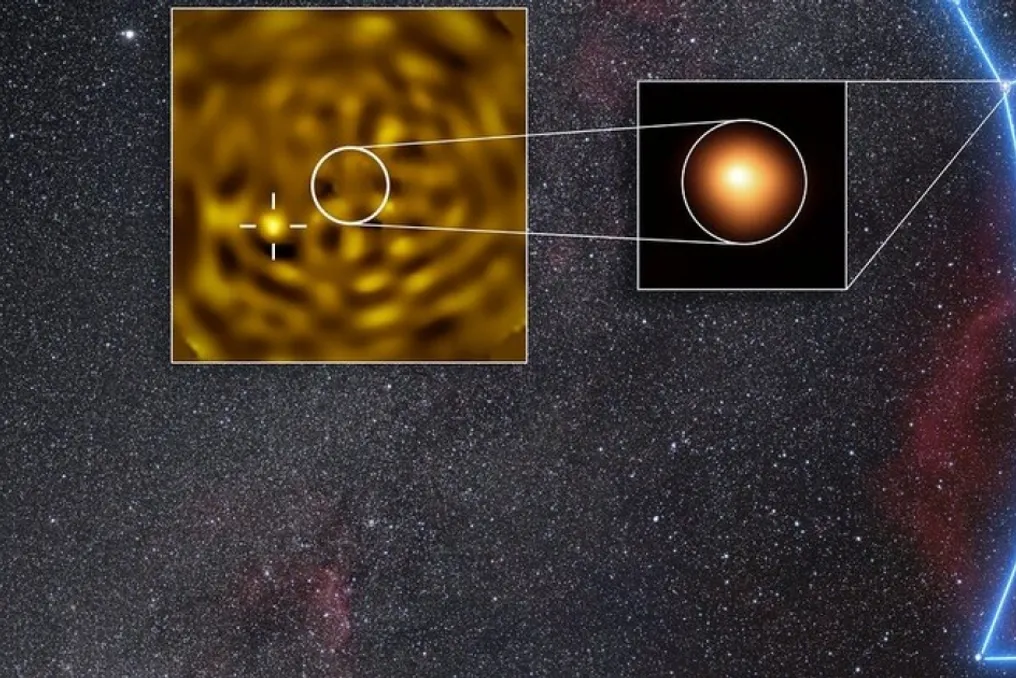
A team of astronomers led by Miguel Montarjes from the Paris Observatory reported the re-detection of Betelgeuse's companion. The discovery was made using the SPHERE instrument and the ZIMPOL polarimeter installed on the ground-based VLT telescope complex in Chile. Observations were conducted from December 3 to 6, 2024, utilizing an adaptive optics system to correct for atmospheric distortions.
Observation Results and Candidate Characteristics
Using the NHa filter (narrow H-alpha line centered at 656.34 nanometers), no sources were detected. However, when observing with the CntHa filter (continuum near H-alpha Hα, centered at 644.9 nanometers) near Betelgeuse, a source of radiation appeared that is excluded as a background object or foreground star. The spatial location of this source matches previous direct observation results, and the statistical significance of the discovery reaches 6.1 sigma. The object is currently considered a candidate because additional observation is required in one year, when the star will occupy a different position in its orbit, allowing for precise calculation of its parameters. At the time of measurement, the candidate was located at a distance of about 8.8 astronomical units from Betelgeuse. The presumed orbital period of the object is at least 5.9 years, and it could be a young main-sequence star with a mass ranging from 2.6 to 3.1 solar masses. Difficulties in determining the companion's parameters are exacerbated by uncertainties in the mass of Betelgeuse itself and its distance from Earth. Nevertheless, researchers believe that the presence of the companion helps adequately explain the long-period variability of the main star's brightness, which is about 2200 days. Previously, Betelgeuse experienced a sharp drop in brightness, which was initially linked to the beginning of the star's death, but it was later found to be a plasma ejection, making the idea of the star's imminent demise less likely.