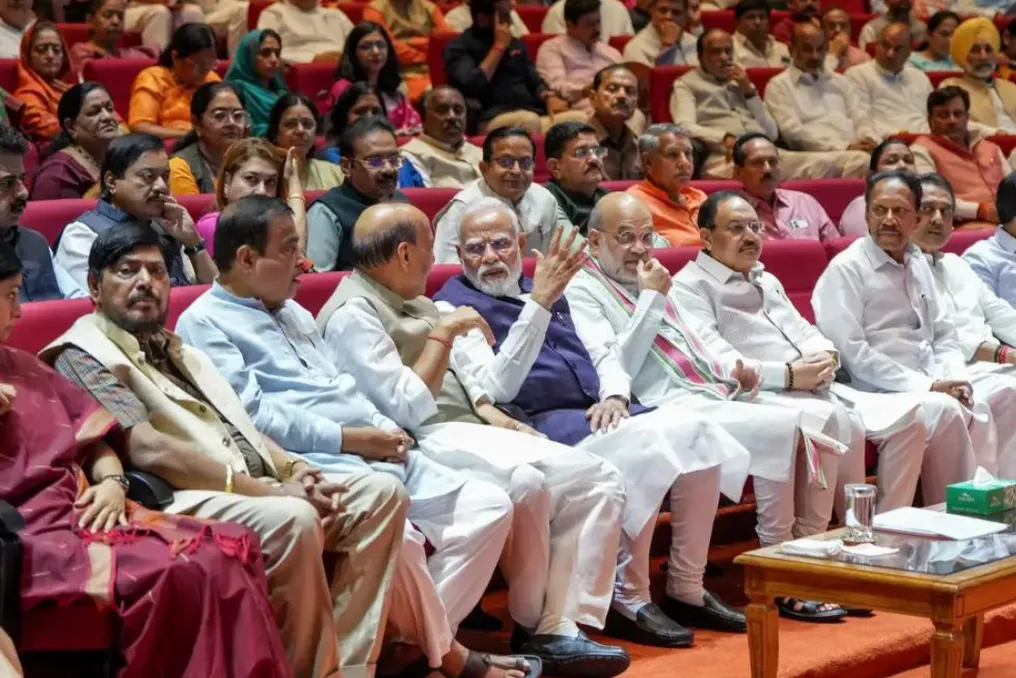
Two Cabinet ministers informed the ruling NDA coalition deputies that the government is concluding trade agreements that are 'fair, equitable, and balanced' with large, high-income, and complementary economies. They contrasted this with the policy of UPA, which, they claimed, signed agreements with predominantly 'small, competing, and low-income per capita economies,' such as SAARC and ASEAN.
Protection of Citizens' Interests
At the meeting of the NDA parliamentary faction, Commerce Minister Piyush Goyal and Fisheries Minister Lalan Singh presented reports on India's free trade agreements and the growth of the fisheries sector. They emphasized that the government has ensured the protection of the interests of farmers, fishermen, small and medium enterprises (SMEs), and the labor sector.
Economic Growth Through Trade
According to Goyal's presentation, the free trade agreements concluded by the NDA government will drive the Indian economy through global trade. It was noted that the GDP volume covered by agreements before 2014 was $10 trillion, whereas under the NDA government, this figure reached $60 trillion.
Participation in the Meeting and Opposition Criticism
A significant participant in the meeting was the detachment of 20 TMC deputies, whose merger with the Nationalist Congress Party of India awaits recognition by Speaker Om Birla. Their first participation marked a formal entry into the NDA. Sources reported that the FTA presentation at the closed session accused the Congress, led by UPA, of signing trade deals without consulting stakeholders, which negatively affected the economy.
Response to Opposition Criticism
Since Rahul Gandhi has repeatedly accused the government of betraying the country's interests within trade agreements, the details of which are still being discussed with the US, it is expected that the NDA will intensify its campaign, especially if the opposition raises the issue in Parliament.
Growth of the Fisheries Sector
Lalan Singh reported that the total fish production increased from 95.79 million tons in 2013–14 to 197.75 million tons in 2024–25, making the country the second-largest fish producer in the world with a global share of 8%. Total seafood exports doubled, increasing from 30,213 crore rupees to 62,408 crore rupees.
Seafood Export Dynamics
The presentation highlighted the resilience of India's seafood exports, which grew from 62,408 crore rupees in the fiscal year 2024–25 to 73,890 crore rupees in the fiscal year 2025–26 (an increase of 11,482 crore rupees), despite US tariffs. New markets include the European Union, the United Kingdom, New Zealand, Australia, Japan, Russia, Southeast Asia, and the Middle East. Although the share of exports to the US decreased by 14% in value, this was compensated by seafood exports to new markets.
Attracting Investments
Another presentation indicated that the government received 'obligatory investments' totaling $100 billion from the European Free Trade Association and $20 billion from New Zealand.