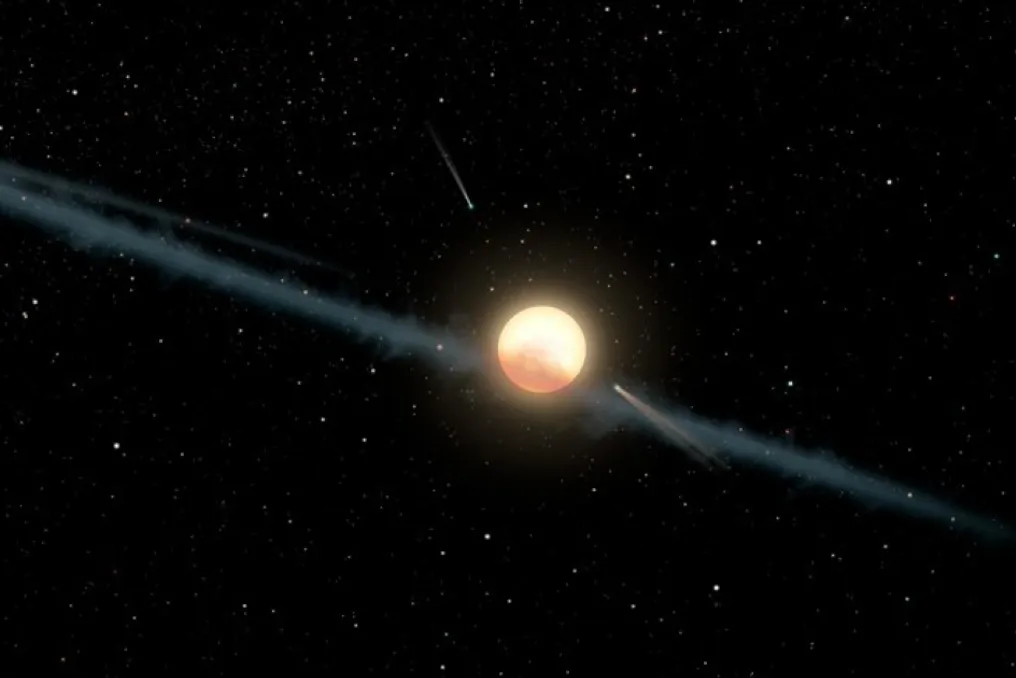
Astronomers have hypothesized the existence of a large moon orbiting the well-known star Tabby, which could be either a giant exoplanet or a brown dwarf. This suspicion was supported by an event resembling a transit. If this discovery is confirmed, it may help explain the irregular and unusual dips in the star's brightness, caused by swarms of small objects moving towards the star under the gravitational influence of this planetary-mass companion. The full text of the study is available on the arXiv.org platform.
The History of the Mysterious Star Tabby
For a long time, KIC 8462852 was considered a typical main-sequence star, classified as F3V and located 1470 light-years from the Sun. However, in 2015, astronomers recorded unusual, prolonged, and uneven changes in the star's brightness that had no obvious explanation. Since then, Tabby's star, named after the leader of the scientific group that first noted this variability, has remained one of the unresolved problems in astrophysics.
Possible Explanations for the Dimming
Many hypotheses were proposed to explain the multiple, asymmetric, and irregular drops in the star's brightness: these could be transits of exocomets, clusters of Trojan asteroids, rings of debris formed by the tidal forces of a large planetesimal or protoplanet, the presence of a stellar companion, a compact object, or a brown dwarf, manifestations of stellar activity (such as spots or plasma ejections), or even hypothetical astroengineering structures like a Dyson sphere. Although none of these versions has been definitively proven, theories about the transits of families of small bodies, rings, and associated objects seemed the most promising.
Data Analysis and Transit Detection
A team of astronomers led by Christine Madourga-Favier from the University of Warwick focused on studying the applicability of transit models to the behavior of Tabby's star. To do this, they analyzed photometric observation data collected by the TESS space telescope, as well as radial velocity variation data obtained using the HARPS, SOPHIE, and HERMES spectrographs. The study covered the period from 2015 to 2025, including the use of archival data from the Kepler telescope and ground-based observatories.
TESS data revealed an interesting symmetric dip in brightness of 1.1 percent, lasting about 21 hours and occurring on September 3, 2019. This phenomenon is best described as the transit of a large body across the star's disk, whereas other options, such as asteroid group transits, exocomets, dust clouds, or stellar activity, do not fit. Similar events were not found in Kepler or ground telescope records, nor could they have been caused by a dim red dwarf orbiting Tabby's star at a wide orbit (projected distance of about 885 astronomical units).
Characteristics of the Proposed Companion
The study of radial velocity variations allowed researchers to focus on the model of a transit candidate. This object is estimated to have a mass of about 9.4 Jupiter masses (with an upper limit of 28 Jupiter masses) and a radius of 1.7 Jupiter radii, placing it in the transition zone between gas giants and brown dwarfs. Furthermore, the calculated bulk density (2.2 g/cm³) and equilibrium temperature (268 K) are more consistent with the model of a large exoplanet than a substellar object. The candidate's orbit must be at a distance of approximately 0.005 arcseconds from the star, corresponding to a slightly eccentric orbit (eccentricity 0.09) with a semi-major axis of 2.35 astronomical units and a period of at least 1030 days.
Conclusions and Future Research
Although only one recorded transit and significant scatter in the radial velocity data do not provide sufficient confidence to confirm the presence of a planetary-mass companion, the statistical significance of the calculated physical parameters is only 2.3 sigma. Nevertheless, the presence of such a body is consistent with the distribution of properties of giant exoplanets around stars and may explain the infall of streams of exocomets or fragments of planetesimals causing irregular dips in brightness through gravitational perturbations. The presence of dust around this companion is also not ruled out. Scientists believe that confirming a planetary-nature moon is possible using astrometric data from the Gaia fourth catalog, and a more precise determination of its characteristics will require data from the Hubble and James Webb space telescopes.
Tabby's star is one of the first examples of observing exotic dimmings; subsequently, scientists were able to observe transits of exocomets, dust rings, and brown dwarfs surrounded by them around their stars. It is also worth noting that ground-based telescopes VLT and Gemini-North recorded a decrease in wind speeds on seven ultra-hot Jupiters as the equilibrium temperature increased, which, according to estimates, may be explained by the braking effect of a planetary magnetic field whose strength is comparable to the fields of Jupiter and Saturn. This article was published in the journal Nature Astronomy.