Mineng Technology, a Chinese startup in the field of neuromorphic computing, has completed a Series A funding round, raising tens of millions of yuan. These funds are aimed at developing its proprietary chip based on Spiking Neural Networks (SNNs), designed for artificial intelligence inference in medical devices.
Energy Efficiency and Chip Application
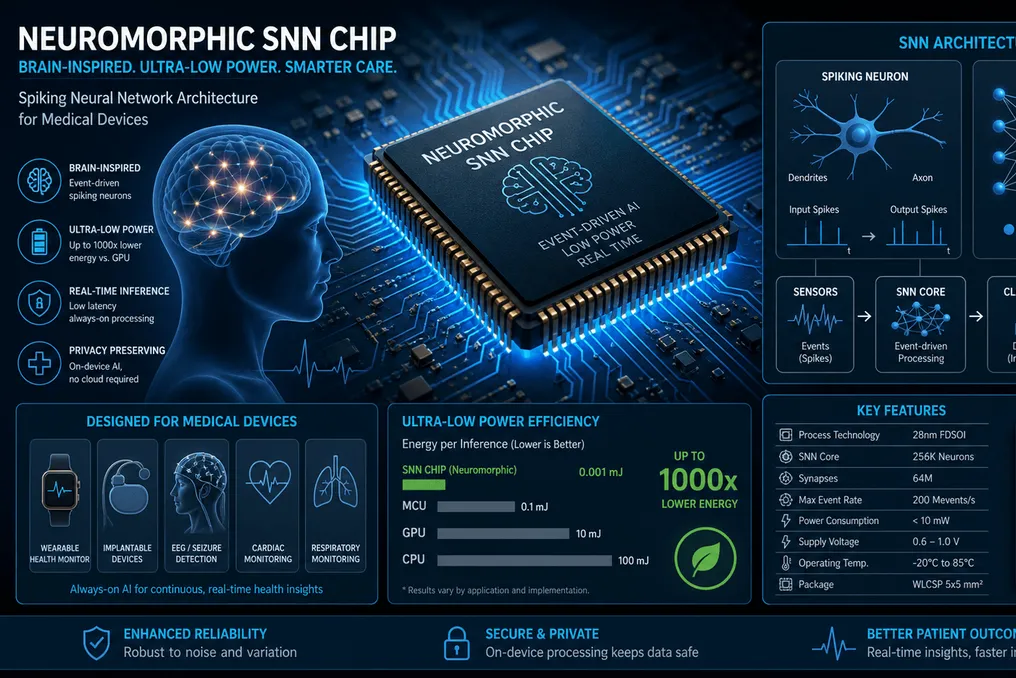
The company positions itself as a core computational center for medical equipment, offering solutions inspired by brain function. These solutions consume approximately one thousand times less energy compared to traditional Graphics Processing Unit (GPU)-based systems while retaining the ability to perform real-time diagnostics for medical image analysis, diagnosis, and biosignal processing.
Unlike standard deep learning accelerators that use continuous floating-point operations, SNN chips mimic biological neural systems by transmitting information through discrete pulses or events. This event-driven approach means the chip consumes power only when impulses occur. This provides a significant increase in energy efficiency for applications requiring constant monitoring but having sparse event processing, such as ECG analysis, EEG monitoring, and preliminary medical image screening.
Strategic Direction in Medicine
The architectural features of the Mineng chip allow it to perform AI inference with significantly lower energy consumption compared to similar GPU or NPU solutions, making it suitable for battery-powered portable medical devices and implantable monitoring systems. The focus on medical equipment is a strategic choice because this market demands high energy efficiency, reliability, and specialized AI acceleration at the edge.
Modern medical imaging methods increasingly integrate AI to assist in diagnosis, anomaly detection, and real-time image enhancement. However, traditional GPU-based solutions generate excessive heat and power consumption, hindering their integration into mobile or point-of-care devices. Mineng's SNN chip solves this problem by providing the necessary power for AI inference within the thermal and energy constraints of portable medical equipment, enabling AI-assisted diagnostics in emergency rooms, field hospitals, and remote clinics.
Context of Neuromorphic Computing Development
Mineng Technology follows the global trend in neuromorphic computing, alongside projects like Intel Loihi, IBM TrueNorth, and academic developments including Tianjic and Darwin. The Chinese neuromorphic computing ecosystem shows growing activity, as both state and private investors see potential in neuromorphic computing as an alternative or complement to traditional deep learning accelerators, especially for Internet of Things (IoT) and edge computing tasks. The advantages of SNNs in processing time-series data make them a natural choice for analyzing medical biosignals, where time-series patterns have diagnostic significance, distinguishing them from conventional AI accelerators optimized for static images and text.