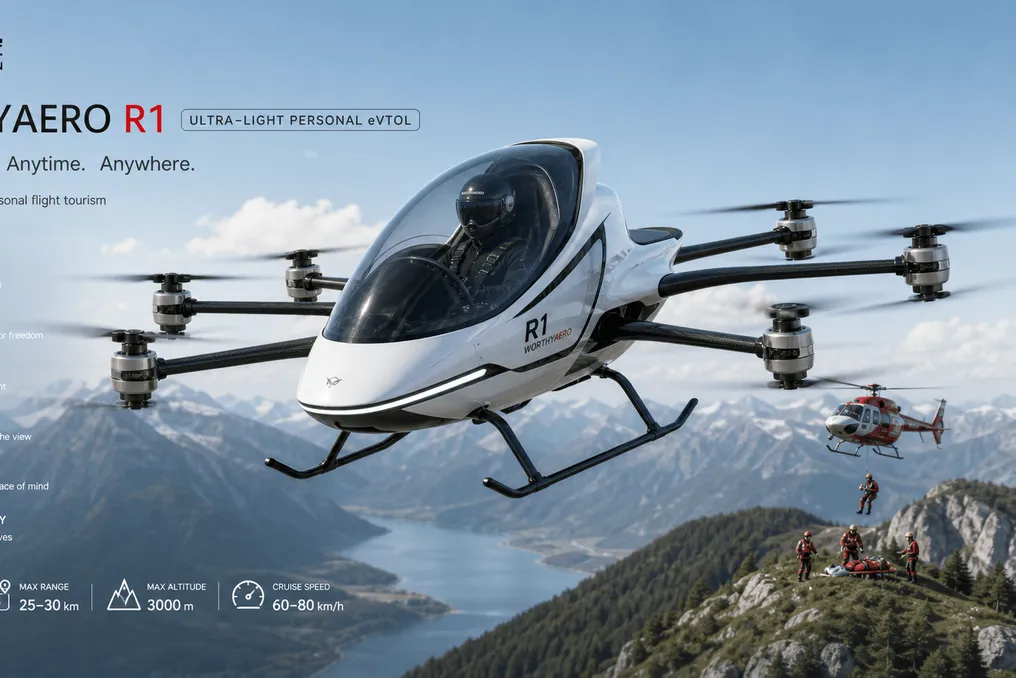
Huaxi Aviation has introduced its ultra-light personal electric vertical take-off and landing aircraft (eVTOL), the WorthyAero R1. This aircraft has an empty weight of 115 kg, a payload capacity of 85 kg, is equipped with amphibious capabilities, and reaches a maximum speed of 100 km/h. The company is targeting the personal flight, tourism, and emergency response markets using a small-to-large validation strategy.
Introduction and Technical Specifications
The WorthyAero R1 was presented by Huaxi Aviation at the International Low Altitude Economy Exhibition in July 2026. The aircraft features six rotor groups, a fully enclosed cockpit for one pilot, and the ability to take off and land both on water and on land. The total testing volume for the R1 and related subsystems amounted to approximately 500 hours. The project is currently in the Mk2 prototype stage within a four-stage iteration plan from Mk0 to Mk3.
Development Strategy and Team
Founder and CEO Zhang Xin explained the productive strategy by stating that a small model must first be created to confirm the functionality of a large system. The R1 serves as a platform scaled down to approximately 1:4 for future, larger aircraft from the company, while retaining the configuration, flight control system, and power train. Over 85% of the team members hold degrees from Tsinghua University, Beihang, Northwestern Polytechnical University, and Nanjing University of Aeronautics and Astronautics, with an average aerospace development experience exceeding 10 years.
Intelligent Capabilities and Amphibicity
Thanks to deep technical expertise, Huaxi managed to develop the R1 with fault-tolerant intelligent flight control, a distributed six-rotor power train, architectural redundancy, and autonomous flight control. These features enable autonomous takeoff, flight, water landing, and visual line-of-sight re-takeoff. Amphibious capabilities are provided by the boat-like lower hull design, featuring keels and side floats that generate restoring force upon contact with water.
Market Plans and Future Development
The company has secured around 40-50 preliminary orders in China from tour operators in Hainan and Guangzhou, as well as about 20 international orders from Canada and Russia, primarily for tourist and experiential flights. Huaxi Aviation plans to focus on B2B sales through tour operators, parks, scenic spots, and field camps in the domestic market, while focusing on individual consumers in regions with a developed private aviation culture internationally.
Hydrogen Energy Prospects
In the future, the company is developing the possibility of using hydrogen power systems for next-generation aircraft. Huaxi acknowledges that the hydrogen aviation infrastructure will develop collaboratively: demand for transport stimulates investment in infrastructure, which lowers operating costs and expands markets. For initial operations, a practical path for commercial implementation is proposed—point-to-point service along fixed routes with centralized hydrogen supply at limited takeoff and landing sites, eliminating the need for a national hydrogen network. Zhang Xin emphasized that the industry requires weak competition and strong collaboration among aircraft manufacturers, infrastructure providers, regulators, and operators to create a low-altitude aviation ecosystem. The R1 demonstrates the feasibility of an ultra-light personal eVTOL for the Chinese market, positioning Huaxi Aviation for expected growth in the low-altitude economy as the regulatory framework matures and demand for personal air mobility develops.