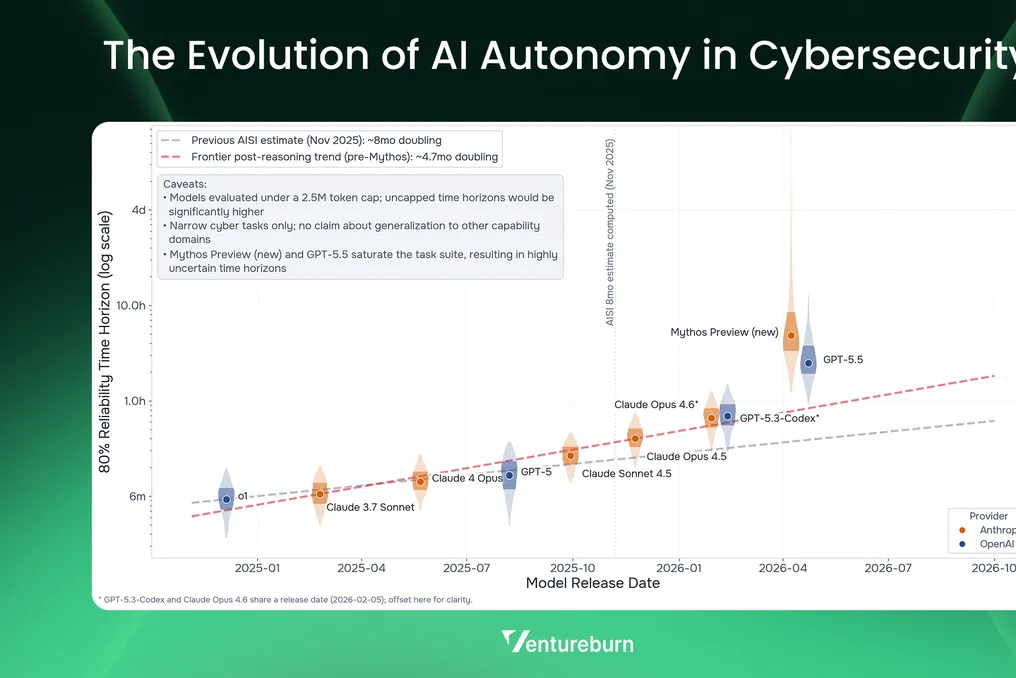
The autonomy of artificial intelligence is demonstrating a significantly faster growth rate than previously expected, moving from doubling every 8 months to doubling every 4.7 months. The exponential growth rate of autonomous duration reached a colossal increase of 1400% year-over-year from the beginning of 2025 to the beginning of 2026, and then increased by another 560% in the first half of 2026 alone.
Growth in AI Capabilities
In 2025, AI autonomy was limited to less than 15 minutes, but by June 2026, AI is capable of operating independently for 4–5 hours without human intervention, representing a staggering increase of 16–20 times. The greatest breakthroughs in capabilities were demonstrated by Mythos Preview (new) and GPT-5.5-Cyber, which in their best attempts approach the completion of all 32 steps, effectively reaching checkpoint M9 (full network capture).
It was noted that after exceeding the threshold of 10 million tokens, older models cease to improve, indicating that increasing computational power does not boost performance. Conversely, the newest models continue to scale sharply, turning greater token consumption into higher task completion rates.
Cyber Threats and AI Applications
Charts show that AI can now automatically execute complex multi-stage cyberattacks, moving beyond simple web exploits (M5) to advanced persistence (M7), infrastructure compromise (M8), and network control.
The total number of monthly downloads has grown exponentially: from a baseline of 15 thousand in November 2024 to 11.8 million in January 2026 (an approximate growth of 780 times). The share of Action tools has steadily increased, following a very predictable trend. Computer usage constitutes the largest single part of the Actions category, accounting for a substantial 49.6% of the data. The remaining share is distributed among software extensions (9.2%), code execution (4.2%), and other categories such as agent/human interaction (1.5%).
The Perception category, represented by 'Sensors,' occupies a large and stable portion of the upper area of the chart, making up 31.7% of the total share. Reasoning-oriented tools have a minimal footprint, led by Analysis at 2.1%, while Planning and Resource Management remain below 1%. At the end of 2024, Reasoning and Software Extension tools had much larger visual proportions, but they gradually decreased as Computer Usage and Sensor tools scaled up to 2026.
Shift from Observation to Action
Agents are shifting from observation to active action. At the beginning of the period, most tools supported perception or analysis tasks, such as reading files or querying data. By the end of 2025, download patterns shifted towards tools enabling agents to take direct actions in external systems, such as executing code or using computer tools that facilitate action. These types of tools now constitute the majority of usage, especially those released by recognized companies.
Over the last year, the number of publicly released MCP tools has increased by more than 35 times—from approximately 5,000 to 177,000, accompanied by a significant rise in download activity of over 175 times (from 80,000 to 14 million). AI performance on Humanity’s Last Exam has risen from less than 10% at the end of 2024 to nearly 50% by early 2026, demonstrating consistent, accelerating growth over 18 months. The 50% ceiling on this exam remains insurmountable.
Leaders and Technological Trends
Google and OpenAI are leaders at the forefront. Google (Gemini 3/3.1 series) and OpenAI (GPT-5 series) consistently set the upper limit of performance, providing the highest base scores on the chart. By early 2026, the gap at the edge is narrowing, as Anthropic (Claude Opus 4.7) and Meta AI (Muse Spark) closely follow the leaders in the 35–40% range.
After July 2025, there was a clear structural shift when the new generation of models successfully overcame the persistent 20% performance limitation that constrained previous systems.
AI Safety and Vulnerabilities
AI agents are capable of detecting up to 77% of vulnerabilities in real software systems. However, less than 1% of the vulnerabilities detected using advanced AI scanning have been patched so far. AI-driven vulnerability detection now covers all major operating systems and browsers. Nevertheless, only 12% apply the same security standards to AI-generated code as to traditional code. Approximately 74% of organizations struggle to provide security provenance data for AI code.
44% of companies report security incidents related to third-party dependencies in AI workflows. Over half of developers (59%) express concerns about the security of AI code. 65% of enterprises worry about data leakage when using AI coding assistants. SQL injections and Cross-Site Scripting (XSS) remain among the most common flaws in AI code. AI tools do not prevent XSS in 86% of test cases, and log injection vulnerabilities appear in 88% of AI-generated scenarios. AI-utilizing repositories show a higher level of secret leakage (6.4%) compared to non-AI projects.
Java has the highest failure rate, exceeding 71%, making it the riskiest language in this comparison. C# achieves a security pass rate of 58% with 42% failures, indicating a more balanced but still moderate risk profile. JavaScript shows a pass rate of 57% and 43% failures, close to C# in security metrics. Python leads with the highest security pass rate at 62% and the lowest failure rate at 38%, suggesting relatively greater reliability.
AI-generated code has 2.7 times the vulnerability density compared to human-written code. Human-written code demonstrates 30–35% fewer critical flaws during corporate audits. Security testing coverage for AI-generated code is 20–30% lower. AI assistants generate insecure code in over 40% of test scenarios, especially in authentication logic. 56% of developers admit to rarely reviewing AI-generated code line-by-line. 61% of enterprises lack formal policies governing the use of AI code. 38% of organizations report accidental data exposure through AI-generated code. 50% of organizations lack policies for handling sensitive data in AI workflows.
During 2026 security audits, 73% of AI systems showed susceptibility to prompt injection vulnerabilities. Prompt injection attacks succeeded at a rate of 50–84% in common LLM deployments, depending on configuration. Indirect prompt injection attacks had a 20–30% higher success rate because malicious instructions were hidden in trusted sources. Direct prompt injection accounted for about 45% of attacks, while indirect injection accounted for over 55% in 2026. Multi-step indirect prompt injection attacks grew by over 70% year-over-year between 2025 and 2026. Code injections via developer companions accounted for 18% of reported prompt injection incidents in enterprises. Multi-turn conversational manipulation improved attack success to 27% compared to single-prompt attacks. CrowdStrike's 2026 reports documented prompt injection attacks against over 90 organizations.
AI Business Growth and Economic Impact
ChatGPT reached 1 million users in just 5 days (OpenAI). By early 2023, ChatGPT had accumulated over 100 million monthly users, and by 2026, it reaches 900 million weekly active users. ChatGPT once held the record for the fastest-growing consumer application, reaching 100 million users in about two months. However, DeepSeek broke this record in early 2025, surpassing 100 million users in just 20 days after the launch of the DeepSeek-R1 application.
1.8% of all job postings in the US are now related to the AI sector. The service sector has become the largest revenue generator for AI, accounting for 36.3% of the total volume in 2025. Regarding specific technologies, deep learning proved to be the most profitable AI area, accounting for slightly over a quarter of the entire industry revenue. AI technologies could increase revenue by more than $15 trillion by the end of the decade.
By continent, North America holds the largest share of revenue, accounting for 35.5% of the total industry volume. It is projected that AI will contribute $15.7 trillion to the global economy by 2030. By 2025, AI may eliminate 85 million jobs but create 97 million new ones, leading to a net gain of 12 million jobs. 63% of organizations plan to implement AI globally within the next three years. Autonomous vehicles could bring $300 to $400 billion in global revenue. About two-thirds of healthcare workers now use computer systems to assist in diagnosis. The FDA has approved over 1200 'AI-enabled' medical devices (FDA).