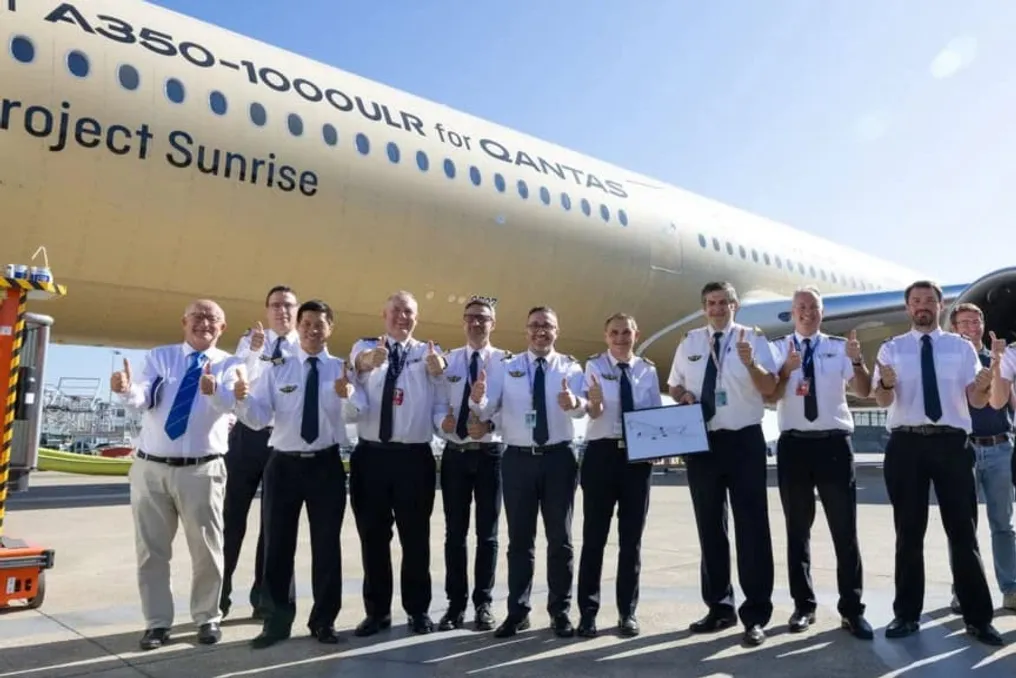
The new aircraft, designed for the world's longest commercial route, reached a historic milestone this Tuesday (the 28th), completing an unprecedented non-stop flight lasting 24 hours and 24 minutes between Australia and France.
Long-Haul Testing
The Airbus A350-1000ULR aircraft covered a distance of 23,075 km on the route from Melbourne to Toulouse. This test flight was conducted to assess the model's capability to operate over long distances in view of future commercial flights.
Project Sunrise and Qantas
The model was created as part of the Project Sunrise initiative, which is being implemented by the Australian airline Qantas. The project aims to connect Australia with destinations such as the United Kingdom and the United States, eliminating the need for intermediate stops.
The aircraft is planned to begin commercial operation in 2027. Significant modifications were made to the design to ensure comfort during long journeys.
Technical Specifications and Previous Tests
The record-breaking flight was made by the aircraft with identification MSN707, which had previously undergone endurance tests between Toulouse and Melbourne. In that previous instance, the aircraft was airborne for 19 hours and 12 minutes, traveling in the opposite direction.
The A350-1000ULR version is a modification of the standard A350-1000. The main difference is the installation of an additional fuel tank capable of holding 20 thousand liters of extra fuel. This increases the aircraft's range by more than 1,800 km, according to Airbus data.
Commercial Implementation and Cabin Configuration
The European manufacturer has signed an agreement to supply 12 units of this model to Qantas. The Australian airline intends to commence commercial flights in October 2027, despite repeated postponements of the initial schedule, which anticipated a start in 2025.
The name Project Sunrise was given because passengers will be able to see the sunrise twice during certain flights, due to the significant time zone difference between Australia and other regions of the planet.
Currently, the longest operating commercial route is operated by Singapore Airlines between Singapore and New York, covering approximately 15,350 km and lasting over 18 hours. For example, a direct flight between Sydney and London would cover approximately 18,500 km.
To make such long journeys feasible, Qantas plans to reduce the number of passengers compared to the traditional aircraft configuration. The model will be designed to carry up to 238 people, whereas the standard A350-1000 accommodates about 300 seats.
Passenger Enhancements
The cabin will be divided into four classes: six seats in first class, 52 in business class, 40 in premium economy, and 140 in economy class. The concept includes special zones for passenger rest, dining, and movement during the flight.
First class will offer private space, a seat that transforms into a bed, a 32-inch television, a wardrobe, and an area for dining and working. Business class will feature seats up to two meters long, which can also convert into beds, as well as features like wireless charging.
In premium economy, passengers will receive back and head support, an individual 13.3-inch screen, and a dedicated space for personal belongings. Economy class will provide head support, more legroom, and screens of a similar size.
The airline also reported that it collaborated with sleep specialists to determine lighting and meal schedules that could minimize the impact of jet lag, and it will provide Wi-Fi access throughout the entire route.