Ubisoft has been exploring the use of generative artificial intelligence in its non-player characters (NPCs). In March 2024, the company presented a prototype at GDC where players could interact with an NPC via voice, eliminating dialogue trees and generating real-time responses. Twenty months after this initial demonstration, the project resurfaced under new configurations.
NEO NPC Project and Technological Collaboration
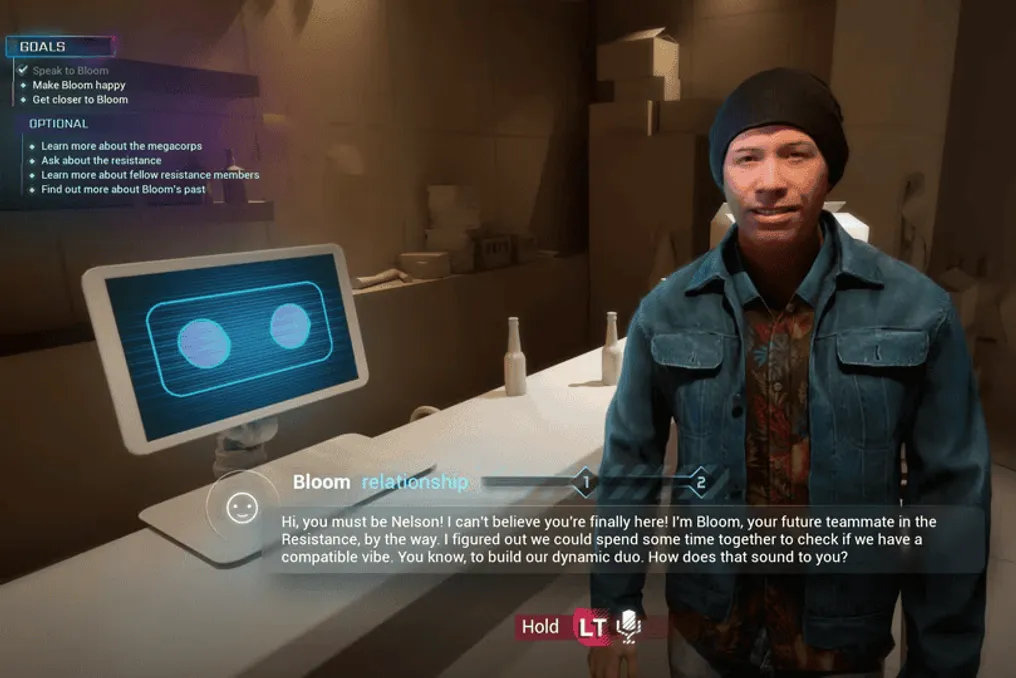
The NEO NPC is a development by Ubisoft's Research and Development (R&D) team in Paris. It integrates Nvidia's Audio2Face technology and Inworld's Large Language Model (LLM). The central purpose of this project is to use generative AI to expand the boundaries of interaction between players and NPCs, allowing conversations that do not follow conventional dialogue structures.
Despite the automation, the project maintains a strong human component, as writers and scriptwriters are responsible for establishing the character's personality, history, and other attributes. This information is then used by the AI to formulate dialogues in response to player actions and interactions.
NEO NPC Demonstration and Challenges
At GDC 2024, the first demonstration of NEO NPC showcased three distinct scenarios focused on establishing a connection with the scene's character. The NPCs were able to interact with the player using their voice, without depending on predetermined choices. Although the focus was on the scenes and the NPC's ability to improvise accurately, issues were noted, such as slow responses and the overly evasive nature of some of them. Additionally, there were instances of the NPC's speech being interrupted by mentions of game events, rather than by issues raised by the player. Despite these difficulties, the tool demonstrated significant potential.
Ubisoft's Teammates Initiative
A new Ubisoft initiative, developed by the same team behind NEO NPC, is Teammates. This enhanced project uses Snowdrop and Google Gemini and was presented in November 2025, offering an even more interactive environment. In this version, the player controls a squad of three robots, two of which obey the player's voice commands. During the demonstration, it was possible to move freely in a first-person shooter style of gameplay, although the objective was to test the voice commands, not combat, as no weapons were available. This approach represents a significant shift, integrating AI as a complement to gameplay, which increases immersion and engagement.
Teammates Status and Investment
Currently, the Teammates project is in closed testing and research phase for development. There are no recent updates, but Ubisoft has increased its investments in this project, as detailed in its 2025-2026 financial report.
Writers' Perspectives
Writers and narrative designers have expressed varied opinions on these technologies, oscillating between enthusiasm and skepticism, with different reactions for each project.
Opinion on NEO NPC
Virginie Mosser, a Ubisoft narrative director with eight years of experience, sees the technology as a way to make game narratives more focused on the player and on creating their own story. However, she also recognizes the challenge this poses to writers, who must give up certain narrative aspects. She expressed her desire to be able to converse with a created character, something she had dreamed of since childhood, despite being accustomed to deeply building the character's history and aspirations.
External critics agree that the AI succeeded in expository and introductory texts. Furthermore, automation can free up time for writers to concentrate on more crucial points of the narrative. However, they warn about a negative point in the use of AI in dialogues, especially from an artistic perspective, as automatically generated text often lacks dramatic tension and emotion. There is also concern that the technology could lead to reduced budgets allocated to writing and dubbing, instead of deepening the narrative.
Opinion on Teammates
By focusing on an opposite aspect, shifting from narrative to mechanics, the reception to Teammates was more favorable. The project adds elements that enrich gameplay, and voice control opens up a range of possibilities for designers and writers, facilitating the incorporation of the feature into the artistic and narrative vision. Despite these positive points, fears persist, especially among the gaming public, due to announcements of large investments in AI after the project's presentation. Distrust remains regarding aggressive integration of generative AI into scripting, art, and programming, generating resistance due to the fear of replacing human workforce and a drop in game quality.
Impact of AI on Game Development
Since the beginning of video games, there has been a heated debate about whether they constitute art, a topic directly influenced by the use of AI. Tools like NEO NPC and DLSS 5 automate processes that are fundamentally human, such as creativity. Elements such as dialogue, design, and even lighting and shadows depend on creative choices to evoke feelings, tell engaging, fun, and emotional stories. Unrestricted use of AI can compromise this, turning into a faster and cheaper substitute for human creativity, rather than an auxiliary tool.
Moreover, much of what is presented about AI, despite being promising, is still in an embryonic stage, far from expectations. This can be seen in the drastic transition from NEO NPC to Teammates: a promising narrative tool evolved into a gameplay feature. While this is a positive advance, it demonstrates that AI-based solutions are not a universal solution for all problems.