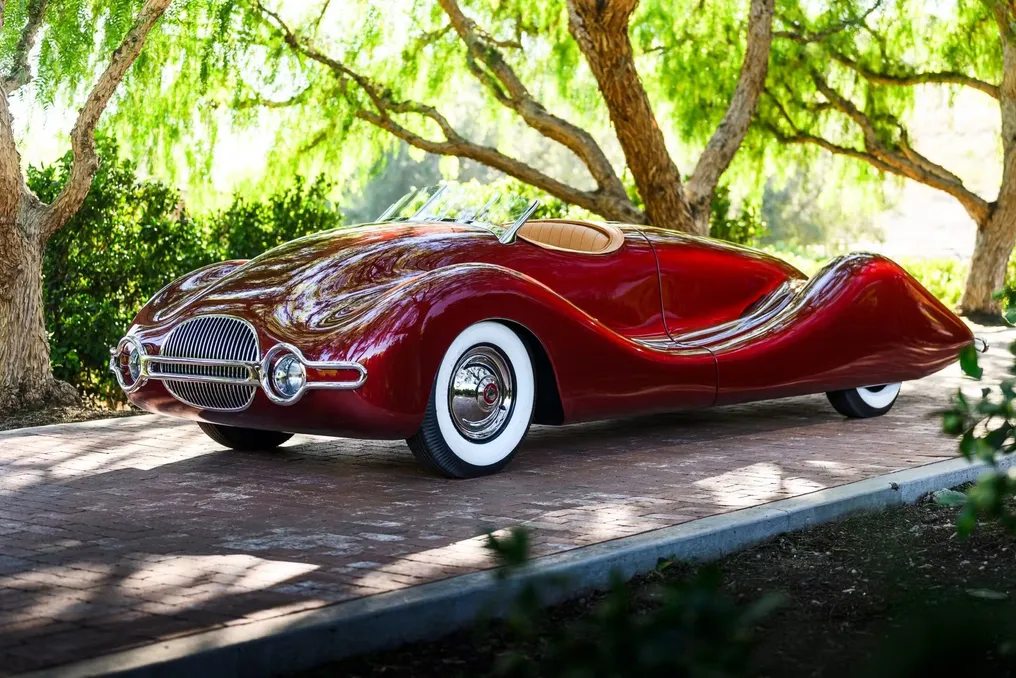
In 1948, mechanical engineer Norman E. Timbs began the project for his streamliner, which would become known as the Norman Timbs Special. This project, considered the pinnacle of his life, would face two distinct losses over time.
Origins and Technical Influences
Born in 1917, Timbs possessed extensive experience in high-level American motorsports. He had collaborated with builder Frank Kurtis, served as a junior engineer on the Tucker 48 project, and developed quick-release rear wheels and axles for Halibrand. Furthermore, with the Blue Crown Spark Plug team of Lou Moore, Timbs contributed to the creation of vehicles that won the Indianapolis 500 for three consecutive years. His knowledge also included pioneering studies on negative pressure under race car floors, a concept that gave rise to what is now called 'ground effect.'
Timbs' vision blended technical precision with European aesthetics. He deeply admired the streamliners from Auto Union, the predecessor to modern Audi, renowned Grand Prix cars with supercharged V16 engines that dominated European tracks before World War II. Wishing to apply this language to a passenger automobile, he created detailed drawings and 1/4 scale clay models, dedicating two and a half years and a budget of $10,000 to building his masterpiece.
Artisanal Construction and Design
To realize his idea, Timbs first created a full-size wooden mold. However, to transform paper and wood into a perfect metal body, he turned to Emil Diedt, a master panel beater from East Prussia who had migrated to the US at age 16 and with whom Timbs had established a friendship in Indianapolis. Diedt charged $8,000, most of the budget, and produced a piece of metallurgical excellence. Without the use of industrial presses, Diedt and his team individually shaped about 107 sheets of aluminum. Using wooden hammers, sandbags, and English wheels, the aluminum was stretched, curved, and TIG welded, joining the pieces into two main sections: the front and the monumental rear.
The result was a structure of extreme fluidity, characterized by the absence of doors, handles, a trunk lid, or sharp creases. Measuring 5.33 meters long, 2.97 meters wheelbase, and only 99 centimeters high up to the split windshield, the Norman Timbs Special evoked the image of a drop of mercury on hot asphalt. The final paint job, in a burgundy tone enriched with gold flakes mixed into the varnish, made the car shine under the Californian sun like an Art Deco jewel.
Advanced Engineering and Performance
Beneath this continuous shell, Timbs' engineering was as innovative as its forms. In an era dominated by heavy ladder frames and solid axles, Timbs conceived a tubular structure using chrome-molybdenum steel tubes with aeronautical specifications. This ingenious solution for the 1940s allowed the chassis to have sealed chambers where a compressor injected pressurized air, increasing torsional rigidity without significantly increasing the total weight, which remained at 1,043 kg.
The mass distribution required an engine positioned in the rear center, located just after the small two-seater cockpit and immediately in front of the rear axle, an unusual configuration for post-war American street cars. The chosen engine was a 1947 Buick Fireball 8, an inline eight-cylinder. Fueled by a custom intake manifold and dual carburetors, it generated approximately 200 horsepower, transmitted to the rear wheels via a steering column-driven transmission. This power was sufficient to reach 193 km/h, a remarkable performance for that era.
To stabilize the vehicle, Timbs combined a Ford solid front axle with an independent swing axle rear suspension, mounted around a Packard rigid differential. The finishing details were refined: a discreet front grille flanked by Packard headlights, aluminum side steps instead of doors, dual Duesenberg J-style exhaust outlets, and small teardrop taillights inspired by a 1939 Ford. An impressive visual feature was the mechanism that, when activated by a button on the dashboard, lifted the entire rear aluminum bodywork, exposing the central-rear Buick engine, the rear suspension, the artisanal fuel tank, and the spare tire.
First Loss and Rebirth
In October 1949, the car appeared on the cover of the second edition of Motor Trend magazine, looking like a futuristic vehicle. However, Timbs' relationship with his creation was brief. After driving less than 8,000 kilometers, Timbs decided to sell it in 1950 for $7,500, despite it being the project of his life. Some experts suggest he valued the creative process more than ownership, seeking the next technical challenge, or that the experience of driving such a unique object in the US in 1950 was excessively draining.
Financially, the sale represented a good deal for an artisanal project, as it recovered three-quarters of the capital invested over two and a half years. In 1952, the car was acquired by Air Force officer Jim Davis, residing in Manhattan Beach. Davis repainted the streamliner in light tones, added license plates to the bumpers, and was the first to officially register it for circulation, being reported in Motor Life in February 1954.
Subsequently, the Timbs Special declined, passing through various hands and losing relevance. For years, it sat parked in front of a restaurant in Los Angeles, where children used it as a slide. It was then towed to a scrap yard in Antelope Valley, near the Mojave Desert, marking its first death: oblivion. For almost four decades, oxidation silenced the prototype, damaging tires, upholstery, and causing galvanic corrosion on the aluminum against the steel chassis. In 2002, what remained of the vehicle was auctioned as Lot 230 at the Petersen Automotive Museum, Barrett-Jackson, being bid upon by Gary Cerveny and his wife, Diane, for about $17,200.
Cerveny investigated the car's history and located Norman Timbs' son, who possessed his father's original sketchpad, containing historical blueprints and photos. With this material, the restoration was carried out with extreme fidelity. Initially, the Cervenys dedicated about 2,000 hours, and subsequently, the Custom Auto shop in Loveland, Colorado, under the direction of Dave Crouse, invested over 4,000 hours over seven years. The aluminum was repaired, the 1947 Buick Straight-8 engine was overhauled, and the burgundy color with gold flakes was reconstructed from samples of the original paint.
The rebirth was triumphant. The car debuted at the Amelia Island Concours d’Elegance in 2010 and, in 2012, won the American Sport Customs category at the Pebble Beach Concours d’Elegance, bringing back the work of Timbs and Diedt.
Second Death and Destruction
If the first loss was a gradual abandonment, the second occurred in minutes during the Woolsey Fire on November 8, 2018. The fire, fueled by winds exceeding 100 km/h, consumed the Cerveny property in Malibu. Inside the sheds, the temperature exceeded 900 °C, forcing physics to confront art. Since the aluminum alloy of the body has a melting point of around 660 °C, the Norman Timbs Special not only burned but melted. The skin worked by Emil Diedt liquefied and flowed down the structure, forming a puddle of molten aluminum on the concrete. Bakelite, glass, and copper components evaporated, leaving only the chrome-molybdenum steel backbone, twisted and covered in soot, concluding the car's second death.