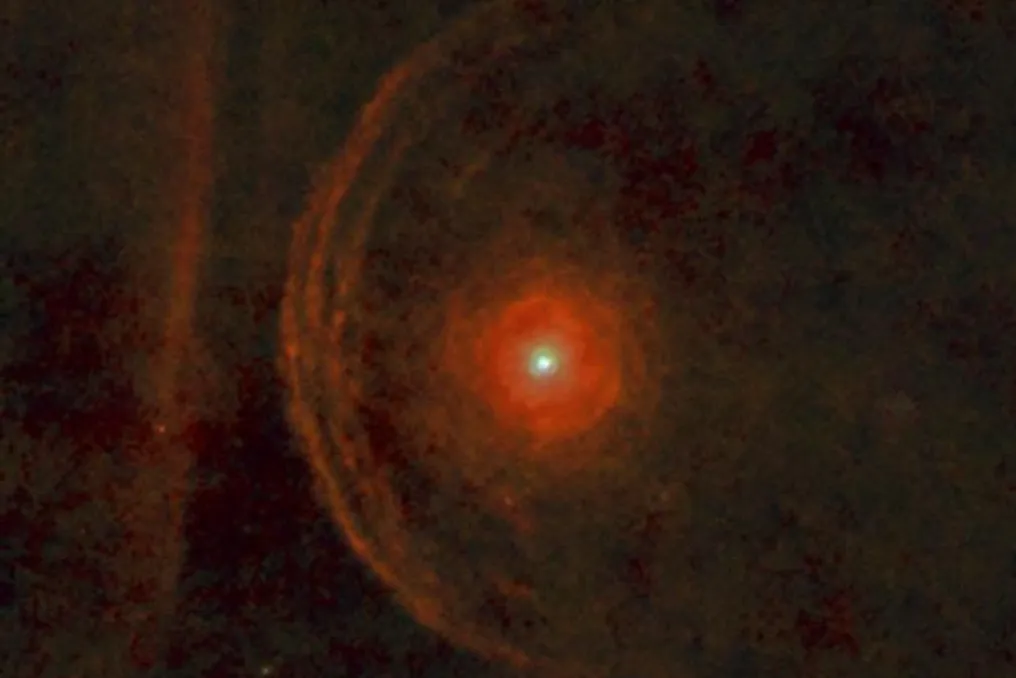
Astronomers have obtained the most robust proof that Betelgeuse, one of the most famous stars in the sky, has a stellar companion, concluding decades of observation attempts.
Details of the Stellar Discovery
This discovery was made using the Very Large Telescope (VLT), belonging to the European Southern Observatory (ESO). The direct visual record provided an answer to an old question regarding the Orion giant and inaugurates a new area of investigation into the star's fate, including its potential explosion as a supernova.
Betelgeuse, located in the constellation Orion, has always attracted attention due to its reddish glow and luminosity variations recorded over time. Despite being an object of study for generations, the star continued to present new aspects.
The Team and the Companion
The research team, led by French scientist Miguel Montargès from the Observatoire de Paris-PSL, obtained the clearest image ever captured of the probable Betelgeuse B, the star orbiting the main body. This finding was formally published in the journal Astronomy & Astrophysics.
Montargès stated that the data demonstrates that Betelgeuse is not an isolated star but is accompanied by a discreet stellar companion. The astronomer himself expressed surprise at the results, reporting that he reacted intensely upon seeing the processed images during the analysis of the records.
Observation Window and Mass
The possibility of finding this companion arose after two studies published in 2024, which pointed to December of that year as the ideal time for detection, as this was when the secondary star would be farthest from Betelgeuse.
The team took advantage of this visibility period with the VLT and dedicated months to analyzing the collected data. The results revealed that Betelgeuse B has a mass greater than previously assumed; it is estimated to be between two and three times the mass of the Sun.
Main Conclusions of the Research
The central results of this investigation include obtaining the clearest image of Betelgeuse B to date, the direct confirmation of the existence of the partner star, the estimation of its mass between two and three solar masses, and the reinforcement of a theory that has been debated for approximately a century.
Montargès emphasized the importance of the discovery, commenting that it is remarkable to be able to identify a nearby companion that is brighter and more massive than the Sun, orbiting such an extensively studied star.
Technology and Next Steps
The image was captured by the SPHERE instrument, installed on the VLT, located in the Atacama Desert, Chile. Co-author Anthony Boccaletti explained that the technologies originally developed for exoplanet location were also effective in finding a companion around a giant and evolving star.
Despite the solidity of the current evidence, researchers plan to conduct a new observation in a year, when Betelgeuse B will be positioned on the opposite side of the primary star, with the aim of definitively confirming its presence. The subsequent challenge will be to determine whether this companion influences the evolution of Betelgeuse and its future supernova event, which, according to Montargès, remains an open question for future research.