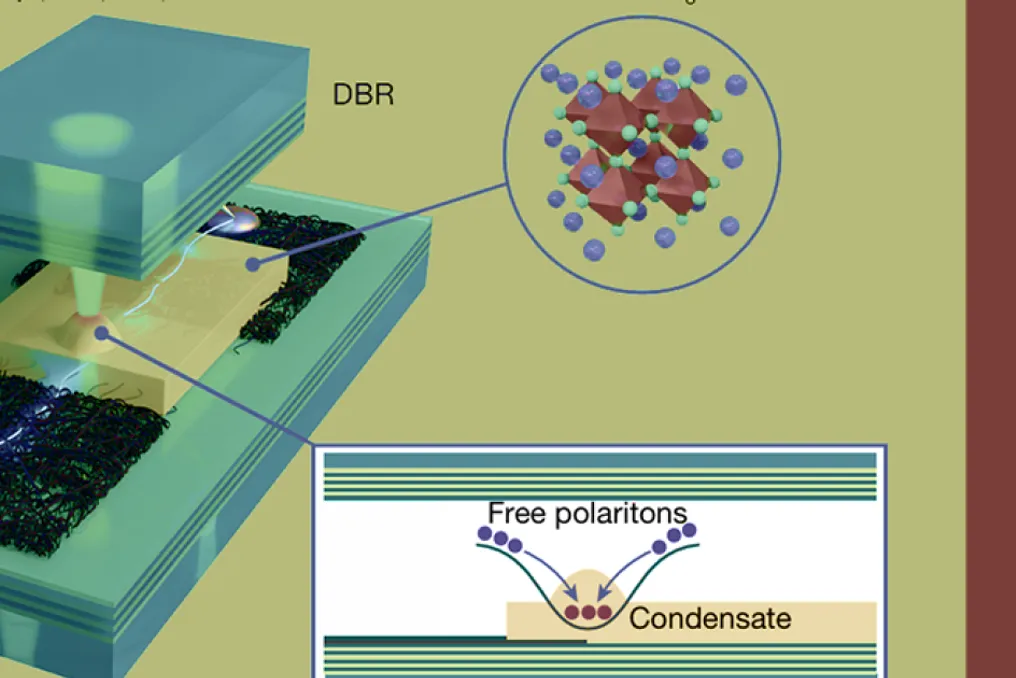
Russian scientists have developed a method that allows a perovskite laser to function without the need for external optical pumping. To achieve this goal, the researchers utilized the phenomenon of ion migration, which is traditionally considered one of the significant drawbacks of perovskite materials. This scientific work was presented in the journal Nature.
Application of Lasers and Perovskite Problems
A laser is a device that generates a narrow, monochromatic beam of light. Today, laser radiation has wide applications in various fields, including medicine and 3D printing technology. To create such a beam, the active medium must first be energized, after which the resulting radiation is repeatedly amplified in an optical resonator. Previously, radiation excitation was carried out by other radiation, but currently, electrical pumping is more commonly used, where energy is supplied to the active zone via electric current. Such lasers are characterized by smaller dimensions and simplified integration into electronic devices.
Halide perovskites are particularly promising candidates for creating such lasers because they can be produced from solution, potentially reducing costs compared to existing semiconductor methods. Nevertheless, creating a perovskite laser using direct electrical pumping proved extremely difficult. When subjected to an electric field, ionic migration is initiated in the perovskite, leading to crystal lattice deformation, followed by electrode corrosion. Additional complexities include the poor thermal conductivity of perovskite crystals, which leads to rapid overheating at high currents. This overheating enhances non-radiative recombination, where electrons and holes dissipate energy as heat instead of light. Although cooling partially solves this problem, it increases resistance and disrupts the necessary balance between electrons and holes. Thus, the problems with perovskite lasers were numerous, and attempts to solve one did not always lead to solving others.
Innovative Solution from Russian Physicists
Russian physicists, led by Anatoly Pushkarev and Pavlos Lagudakis from Skolkovo University, found an original approach to this problem. They placed a CsPbBr3 perovskite microcrystal between two electrodes made of single-walled carbon nanotubes and integrated this structure into an optical microresonator formed by two Bragg mirrors. After applying an electric field, the expected process of ionic migration began in the perovskite, and a p-i-n junction formed: a layer enriched with holes formed at the anode, and a layer saturated with electrons formed at the cathode, which promoted better charge carrier injection.
However, further application of the field led to continued migration and the manifestation of all negative consequences, which degraded the device's performance. To stop this process, the physicists applied a two-stage cooling process, different from the standard one. First, the device was cooled to 280 Kelvin, which slightly slowed down ion movement, and then the temperature was lowered to 8 Kelvin. This allowed the p-i-n junction to 'fix' at the required stage while maintaining efficient carrier injection.
Results and Development Prospects
Furthermore, the optical microresonator contributed to intense interaction between light and excitons within the perovskite, and the cooling presumably stabilized these excitons. Thanks to these factors, the device was able to enter an operational state. The authors effectively transformed the main obstacle to electrical pumping of perovskites into an element of their own solution: first, they allowed the ions to spontaneously form the p-i-n junction, and then they fixed it using two-stage cooling. Currently, the device operates only at extremely low temperatures, but the methodology proposed by the Russian physicists may also be useful for other solution-processed semiconductors and will bring practical applications of polariton lasers closer.