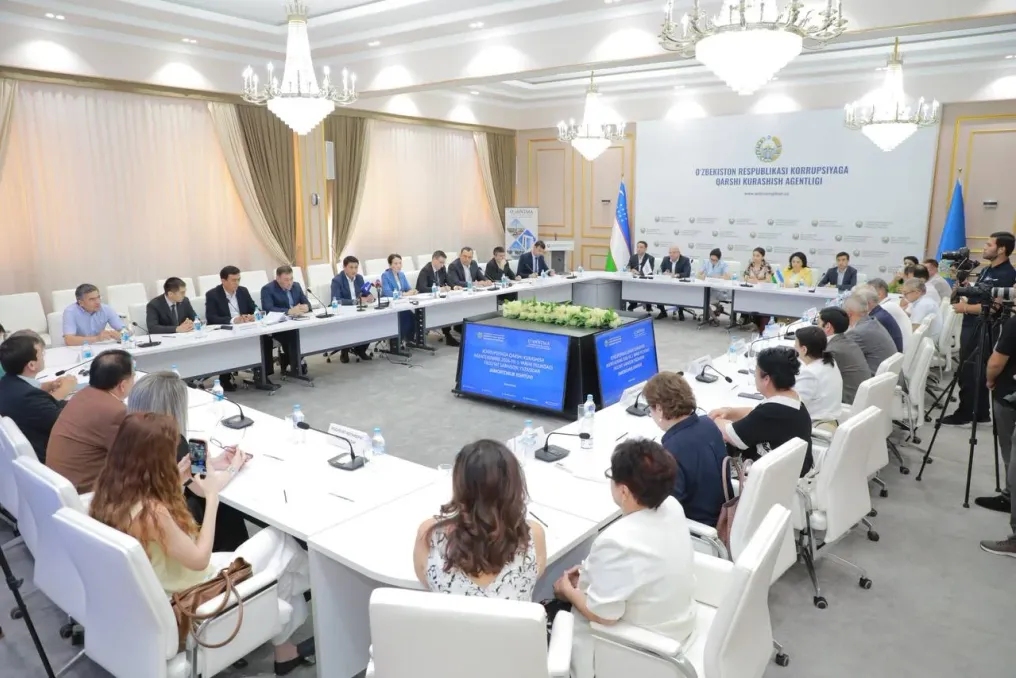
The Uzbekistan Anti-Corruption Agency held a public hearing on July 28 to review its activities in the first half of 2026, followed by a meeting of the Agency's Public Council.
The Uzbekistan Anti-Corruption Agency held a public hearing on July 28 to review its activities in the first half of 2026, followed by a meeting of the Agency's Public Council.
The meeting covered achievements in preventing corruption, ensuring transparency and openness of public administration, eliminating corruption risks, and expanding international cooperation, as well as defining priorities for the upcoming period.
It was noted that Uzbekistan's anti-corruption legal framework was further strengthened this year through the adoption of five key regulatory documents. These measures established a clear list of crimes related to corruption and introduced new preventive legal mechanisms, including an electronic register of persons convicted of corruption offenses and corruption risk maps, while also improving the compliance control system.
A new practice was also introduced requiring candidates for positions in the Cabinet of Ministers and regional governors to submit anti-corruption plans when their candidacies are considered by the Oliy Majlis and people's deputies councils at the regional, district, and city levels. Furthermore, a procedure was developed for anti-corruption units in state bodies and organizations to conduct anti-corruption checks on large investment projects.
Additionally, procedures were approved aimed at improving the organization of internal units for monitoring compliance with anti-corruption norms, as well as professional development, internships, and certification of their employees.
As part of efforts to fully digitize the Agency's activities and the internal control bodies of state structures, the information and software system 'Raqamli Compliance' ('Digital Compliance') was launched. The Cluster for Corruption Prevention also began its operations.
During the reporting period, internal anti-corruption control units conducted 19,709 investigations, monitoring exercises, and control measures in state bodies and organizations. Financial errors and deficiencies amounting to 1.886 billion soms were identified. Illicit use of funds amounting to 587.8 billion soms was prevented, and legislative violations totaling 264.7 billion soms were rectified.
A total of 28,318 civil servants underwent training through the Virtual Anti-Corruption Academy platform. At the meeting, it was also reported that administrative protocols were drawn up against 127 officials for violating the law on conflict of interest under Article 193⁴ of the Code of Administrative Liability. These protocols were forwarded to the relevant courts.
In 73 state procurements involving procurement law violations, damage amounting to 298.4 billion soms was detected. Ministries and agencies received 42 reports on these cases, covering a total amount of 168.7 billion soms. 43 sets of materials were sent to law enforcement agencies for legal assessment.
During the reporting period, 185 draft normative legal acts underwent anti-corruption expertise, during which 255 corruption-related factors were found. Proposals for their elimination were sent to the relevant ministries and agencies.
The Agency also analyzed 19,495 decisions and orders adopted in the E-qaror system under the status 'hidden'. It was found that 775 such documents received this status without sufficient grounds, and 27 requests were sent to local authorities demanding their publication.
A draft of the Fifth National Report on Combating Corruption in the Republic of Uzbekistan was prepared and presented to the Oliy Majlis chambers. An Openness Index for state bodies and organizations based on 2025 results was also compiled.
Members of the Public Council separately reviewed joint work with civil society institutions. For the first time, the analytical center 'Open and Transparent Uzbekistan' and the Center for Retraining Journalists of Uzbekistan conducted an independent monitoring to assess Uzbekistan's compliance with Articles 5 and 13 of the UN Convention Against Corruption.
Within the framework of international cooperation, the report 'Assessment of the National Integrity System' (NIS) was published in Uzbekistan jointly with Transparency International, and a roadmap for its implementation was developed. Together with the European Union and the United Nations Development Programme, the project 'LISA — Local Integrity System' was implemented. Within this project, corruption risks in the local governance systems of the Karakalpakstan, Samarkand, and Kashkadarya regions of the Republic were assessed.
Uzbekistan also received a decision to host the XII Conference of States Parties to the UN Convention Against Corruption in 2027. Representatives of non-governmental organizations and media shared their opinions and suggestions regarding the results of the reporting period. The meeting concluded with a detailed presentation of priorities for the Anti-Corruption Agency and its Public Council for the second half of 2026.
The International Monetary Fund (IMF), in its Selected Issues report on Uzbekistan, conducted an assessment of the financial condition of state-owned enterprises and the associated risks to the state budget.
According to data from the State Assets Management Agency, cited by the IMF, out of a total of 2,148 state enterprises in 2024, only 982 were profitable, accounting for 46%. The remaining enterprises either showed losses, were inactive, were undergoing liquidation procedures, or did not provide data on their profitability.
The mining sector demonstrated the highest profit as a percentage of GDP. This was followed by the oil and gas sector, as well as the banking and finance sectors. The most problematic areas were electricity, housing and communal services, and water management. The IMF links the unprofitability in these sectors to the fact that enterprises provide services to the population for which they receive only partial or no compensation.
The structure of dividend revenues to the budget also indicates a high dependence on the mining industry. The Fund noted that about 80% of state enterprise dividends in 2024 came specifically from the mining sector, while the oil and gas sector contributed 9.5%, and other profitable industries contributed 10.5%.
The IMF concluded that the state, acting as a shareholder, receives low returns from a significant portion of its investment portfolio. Furthermore, the fund conducted a special audit of the financial condition of 21 largest non-financial state companies that have audited IFRS reports. The aggregate value of assets of these companies was estimated at approximately 48% of GDP.
The analysis included assessments of solvency, liquidity, and profitability. Between 2021 and 2023, four out of 21 companies consistently remained in the moderate risk zone, primarily belonging to the mining sector. Seven companies had a higher level of risk, including enterprises in the electricity, gas, and chemical industries. Another ten companies were in the 'grey zone' of moderate risk, mainly due to weak debt burden and liquidity.
As of 2024, indicators for 16 out of 21 companies showed improvement compared to the previous year. The IMF attributes this mainly to the 'significant increase in regulated tariffs for electricity and gas,' which occurred in May 2024 and positively affected three companies in the energy and gas sectors.
Overall, there has been a 'moderate improvement' in risk indicators over the period from 2021 to 2024. Of the fifteen companies for which data is available for the entire period, six improved their performance, and three worsened. Six of the companies that improved operated in the electricity and gas supply sectors.
State enterprises receive support in various forms: this can include budgetary subsidies, external loans, redirected loans from the Reconstruction and Development Fund, internal banking system credits, and state guarantees. The World Bank also indicated that support is provided through non-financial methods, such as exemptions from laws aimed at stimulating market discipline, or preferential access to land and public procurement.
The Fund acknowledges that the share of such support as a percentage of GDP is gradually decreasing due to stricter conditions for its provision. Nevertheless, the IMF believes that 'soft budgetary constraints' continue to weaken the motivation of state enterprise management to improve efficiency and restructure. The regulatory framework lacks a clear separation between commercial activities and the fulfillment of socially significant obligations, which leads to a blurring of responsibility for final results.
Moreover, the absence of a requirement for state enterprises to ensure profitability comparable to the market contributes to the persistence of inefficiency. Existing legal exemptions grant these enterprises unjustified advantages. The IMF insists that obligations must be defined, calculated, and fully compensated from the budget. State aid, if necessary for reforms, must be based on convincing restructuring plans, tied to reform outcomes, and gradually phased out.
The blurring of accountability and responsibility occurs due to the overlap of ownership functions among local authorities, sectoral ministries, and the State Assets Management Agency. The IMF also noted that strict criteria for justifying state participation in the economy, established by the Law 'On State Property Management,' have not been implemented. In corporate governance, supervisory boards suffer from a lack of autonomy due to a limited number of qualified independent members, and their powers are often restricted. The application of corporate governance principles to state enterprises is uneven.
Regarding transparency, the AUMA register of state enterprises has an inconsistent structure and does not contain a clear definition of what constitutes a state enterprise. There is also a lack of centralized control over privatization programs. These two factors hinder adequate monitoring and evaluation of the privatization process. Achieving the goal of having audited financial statements under IFRS for all state enterprises remains an unfinished task.
The IMF also pointed out that about 84% of enterprises with state participation in Uzbekistan operate in competitive sectors where justifying the state's presence is difficult. Such sectors include agriculture, tourism, pharmaceuticals, services, and markets. By the end of 2024, the assets of state enterprises exceeded the country's GDP, reaching 101% of GDP. According to Fitch Ratings, between 2021 and 2025, state assets worth about $5.1 billion were privatized in Uzbekistan, after which the agency upgraded its outlook from 'stable' to 'positive'. Preliminary calculations by Fitch Ratings show that only in 2025 will the volume of privatization reach $1.6 billion.
Law enforcement agencies in Uzbekistan are investigating a group of individuals suspected of embezzling funds from more than 456 people. The fraudsters used a fake website imitating the country's official Interactive Government Services Portal, my.gov.uz.
According to preliminary investigation data, the organizer of the scheme is a 33-year-old resident of the Khorezm region. He created a counterfeit website that outwardly resembled the government services portal and actively promoted it on Instagram through advertising. The advertisements claimed that users were entitled to receive state compensation and social benefits. To give the scheme an appearance of legitimacy, the name 'Moliya vazirligi' ('Ministry of Finance') was used.
Victims were promised the automatic transfer of about 30 million soums to their bank cards. To receive these funds, victims were asked to click a special link, fill out an online form, and provide their bank card details. Investigators claim that after receiving this information, the suspects gained access to the victims' bank accounts and appropriated the funds held therein.
The investigation established that individuals aged 20 to 24 participated in the scheme. According to the Ministry of Internal Affairs, these young people provided the criminal group with 293 drop cards registered under the names of 26 people. The stolen money was first transferred to these cards and then converted into cryptocurrency for subsequent laundering.
Criminal cases have been initiated against the suspects under Articles 168 (Fraud) and 278-6 (Creation, use, or distribution of malicious software) of the Criminal Code of the Republic of Uzbekistan. The investigation is ongoing.