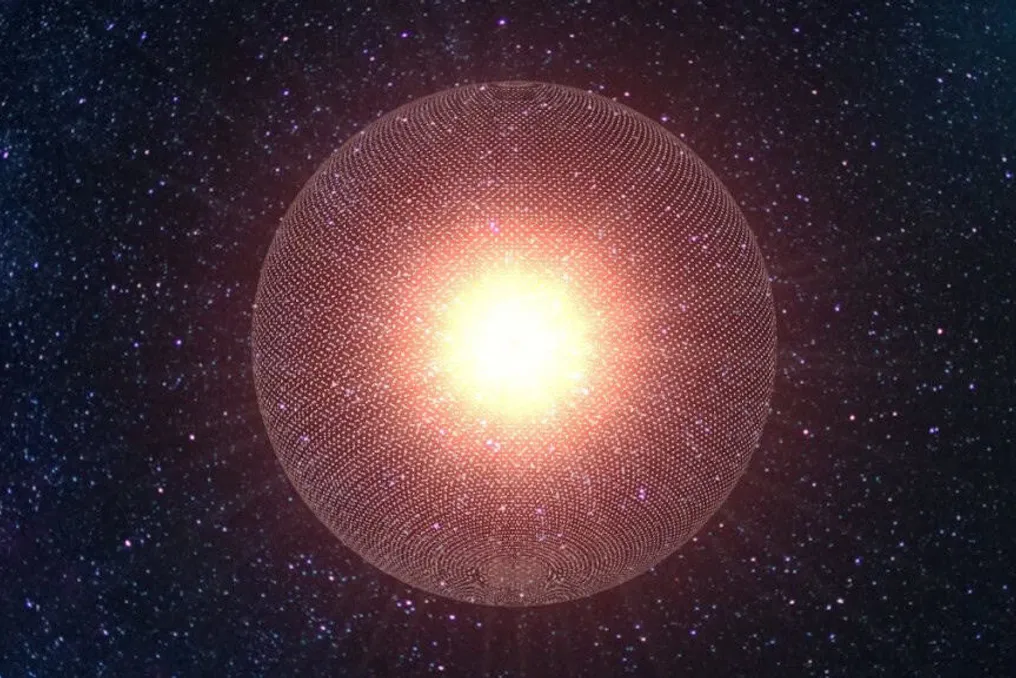
Two stars that were considered strong candidates for exhibiting signs of possible Dyson spheres were studied by the James Webb Space Telescope. The research results surprised scientists because the infrared radiation was not originating from the stars themselves, but from distant galaxies hidden behind them.
The Nature of the Anomalous Glow
This finding did not lead to the discovery of an extraterrestrial civilization, but it helped demonstrate how nature itself can generate signals similar to those sought in the search for intelligent life.
A Dyson sphere is one of the most well-known concepts in the search for extraterrestrial intelligence. Theoretically proposed in 1960 by physicist Freeman Dyson, the hypothetical structure is capable of collecting a vast amount of energy from a star. The main indicator would be the heat emitted as a result of this process. A technology of this scale could not completely hide its energy emission, which would manifest as a glow in the mid-infrared range.
Data Analysis and Observation Results
Olivia Curtis, an astrophysicist from the University of Pennsylvania, emphasized: 'The thermal remnant. That is the central point of everything.' The 'Hephaestus' project, led by Eric Zuccarisson from Uppsala University, analyzed about five million stars in the Milky Way for such excess radiation.
After applying a series of filters, seven stars remained as potential candidates. Two of them were deemed the most interesting and underwent detailed observation using James Webb. The images showed that the signal was not coming from the stars. In fact, perfectly aligned galaxies were located directly behind them, creating the illusion of a light source.
Object Identification and Conclusions
The objects identified by the researchers include the Hot DOG galaxy, which contains a large amount of dust heated by a supermassive black hole; a galaxy with intense star formation; and natural sources of infrared radiation capable of mimicking a possible technological signature. Curtis commented on the observations, stating: 'The first image settled everything.'
Although the two initial candidates were ruled out as possible Dyson spheres, this result is not a failure for the research. On the contrary, understanding these false signals helps make future searches more reliable. Curtis noted: 'The field grows when we completely eliminate false positives.' The study also allowed for the development of new methods for separating light from different celestial bodies, which is crucial for upcoming astronomical surveys. The search for extraterrestrial technologies continues, but every excluded candidate helps scientists better understand the boundaries between natural phenomena and potential signals from other civilizations.